Movie review: Kiss Me Deadly
The other day a friend of mine told me noir novels and movies, the dark dramas and private eye tales from the 1930s through 1950s, were generally played for laughs.
Like any in other genre, some noir stories are humorous–unintentionally.
But certainly the likes of Raymond Chandler and James M. Cain were not writing comedy. Some noir novels and movies, however, were not without a humorous take on the genre. Kiss Me Deadly comes to mind.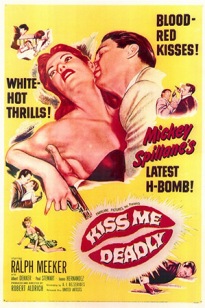
Some years ago I discovered this film and posted a review. Here’s a revised version of that commentary that’s expressly for noir fans who’d like to lighten up, not for those who see this as typical of the genre.
When you read the plot synopsis and cast list, Kiss me Deadly, adapted from a novel by Mickey Spillane, sounds like a run-of-the-mill detective movie: A private eye finds a lost girl along on a road at night. This film, however, is a bit more complex.
When I first watched it I thought it might be filled with campy fun. The title tells you that, doesn’t it? Turns out, some people see this as a classic noir detective yarn that ranks with the best of the genre.
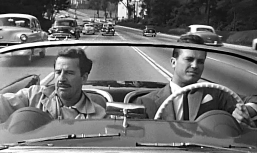
Ralph Meeker, right, and Fortunio Bonanova cruise an LA highway in Meeker’s Corvette, not the Jag he drives in the first scene.
The film, a Mike Hammer detective story, is a product of two period influences, one of which anchors the 1955 movie in the film noir category, albeit a late comer, and the other links it to the string of atomic-age, nuclear scare films that filled screens throughout the 1950s and early 1960s.
You can view the film, directed by Robert Aldrich, as escapist crime fare or as a specimen of filmmaking that includes requisite noir scenes, creative cinematography, good and less-than-good acting and enough plot roadblocks and violence to keep Hammer constantly on the alert.
Perhaps the most memorable part of the film is the opening scene. A very young Cloris Leachman is running down a lonely highway at night dressed only in a trench coat. She waves at cars to stop, but finally resorts to standing in middle of the lane. Hammer, played by Ralph Meeker, is forced to swerve his top-down Jaguar onto the shoulder to avoid hitting her. He picks up Leachman who is panicky and out of breath. They pull back on to the road, we hear Nat King Cole singing Rather Have the Blues on the radio, and the slanted, Star-Wars-style credits start to roll, in reverse, from top to bottom.
The good:
Meeker, appearing in the fourth film of his movie career that ran from the early 1950s to 1980, is a creditable Hammer. The sleazy PI specializing in divorce, gets caught up in a mysterious plot involving gangsters, scientists, government investigators and an assortment of other suspicious characters.
The mostly snappy PI dialog is enhanced by Meeker’s I-don’t-really-care-what-you-think deadpan delivery. “Alright, you’ve got me convinced. I’m a real stinker,” he tells investigators grilling him.
Another highlight of the film is the cinematography. Scenes are shot from almost every possible camera angle. In an early scene, Hammer is in the hospital and we see him in a bed-level profile. Then as two people talk to him, we see them from his viewpoint, towering over the bed.
Hammer’s swanky Wilshire Blvd. apartment is shown from eye level, from outside the window looking in and even from a bird’s eye view from the ceiling. Dark street scenes framed with shadows or arches, a scene shot in a mirror and one highway view looking over Meeker’s shoulder when he’s driving, keep the movie always visually interesting.

Ralph Meeker as Mike Hammer.
Be sure to watch for familiar faces. A rich supporting cast of character actors includes Jack Elam, Strother Martin, Paul Stewart, Percy Helton, Leachman and many others.
The no-so-good:
Not every player turns in a superb performance. Hammer’s mechanic, for example, is an over-the-top ethnic stereotype and some of the dour state crime commission investigators are straight out of central casting. But likely that was part of the shtick along with the camera angles.
The movie’s creepy, silly ending, and the lead up to it, could spoil the picture. But you need to accept that in the 1950s atomic bombs were everyone’s bogeyman even while radiation was little understood. The “alternate ending” included when the film came out in DVD is even darker than the original semi-Hollywood ending.
Kiss Me Deadly doesn’t take itself too seriously. It will not replace Touch of Evil, Double Indemnity and other dark classics, but it’s a blast to watch.
—–
“Writer’s block” note:
The above review was modified using my new speech-to-text software. The program read two of my books and will remember unique spelling, unusual words, and it now knows my style so it will be better able to understand what I say.
Went to PT today. Arm feels a bit better. I can type for short stretches. Am more optimistic. And back working on the next Nostalgia City mystery.
 Nostalgia City Mysteries