Nostalgia City Mysteries

Mark S. Bacon

Unknown's avatar

About mbaconauthor

Mystery writer and journalist; former newspaper police reporter.

E-Book update

Best-seller lists expand to encompass electronic titles; romance popular

One thinks big name authors live and die by the best-seller list rankings.  Those of us toiling in the lower levels of the literary landscape admire the sales figures and scour the lists looking for our next book to read.  E-book publishing, once the techy stepchild of the publishing business, is the fastest growing market segment and the subject of dedicated best-seller lists.  E-books also contribute significantly to sales in a new list for self-published books.

Publisher’s Weekly (PW) the trade journal for the book publishing/distributing business, has started a new list, recording the best-selling books self-published through the Smashwords platform.   The top-25 list is dominated by romance titles with three authors appearing three times each.  Each of those authors, Katie Ashely, Abbi Glines, and Shayne Parkinson, publish in e-book and paperback formats, as do many if not all in the top 25.

A list of the most popular e-books in 2012 was also published by PW and it’s comprehensive.  The list includes hundreds of e-books in graduated categories from 15 million in sales to 50,000.  Makes interesting reading.  There’s no indication as to which publishers PW queried, but it probably omitted very small houses and self publishers.   The first comment the online PW article generated was by someone suggesting they publish a list of the top selling self-published e-books.  A good suggestion, though the list might be quite similar to the above-mentioned self-publishing list.  With Amazon’s Create Space program, it’s simple for an author to create a paper book and e-book simultaneously; often the e-book is priced lower.

Other e-book best-seller lists are, if not plentiful, easily accessible.  In the latest Digital Book World list, for the week ending Aug. 18, an e-book from a small publisher beat out the big New York names.   As noted in the listing, the top selling e-book, The Boy in the Suitcase,  was priced significantly below the e-books from larger publishers.  Price has an effect on e-book sales, as discussed in this blog before, and the best-seller lists are good places for book buyers, authors and others to keep up with market trends.

The venerable New York Times also has e-book best seller lists for fiction and nonfiction and Amazon lists the top-selling Kindle books this year to date.

Also worth reading is Jeremy Greenfield’s article on top selling e-books from Forbes last month.  Hachette, one of the Big Five US publishers,  has recorded 153 e-book best-sellers this year, Greenfield reports.

Hyperlinks–

Publishers Weekly: Self-published best sellers

Publishers Weekly: Best-selling e-books of 2012

Digital Book World: Best-selling e-books

NYT: Best-selling e-book nonfiction

NYT: Best-selling e-book fiction
Best-selling Kindle e-books in 2013

Forbes: Who is getting the big piece of the e-book pie

News update:

Future of e-books muddled

Everyone’s jockeying for the best position in the complex, brave new world of e-book marketing.  And it appears that future book buying details, including the prices readers pay for books and the amount authors get paid, will be determined by corporate lawyers and judges.

Last month a federal judge ruled that Apple conspired with five of the leading publishers to raise the going price of e-books.

Reuters reported that U.S. District Judge Denise Cote in Manhattan found “compelling evidence” that Apple violated federal antitrust law by playing a “central role” in a conspiracy with the publishers to eliminate retail price competition and raise e-book prices.

Apple was accused of trying to erode Amazon’s dominant position in e-book sales causing some e-book prices to rise by $3 to $5 each.

The U.S. Justice Department hailed the verdict as a victory for book buyers.

At issue are “agency model agreements” where publishers set the price of books, rather than retailers.

In the “wholesale” model, publishers offer books to booksellers at roughly half the price the publishers set as the recommended retail price of a book.  Then the retailer is free to sell the book at any price, even below the wholesale price paid for the book.

Graham Spencer, writing in Macstories.net, explains that Amazon decided to sell some e-books below wholesale to gain a larger percentage of the market and to speed the sales of Kindles.  When Apple launched its online bookstore, Spencer says, it contracted with publishers using the “agency” model that authorizes publishers to set retail prices.

(This is an oversimplification of a complex process and Spencer has a detailed explanation of the e-book sales models in his article. )

The recent court decision overturned Apple’s agreements as a conspiracy with publishers to drive up prices.  The five publishers involved in the suit, HarperCollins, Hachette, Penguin Random House, Simon & Schuster, and MacMillan settled prior to the Apple verdict and were told by the court they would have to wait two years before entering into agency model agreements.

Presently the court is considering what form of penalty to impose on Apple.  Suggestions include forcing Apple’s bookstore to provide links to competitors.   A final resolution is in the works and Apple promises an appeal.

“Used” e-book sales

Although fraught with possibilities for the future of books and e-books, the Apple case is just a bump in the road compared with the likelihood that a market for “used” e-books will materialize.

According to Publishers Weekly magazine, a German district court recently ruled that digital books can’t be resold by purchasers.  The authoritative trade journal said the court ruled that books are not subject to “exhaustion of the rights of the author.”  Apparently the ruling means that e-books can only be resold with the permission of the author.

Earlier this year a U.S. federal judge ruled that ReDigi, a Massachusetts company, infringed on the rights of Capitol Records by facilitating the resale of digital music.  Regardless, according to Boston Magazine, Redigi is reportedly moving forward with plans to sell previously owned e-books in the U.S.

Reports Boston Magazine, “Legal issues aside, many analysts feel these markets are almost inevitable.”

Hyperlinks:

Reuters: Ruling says Apple violated antitrust law

Graham Spencer in Macstories.net  

Publisher’s Weekly

Boston Magazine  

Return of the Scandinavian sleuth

0
The Keeper of Lost Causes (Department Q)
by Jussi Adler-Olsen
Translation by Lisa Hartford
Plume, reprint edition  416 pages
Paperback $12.09

“Just because somebody is a shit, it doesn’t mean he has no integrity.  Like yourself, for example.”

Carl Morck’s had it tough.  Smart-alecky responses from a guy he’s questioning are nothing.  Weeks earlier he and two fellow Copenhagen police detectives were ambushed as they investigated a crime scene.  One of his team was killed, the other, Hardy Henningsen, paralyzed.  Morck’s physical wound was superficial.

The experience does nothing to soften the generally acerbic detective and his superiors decide that for the good of the force, Morck will be assigned to the basement, in charge of cold cases.

               He actually liked the man, [thinks Morck’s boss] but those eternally                       skeptical eyes and caustic remarks could piss anyone off…

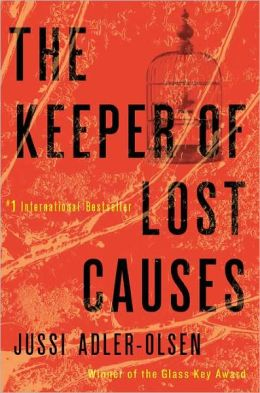
Prior to the shooting, Morck’s wife, Vigga, left him for a succession of young artists, and Vigga’s son Jesper, who loves heavy metal at high volume, decided to stay with Morck.  When Morck visits his buddy Hardy in the hospital, his friend, paralyzed from the neck down, asks Morck to kill him. Keeper of Lost Causes Cover No wonder Morck would be happy sitting in the police department basement doing nothing.

The new cold-case squad, Department Q, consists only of the battered and blue but likable–in an arm’s length sort of way–detective and his assistant Hafez el-Assad, an enigmatic Syrian refugee.   Morck initially limits Assad’s duties to driving him around, mopping the basement floors and generally staying out of his way.

But when Morck’s boss wants to see what case he will be working on first,  Assad suggests a five-year-old missing persons case.  Morck likes it, in part because one of his rivals in the department had failed to solve it.  Soon Morck and Assad are absorbed in the case of a popular, beautiful politician who disappeared.  You will be absorbed too.

The Keeper of Lost Causes by Danish writer Jussi Adler-Olsen is another in the line of what one reviewer calls “Scandinavian sadism.”  Readers all over the world were hooked on The Girl with the Dragon Tattoo book series by Stieg Larsson, the Swedish writer who died unexpectedly at age 50.  The popularity of Norwegian mystery writer Jo Nesbo has increased since the publication of the Larsson novels.  Adler-Olsen shouldn’t be far behind.  His American publisher even adopted a book cover for him similar in font and layout to the Larsson books.

Adler-Olsen’s story is told in chapters that, for part of the book, jump back and forth between detective work by Morck and Assad and the earlier life of the missing person, Merete Lynggaard.  Sadism is an appropriate description of the treatment Lynggaard receives, but it’s as unique a form of torture as that rendered on, and ultimately by, Larsson’s Lisbeth Salander.   Lynggaard’s strikingly bizarre fate is revealed early in the book, but what keeps the plot lively and surprising is the search for the motivation, the means and the culprit or culprits, not to mention an ingenious plot twist that will not be mentioned here.

Selection of a Muslim sidekick for Morck is curious.  It was a newspaper cartoonist in Denmark who ignited a firestorm of violent protests in the Middle East and elsewhere in 2005 by drawing caricatures of the Prophet Muhammad.   Adler-Olsen doesn’t mention or allude to the controversy and although he has Morck criticize Assad from time to time, the comments are not as derisive as those he uses on other police employees, and none are directly related to Assad’s faith.

For much of the book, Assad, who is not a policeman but simply a civil employee, is treated as a driver and gofer, yet his take on human nature and his powers of observation become useful to Morck.  Assad’s not-quite-perfect mastery of Danish gives him a unique voice and makes for some amusing misunderstandings between him and Morck.

Morck’s relationship with his wife, stepson and with Hardy are not resolved, neither is the reason for the ambush at the beginning of the book.  None of these things are essential to the Lynggaard case and await further exposition in following novels in the series.

The book has an entertaining and believable relationship between the two protagonists, a complex plot and a fast, breathless conclusion.  Assad and Morck, with his many burdens, will be back.