The word “black” appears in the title of five Cornell Woolrich novels–considered his best–written in the 1940s. Darkness describes his literary themes and his life. He was married only briefly, had no children and lived in New York hotels with his mother until she died. He was preoccupied with death, disliked much of his own work–which included two dozen novels and hundreds of short stories–and died virtually alone. Yet his haunted, bleak life led him to create the discouragement, distrust and panic that colored his suspense-filled, austere novels. Rendezvous in Black is such a story.
Johnny Marr always met his girlfriend Dorothy in the same place, outside the drugstore down by the town square. “He had special eyes for her, just as she had for him.” Their wedding was set for June. But on May 31, in a bizarre, unlikely accident, Dorothy was killed as she waited for Johnny by the square. Johnny’s life exploded. When the shock finally wore off–or did it ever?–it took him only a short time to figure out how she had been killed, and a little more time until he had a list of five men, one or all of whom were responsible.
What follows is the episodic tale of Marr’s crazed, devious retribution. He doesn’t kill the men on his list; his revenge is more appropriate, more cunning. And always on time. The men who populate Johnny’s list are only loosely connected and they live vastly different lives as we discover as the deranged lover tracks them down.
This is part of an occasional series on the work of noir thriller writer Cornell Woolrich (1903-1968).
Johnny’s indirect form of revenge makes it difficult for the police to anticipate his moves and collar him. As writer Richard Dooling says in the introduction to the 2004 Modern Library edition of the novel, “The reader finds no shelter in a comfortable central character or crime-solving Hollywood hero….” The less-than brilliant detective on the case, MacClain Cameron, says Dooling, is “a mere accessory to a story governed by the mighty forces of murder, retribution and fate.”
As the novel lurches forward, each specimen of revenge becomes almost a separate story, connected by the presence of Johnny Marr lurking somewhere off-camera and detective Cameron usually several, clumsy steps behind.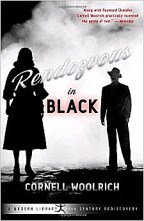 We know that each long chapter will end with something horrible.
Woolrich’s language is sometimes criticized–by a few of the small number of reviewers who even know of his existence–as more clunky than that of Chandler or Cain–but his fast pace and taut suspense keeps your eyes racing forward. His writing skills, however, often flower and he can deepen an already gloomy atmosphere.
All the way up those deliberately curving stairs, the shadow pursued him along the wall panels and he fled from it. But as the stairs curved, it relentlessly overtook him, then swept around before him, to confront him accusingly as he reached their top.
Johnny’s methods for revenge obviously take much planning, and they become more ingenious as the book progresses. This is not a question of whodunit, but of how is he going to do it this time, and will he be caught. The conclusion is sufficiently suspenseful. Until the last page, you’ll be guessing whether Woolrich will conclude with a Hollywood ending. When you finish, you’ll have to decide if the ending was “Hollywood,” or a bit darker.
 Nostalgia City Mysteries