Nostalgia City Mysteries

Mark S. Bacon

Category Archives: noir novels

Temptress Claire has lots to offer, but not to poor Quimby

0
Movie review

Pharmacist Warren Quimby (Richard Basehart), night manager of a 24-hour Los Angeles drugstore, is a fool.

In an early scene in 1949’s Tension his wife Claire (Audrey Totter) is introduced by  sultry music as she’s eating dinner at the soda counter in Quimby’s drugstore.  Dressed in a slinky blouse, she takes an indifferent glance at her husband as he approaches tentatively, and she mumbles as she bites into a hamburger.

When he goes back to work on the other side of the store, Claire’s boyfriend shows up.  In an undisguised lie, she tells the counter clerk she’s going back to the Quimby’s apartment above the store.  Then she slips off her wedding ring and follows her suitor outside to his car.

Richard Basehart: resentful or scheming?

Quimby’s blindness to his wife’s blatant infidelities, coupled with his puppy-dog devotion—even after she deserts him for a boyfriend—is the film’s plot foundation.  You know this is more than a domestic drama however; because, in addition to its suggestive and suspenseful musical score and noirish nighttime settings, the movie is introduced and narrated by a homicide detective, Lieutenant Collier Bonnabel played by Barry Sullivan.

Basehart’s character is so innocent and trusting you want to root for him, but he’s so foolish you just want to smack him.  He’s stuck on his wife even after he tracks her down to a love nest in Malibu, vainly begs her to come home and gets beat up by her boyfriend, Barney Deager (Lloyd Gough).

When the film played in a 1998 San Francisco festival, SF Chronicle movie reviewer Walter Addiego wrote that Quimby was a “prize-winning sap.” 

Does he ever wise up?

Yes, but slowly.

While Claire continues her suggestive shenanigans at the beach, Quimby concocts a complex plan creating a new name and a layered second identity for himself. It’s unclear if he still wants Claire back, but his main goal is revenge and his phony identity will somehow be his cover.

In his new name he rents a Westwood, Calif. apartment—in addition to his flat over the pharmacy.  He meets an attractive Westwood neighbor, Mary Chanler (Cyd Charisse). Chanler is attracted to Quimby, who tells her he sells cosmetics and is on the road on weekdays, home on weekends. The two go out together, but Quimby tries not to return her affections.  He’s working on his revenge. Continue Reading →

Can I dictate my next mystery as long as I don’t drive in the dessert?

5
Writer’s block part III

Here are two short paragraphs from my second Nostalgia City mystery:

Lyle Deming braked his Mustang hard and aimed for the sandy shoulder of the desert road. Luckily, his daughter Sam had been looking down and didn’t see the body.

He passed a thicket of creosote and manzanita and pulled onto the dirt as soon as he could.

Here’s how the Windows voice speech recognition program transcribed it when I read it to my computer:

Lyell great use loss think are 10:00 AM and four are being sent the shoulder of the dessert row . Luckily his daughter center had been looking Gould shaw and didn’t see the body The house a thicket of creosote her and send you a toll on two the tour as soon as he caught.

Writer’s tool kit

And people are worried about AI taking over?

In my last post, I explained that I have a tear (seven millimeters long) in a tendon in my right arm. The pain makes it impossible for me to type, and my orthopedist says I have months to go.

Rather than complain—which is silly and pointless—let me quote from an email I got recently from my friend Larry:

It seems unnecessarily cruel that God or fate attacks an author’s fingers. Why not his toes, knees, or ears?

Thanks for the support, Larry, but I already have a bum knee, and I’d like to keep my hearing.

Help is on the way.  First, my arm and hand are only slightly and occasionally painful (I still can’t type) and I’m doing PT exercises daily. Second, I’m so excited about the next Nostalgia City novel and eager to develop its quite contemporary plot, I bought professional speech-to-text software. Continue Reading →

Ross Macdonald’s ‘The Chill’ — Convoluted, complex or chilling?

0

It wasn’t until recently that I discovered Ross Macdonald named his detective Lew Archer after Sam Spade’s partner, Miles Archer.

Makes sense. Many critics identify Macdonald as the literary heir of Dashiell Hammett and Raymond Chandler, as the writer who polished and redefined the classic detective hero.  Macdonald said Chandler was one of his (other) main inspirations. He took Philip Marlowe and added a layer of psychosocial depth. But not right away. 
According to a variety of writers, the early books in Macdonald’s 18-novel series were more hard-boiled, cynical. Later, perhaps after his sixth novel, according to today’s mystery critics, Lew Archer developed a stronger social conscience distancing him from Spade and Marlowe.

Debatable. Sam Spade has a code which he explains or demonstrates more than once in The Maltese Falcon.  In one of the final scenes, Spade says,

“When a man’s partner is killed he’s supposed to do something about it. It doesn’t make any difference what you thought of him. He was your partner and you’re supposed to do something about it.”

Hammett explored the theme of duty more extensively in another book, The Glass Key. But regardless, a number of Macdonald’s later books examined the responsibilities and consequences of personal relationships, especially family relationships gone bad, skeletons, black sheep, sometimes covering more than one generation.  To solve his crimes Archer looked at family and community allegiances and probed the psychological makeup of suspects and victims.

The psychological element in crime is twisted and turned and studied in The Chill, Macdonald’s 11th Archer novel. One of the initial suspects is even kept under the care of a psychiatrist for much of the book.  The plot moves from one suspect to another with a string of three murders, one dating back twenty years; another, ten years; another, two hours.  Are they connected?  That’s one of many questions Archer has to answer.

Alex Kincaid hires Archer to help him find Dolly, his wife of less than 24 hours.  The couple, in their early 20s, were spending their honeymoon at a Southern California beach hotel when Dolly disappeared.  Rebuffed by indifferent local police, Kincaid spends almost two weeks searching for Dolly in vain. Archer finds the runaway bride after only a day’s work, but the trouble for Archer and his client is only beginning.

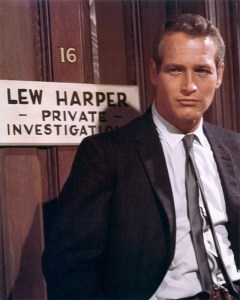
Paul Newman was Lew Harper, not Archer, in two films made from Ross Macdonald novels.

The story takes place in a fictional Southern California city, Pacific Point, where Archer finds Dolly attending classes at a local college and chauffeuring part time for a wealthy woman. Shortly after he finds her and reunites her with her husband, Dolly suffers a mental breakdown, and confesses to shooting her college advisor, Helen Haggerty. 

Archer had met the unmarried Haggerty at the university when he was looking for Dolly.  She poured on the charm and invited Archer up her nearby house for a drink.  She tells him she’s received telephone death threats and fears for her life. She asks him to spend the night. He turns down the attractive woman’s offer.  As he drives back to his Pacific Point motel he tells himself there was “no right  thing to do—only sins of commission and omission.”

Here’s where it gets complicated, and complications soon pile on. When Archer hears Dolly’s confession, he drives back to Haggerty’s home to find her dead in a pool of blood.  In the dark he fails to stop a man running from the house.  The stranger manages to drive away, but Archer makes note of his Nevada license plate number.

From here Archer follows leads—family connections of Haggerty and Dolly—that take him to Reno and a small town in Illinois.  He suspects the murder of Haggerty and of Dolly’s mother twenty years ago are connected.  It’s a confusing spiral, but it all makes sense in the end.

As you’re sorting out the complex story, Macdonald entertains you with philosophy and bits Chandleresque humor:

Some men spend their lives looking for ways to punish themselves for having been born, and Begley had some of the stigmata of the trouble-prone.

 _ _ _ _

“You’re entitled to your opinion,” she said, as if I wasn’t.

_ _ _ _

“What are you trying to do, trap me into a mistake?”

“It’s an idea. [I said] What sort of mistake did you have I mind?”

One Goodreads reviewer said the book is “extraordinarily complex but never convoluted.”

Maybe. The last sixty pages make you think, remember. Pour over the clues, the conversations that Archer has in Pacific Point and Reno and Illinois. Is the resolution far fetched? Not really.  Archer solves it by the process of elimination.