Nostalgia City Mysteries

Mark S. Bacon

Category Archives: Reviews of mystery/suspense books

Mystery writer T. Jefferson Parker: from ‘Laguna Heat’ to ‘Silent Joe’ and beyond

1
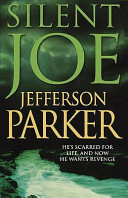
Silent Joe
T. Jefferson Parker
Hyperion reprint edition 2002   416 pages
Mass market paperback $7.99

I have a signed copy of Laguna Heat, T. Jefferson Parker’s first mystery novel.   It was a gift from a friend. My wife and I were living not far from Laguna at the time and it was a huge treat to receive the book. Everyone in Orange County was talking about it.

A few years later I met Parker when he was a speaker at an unusual college course on forensic science. In class, Parker talked about his book, his background as a newspaper reporter and some of the details of writing a good mystery story.

Here’s Parker’s first sentence in Laguna Heat: “A perfect morning in a city of perfect mornings; an artist would have worked, a god would have rested.” On his blog he says he was proud of that sentence.   But it was the next two Silent Joesentences, especially the metaphor at the end, that I remember:
       “The convertible slowed as it approached the stables, then pounced from the road onto a gravel driveway. Its headlights swung left-to-right, acute angles filling with dust, while gravel popped under the tires like grease in a skillet.”

            Laguna Heat was a hit. It became a TV movie starring Harry Hamlin, Jason Robards and Rip Torn. Parker’s career was set. Since that time, he’s written 20 novels and picked up three Edgar awards. Silent Joe earned Parker his first Edgar in 2000 and it does not take a detective to see why the first-person novel about “acid baby” Joe won the award. If you’re looking for a place to acquire a taste for T. Jefferson, this is a good starting point.

Joe Trona is a 24-year-old Orange County Sheriff’s deputy assigned to jail duty. Many evenings, he serves as driver and often guard for his adopted father Will, a kind-hearted but dishonest county supervisor. The extent of his dishonesty, albeit with mostly good intentions, is exposed slowly to Joe throughout the novel. One evening as Joe is escorting his father Will on an errand that includes rescuing a young girl who apparently has been kidnapped, Will is trapped and murdered in an alley while Joe looks on, unable to dispatch all of his father’s attackers.

The balance of the book is Joe’s search for Will Trona’s killers. Along the way, Joe revisits his painful past. His birth father poured acid on Joe’s face when he was a baby, forever scaring him. Five years, later Will adopted Joe from an orphanage, an act of kindness that Joe has never forgotten. When he grew up, Joe went into law enforcement.

When possible, Joe wears a hat pulled low over his face. Parker’s description of Joe’s face makes him sound somewhat like the phantom of the opera.

Double-dealing Orange County politics forms the background for the story. A rich developer and his psycho son, a county department head on the take, the county’s premier televangelist, an odd assortment of inmates and other crooks plus members of Joe’s unusual family populate the novel. But Joe is the star.

He’s a tough cop. He’s muscular and works out regularly, knows how to handle himself and is a skilled marksman. As a result, this could be a Rambo type story with a hard-ass tough-guy protagonist bent on revenge, but Joe is a complex character and the complications in his life lift this story to surprising and rewarding heights.

I marveled at Parker’s creation and wondered if other readers–or reviewers–recognized the subtle, elusive nuances I sensed in Joe. Bill Sheehan, a Barnes and Noble reviewer, said Joe was an “evolving protagonist with love and loyalty issues.” Some reviewers referred to Joe’s intelligence. He is smart and has an eidetic memory. He recalls everything he sees and hears.

But there’s more to Joe. He’s polite–not smart-alecky–and doesn’t swear. He’s slow and introspective; his scars are not just on his face. One reviewer said Joe was “hesitant.” The voice Parker gave Joe, however, is unique in a way that makes other “unique” voices in fiction sound commonplace.

Silent Joe gets more gritty and compelling as it goes along. Joe learns more about his suspects, his parents and himself.   He exchanges barbs with the sadistic jail inmates and also falls in love.

Parker keeps up the pace using staccato sentences and fragments to move the action swiftly in some scenes. He doesn’t neglect metaphors, either. Explaining rush hour traffic he says, “But cars on Orange County freeways at six o’clock move about as fast as cars on showroom floors.”

The novel’s supporting cast–particularly the jail prisoners–from the crazy biker who carried the head of a victim around in a pillowcase tied to his hog for a week to a former assistant DA who planned to go to Tahiti with his family when he got out, fills the story of Joe’s life with fascinating details.

Toward the end of the book, Joe talks to one of his father’s friends, or more appropriately, acquaintances. After the meeting, Joe summarizes his situation and reviews his father’s oft-repeated advice that was possibly Joe’s nascent philosophy:

              “The idea struck me that I was inheriting my father’s friends, as well as his enemies. I just wasn’t positive which was which. I wondered if Will was. You only had to be wrong once.

                               “Love a lot.  Trust few.”


Mystery – Suspense: New novel releases

2

The Killing: Uncommon Denominator
Karen Dionne
Titian Books  320 pages
The AMC TV series, The Killing, was taken from Forbrydelsen, a Danish detective series. The original show (available on DVD in Danish) was good but just a little hard to follow. You had to read the subtitles while listening to the swift dialog and trying to watch expressions at the same time. The U.S. series starred Mireille Enos and Joel Kinnaman as Sarah Linden and Stephen Holder. The superb cast, including a host of supporting actors, made the dark, gripping series something millions of viewers looked forward to each week. This was modern roman noir at its best. Two subsequent seasons of the show were not quite as sharp and compelling as the first. Titian Books acquired the rights to The Killing and hired thriller writer Karen Dionne to write books based on the original U.S. series. The first one is out now with the familiar characters of Linden and Holder.

The Killing stars

Enos and Kinnaman as Linden and Holder


The Doc / Tim Desmond / Black Opal Books    306 pages

A doctor and Civil War reenactor is asked to investigate the murder of a friend’s daughter and uncovers a murder squad run by the Department of Homeland Security.

The Inheritor / Tom Wither / Turner Publishing   348 pages

In this debut suspense novel, Islamic terrorists attack the U.S. energy infrastructure. Publishers Weekly called it a “high-stakes action thriller.”

The Ways of the Dead / Neely Tucker / Viking    288 pages

A reporter and former war correspondent covers the murder of a teenage girl, daughter of a high-profile Washington, D.C. judge. Of the plot twists, Kirkus Reviews said, “The shocks resound with acrid, illuminating insights into the District’s nettlesome intersections of race and class at the hinge of the millennium.”

Lights Out / Donald Bain / Severn House   203 pages

A hapless electrical engineer turns to crime to finance an affair with a beautiful Argentinean woman and winds up being sought by the Mafia, the cops and a PI hired by his wife.

No Stone Unturned / James W. Ziskin / Seventh Street Books   272 pages

Ellie Stone is a 24-year-old reporter for a small daily in upstate New York. Nearly ready to give up her job and return to New York City, she gets involved in the search for a killer.


Victim plots creepy, bizarre revenge in Woolrich’s ‘Rendevous in Black’

1

The word “black” appears in the title of five Cornell Woolrich novels–considered his best–written in the 1940s. Darkness describes his literary themes and his life.   He was married only briefly, had no children and lived in New York hotels with his mother until she died. He was preoccupied with death, disliked much of his own work–which included two dozen novels and hundreds of short stories–and died virtually alone. Yet his haunted, bleak life led him to create the discouragement, distrust and panic that colored his suspense-filled, austere novels.   Rendezvous in Black is such a story.

Johnny Marr always met his girlfriend Dorothy in the same place, outside the drugstore down by the town square. “He had special eyes for her, just as she had for him.” Their wedding was set for June. But on May 31, in a bizarre, unlikely accident, Dorothy was killed as she waited for Johnny by the square. Johnny’s life exploded. When the shock finally wore off–or did it ever?–it took him only a short time to figure out how she had been killed, and a little more time until he had a list of five men, one or all of whom were responsible.

What follows is the episodic tale of Marr’s crazed, devious retribution. He doesn’t kill the men on his list; his revenge is more appropriate, more cunning. And always on time. The men who populate Johnny’s list are only loosely connected and they live vastly different lives as we discover as the deranged lover tracks them down.

This is part of an occasional series on the work of noir thriller writer Cornell Woolrich (1903-1968).

Johnny’s indirect form of revenge makes it difficult for the police to anticipate his moves and collar him. As writer Richard Dooling says in the introduction to the 2004 Modern Library edition of the novel, “The reader finds no shelter in a comfortable central character or crime-solving Hollywood hero….” The less-than brilliant detective on the case, MacClain Cameron, says Dooling, is “a mere accessory to a story governed by the mighty forces of murder, retribution and fate.”

As the novel lurches forward, each specimen of revenge becomes almost a separate story, connected by the presence of Johnny Marr lurking somewhere off-camera and detective Cameron usually several, clumsy steps behind.Rendezvous in black 2   We know that each long chapter will end with something horrible.

Woolrich’s language is sometimes criticized–by a few of the small number of reviewers who even know of his existence–as more clunky than that of Chandler or Cain–but his fast pace and taut suspense keeps your eyes racing forward. His writing skills, however, often flower and he can deepen an already gloomy atmosphere.

All the way up those deliberately curving stairs, the shadow pursued him along the wall panels and he fled from it. But as the stairs curved, it relentlessly overtook him, then swept around before him, to confront him accusingly as he reached their top.

Johnny’s methods for revenge obviously take much planning, and they become more ingenious as the book progresses. This is not a question of whodunit, but of how is he going to do it this time, and will he be caught.   The conclusion is sufficiently suspenseful. Until the last page, you’ll be guessing whether Woolrich will conclude with a Hollywood ending. When you finish, you’ll have to decide if the ending was “Hollywood,” or a bit darker.

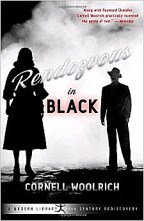
Rendezvous in Black
Cornell Woolrich
Modern Library Paperback Edition, 2004 Original printing, 1948
211 pages     $14