Nostalgia City Mysteries

Mark S. Bacon

Category Archives: Reviews of mystery/suspense books

Woolrich: novels or short stories?

0

Last week, a reader, intrigued by my recent articles, asked if I could recommend a starting point for reading Cornell Woolrich. Although I’m just beginning to explore this little-known author myself, I have a suggestion or two.

The Woolrich works I’ve read thus far are best considered for the journey, rather than the destination. Each scene, each page drags you deeper into the protagonist’s miasma as he or she races against the clock or death or both. The idea that every scene in a detective story should be as important and as involving as the conclusion–when the mystery is solved–was a priority for Raymond Chandler. And in his novels, each chapter and each dark, gritty scene created more trouble for Philip Marlowe. Finding out whodunit was just the final step in a perilous journey. The same can be said for Woolrich.

Therefore, I recommend the 1941 novel, The Black Curtain, as an introduction to Woolrich. In it, Frank Townsend gets a bump on the head and suddenly three years of his life disappears–or reappears. He searches for his home and discovers his apartment is vacant and that his wife has moved out.   He finally finds her and she tells him she hasn’t seen him for three years.

So starts this different version of an amnesia story. After he’s been back with his wife a short time, Townsend discovers someone is following him. The more dangerous the pursuit becomes, the more Townsend realizes he must figure out what happened during the missing three years.

His struggle to discover his past leads him through a threatening world of suspicious looks and dead ends. The fast-paced story includes a case of murder and a decrepit, isolated mansion.The Dancing Detective
Like most roman noir novels, there isn’t exactly a Hollywood ending. The plot twists at the end leave some unanswered questions, but each step along the quick trip through Townsend’s cloudy world is worth the effort and then some.

To be picky, Woolrich uses terminology that refers to a semi-automatic pistol after he has already identified a gun as a revolver. The difference between the two types of handguns is significant in several ways and they look nothing alike.   But confusing revolvers for semi-autos is so common in mysteries that I didn’t even notice the first time through.

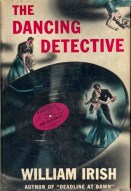
The other way to get an introduction to Woolrich is through one or more of his numerous short stories. The best one I’ve read is “The Dancing Detective” written under the pen name, William Irish. The protagonist’s first person voice is unique and so strong she captures you from the first paragraph. “Dancing Detective” appears in several mystery/suspense anthologies and in Woolrich collections. Of course for short stories it’s hard to beat “Rear Window,” Woolrich’s most famous creation. Even if you’ve seen the movie, the story is still compelling.

New crime books briefly noted

2

Way to Go

Jennifer Moss
Black Opal Books  294 pages
$3.99 Kindle    $10.55 trade paper

When motivational speaker Jessica Way entered the squad room, she stopped to smile at every cop who was staring at her.  When Det. Ryan Doherty asked her to sit down “she scrutinized Ryan from head to toe in a way that made him feel almost violated.”   She told the detective she thought someone was trying to kill her, but he didn’t take her quite seriously.  A day later she was dead, shot in the face.  This novel is the second in the series.


City of Darkness and Light

Rhys Bowen
Minotaur Books   320 pages
$11.04 Kindle    $19.99 hardcover

I got my first introduction to Ms. Bowen in her earlier, delightful Constable Evans books that take place in Wales.  You learn about Welsh customs, geography and language while you’re solving a mystery.  This new book is the 13th in the Molly Murphy mystery series featuring feature an Irish immigrant woman in turn-of-the-century New York City.


Drowning Barbie 

Frederick Ramsay
Poisoned Pen Press  250 pages
$6.99 Kindle  $21.20 hardback  $13.46  paperback

The intriguing title of this mystery is exceeded in bizarre only by the name of the first murder victim: Ethel Smut.  This is the nineth in Ramsay’s Ike Schwartz series of police procedurals.


Pinkerton’s Great Detective:  The Amazing Life and Times of James McParland

Beau Riffenburgh
Viking  384 pages
$32.95 hardback

McParland was a top man in Pinkerton’s National Detective Agency and a tough character.  In creating this biography Riffenburgh used recently released Pinkerton archives.  He tells, among other things, how McParland became famous breaking up the Molly Maguires, an infamous gang of coal miners accused of murder, arson and other crimes.   McParland was, according Ben MacIntyre’s review in The New York Times, “the prototype of a character that has become an adored part of America’s cultural landscape, the hard-boiled gumshoe, the lone sleuth in search of justice.”


Jeff Parker’s reissues

When was the last time you read a crime story by T. Jefferson Parker?  Four of his relatively recent novels, Storm Runners,The Fallen, California Girl and Cold Pursuit have been reissued. Parker’s latest is The Famous and the Dead, the conclusion to his series about Los Angeles County sheriff ’s deputy Charlie Hood, attached to the ATF, working along the U.S.-Mexican border.  The Washington Post said the book was, “not only well-plotted and suspenseful, but subtle, surprising and endearingly perverse.”  Three-time Edgar winner Parker rarely disappoints.

Follow Woolrich down this alley

0
The Black Path of Fear
by Cornell Woolrich
Ballantine Books  1982
160 pages
Price varies (available used only)

Bill Scott is honest, though obviously not the brightest guy in the world.  But he can’t help himself.  He’s in love.  Unfortunately Eve Roman, his new love, is married to a Miami mob boss.  But she loves Scott, too, so they runaway together—to Havana.

In the first few pages of Cornell Woolrich’s The Black Path of Fear, Eve is stabbed to death in a Cuban nightclub and the police blame Scott.  We get the backstory of how Scott and Mrs. Roman got together in a long flashback, but the majority of  the book—which hour-by-hour covers no more than a day and a half—describes Scott’s desperate attempts to find the murderer and clear himself.  His chances look dim.  He doesn’t speak Spanish, the police are combing the city for him, he knows no one in Havana and when it comes down to it, a big part of him doesn’t really care.  Eve is dead.

I’m working my way through Woolrich novels and short stories.  It’s a rewarding journey although Black Path is not his best.  My 1982 printing of the book (it was first published in 1944) reads almost as if it lacks a final edit.   The dialog occasionally sounds a bit off, Scott’s hat mysteriously appears in one scene—after he’d dropped it somewhere else—and he doesn’t use his love for the dead woman as an argument for his innocence.

That’s the bad news.  The good news is Woolrich takes a certainly unoriginal plot (though undoubtedly copied many times since) and builds it into a succession of nail-biting scenes in some of the most Black Path of Fearmemorably ugly, foreboding settings you can imagine.   In one scene Scott is escorted by police down a suffocatingly narrow  alley—too small to accommodate a car—in a run-down portion of Havana’s Chinatown.  The alley smelled “like asafetida and somebody burning feathers, and the lee side of a sewer.”  It was also dim.

It wasn’t of an even darkness; it was mottled darkness.  Every few yards or so an oil lamp or kerosene torch or a Chinese paper lantern, back within some doorway or some stall opening, would squirt out a puddle of light to relieve the gloom.  They were different colors, these smears, depending on the reflector they filtered through: orange and sulphur-green, and once even a sort of purple-red, were spewed around on the dirty walls like grape juice.

In another scene Scott is feeling his way in pitch darkness across a silent and seemingly empty skid-row office when something pricks his ear.  It’s a clever, suspenseful set-up that leads to a creative result.

Scott is similar to many Woolrich protagonists, an ordinary guy dumped into extraordinary circumstances and challenged to save someone else, himself, his sanity, or all three.  Emotions, not only of fear, but loneliness, disgust and hopelessness often drive his plots.

She had the look on her face of someone who has just been granted a quick glimpse down into the bottommost depths of hell from the top of the stairs.  And didn’t turn away quickly enough.

Woolrich was a noir master.  Although he’s not as well known as Raymond Chandler or Dashiell Hammett, according to his biographer Woolrich influenced not only the French Roman noir novels but the bleak Hollywood crime dramas, film noir.

To me, noir represents not only a grim, dark setting or plot, but a style of writing. And Woolrich’s style is unmistakable: “Silence fell, and we kicked it around between us for a while.”

Like the majority of Woolrich’s novels and short stories, Black Path was dramatized, in this case, many times: One of several radio versions starred Cary Grant (1946), the movie version (1946) starred Robert Cummings and Peter Lorre and a TV drama (1954) had James Arness as Scott.

Black Path was one of Woolrich’s “black” series in the 1940s, when the author was in his prime, cranking out so many thrilling novels that he released some under two pen names, William Irish and George Hopley.  Biographer Francis Nevins, Jr. called Woolrich the Poe of the Twentieth Century.  Black Path is an entertaining, compelling read, but stick with Woolrich titles for the whole dark ride through the 1940s.