Book Review
In a Lonely Place
Dorothy B. Hughes
NYRB Classics Edition, Aug. 2017 (Orig. 1947)
224 pages
$15.95 paper, $11.99 ebook Barnes and Noble
In Dorothy B. Hughes’ intense, ground breaking serial-killer novel, In a Lonely Place, Dix Steele is a scheming ex-GI psychopath. He rapes and murders young women in post-World War II Los Angeles. A 1950 Humphrey Bogart film of the same name was adapted from the book. 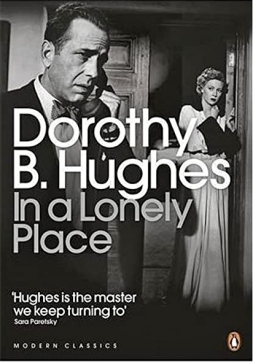
Or was it?
In the film version, Bogart’s Dix Steele is an out-of-luck screen writer with a bad temper. See the resemblance? Except for the title and the name of the main characters, the film is as close to the Hughes novel as it is to Dr. Seuss.
Coincidentally perhaps, both works are engaging, well plotted and populated with memorable characters. I suggest viewing them as separate creations albeit with somewhat similar themes.
According to Wikipedia, Hughes was “not bothered by the changes” made by the film’s director Nicolas Ray and its two script writers. I’d like to know why, given the reaction so many novelists have to films that alter, over simplify and otherwise mangle their original stories. It could be that Hughes recognized a good movie, even though it was not her idea. Presumably it helped her book sales.
Here first, is a look at the novel. A movie review follows in the next blog installment.
Dix Steele is stalking a woman in the foggy Pacific Palisades of Los Angeles. His target is “more than pretty, she was nice looking, a nice girl.”
He follows her cautiously, but not too cautiously. He knows she’s heard him behind her for she quickens her pace. It’s dark. She’s alone and afraid. But he doesn’t want to catch up to her too soon. He anticipates finally reaching her when she’d “give a little scream.” Unexpectedly however, cars appear ahead, their headlights bathing Steele and the road in “blatant light” spoiling his pursuit. “Anger beat him like a drum.”
The story is told in third person, but Hughes shares Steele’s internal dialog, making it the disturbing voice of the book. We know the protagonist’s loathsome thoughts, a technique that would be used again by other serial killer novelists and screenwriters.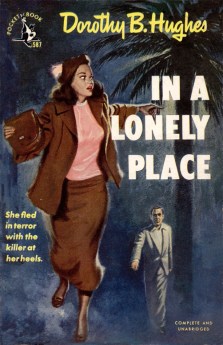
Thwarted in his attempt to abduct the young woman at the foggy coast, Steele decides impulsively to call his old Army buddy Brub Nicolai. He and Nicolai met in England when both served during World War II.
The outgoing, sociable Nicolai immediately invites him over to his house and introduces him to his wife, Sylvia. Steele takes stock of her “palest gold, a silvery gold” hair. The slender woman moved quietly with accuracy and Steele thinks, “she was probably a wonderful woman to bed with; not waste motion, quietness.”
Steele was less surprised by Nicolai’s choice of spouse than he was of his friend’s occupation: LA police detective. This sets the stage for a twisted cat-and-mouse game where only the rodent knows the score and is fond of taking calculated risks.
Hughes creates a perfect predator: medium height and weight with a “good looking face,” enough to attract victims, but “nothing to remember, nothing to set it apart from the usual.”
As a series of rapes and murders catches LA headlines, Steele socializes with his detective friend and his wife, taking pleasure in their pain:
“They would cling together for a moment, fear in both of them. The woman fearing to have her man sniffing the spoor of a murderer, fearing lest he catch up with evil. Fearing less for herself, only the unease she must feel, infected by Brub’s fear for her. Brub fearing for her because she was a woman, because she was his woman, and women were being stalked in the night.”
Hughes takes the reader into Steele’s angry head throughout. Leaving the Nicolai’s one night after a dinner party he reflects on one disagreeable guest, Maude.
“He took a deep breath outside to expel the odor of Maude from his lungs. He’d liked to meet her on a dark corner. It would be a service to humanity.”
He hates women but is drawn to them sexually. Reading a newspaper account of one of his abductions he thinks, “the only exciting thing that had ever happened to her was to be raped and murdered.”
Steele lives in a Hollywood garden apartment, one of a few story similarities retained in the movie. It’s here he meets an attractive, red-headed neighbor, Laurel Gray. “She’s the sweetest built job I’ve seen in Hollywood,” he tells Nicolai. Has Steele scoped her out as his next victim or does he have something more long-term in mind?
The string of murders has Nicolai frustrated, on edge and Steele wants to know what progress the police may be making. He tells his friend that he’s writing a detective novel, giving him cover to ask questions about police procedure in general and the serial killer case specifically.
Actually, Steele does not write or do much of anything except check out dark corners of nearby neighborhoods that would make good places to grab an unsuspecting woman. He survives on a $250 monthly stipend from his rich Uncle Fergus.
Nicolai introduces Steele to his boss, Captain Jack Lochner, as a mystery writer interested in crime, giving the serial killer even greater access into the police investigation.
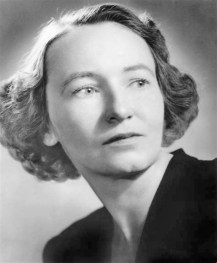
Dorothy B. Hughes
Again, this close relationship between criminal and cop is familiar to viewers of crime TV shows and films. Hughes may not have invented the trope, but she develops it, propelling the story through Nicolai’s naiveté and Steele’s cunning.
The deranged Steele alternates between periods of insecurity and superiority, and we’re encouraged to understand him, to anticipate his next move.
After an argument with girlfriend Gray, Steele is contrite. “He was ashamed of his anger; it hadn’t been he; some stranger had performed that way. But the stranger was himself.”
Earlier Nicolai tells Steel that the murderer “has to live with himself. He’s caught in that lonely place.” The book continues its psychological grip until the satisfying end. If you’re a fan of serial killer novels and you haven’t read Hughes’, do it now. It won’t kill you.
—-
Dorothy B. Hughes was born in Missouri in 1904 and graduated in journalism from the University of Missouri. She later did graduate work at Columbia University and the University of New Mexico. She was a newspaper writer, literary critic and novelist. She lived much of her life in Santa Fe, N.M., setting some of her books there. In addition to In a Lonely Place, her novels Ride the Pink Horse and The Fallen Sparrow were made into films. She reviewed mysteries for the Los Angeles Times, New York Herald-Tribune and other publications. Although not as well known as some of her contemporary noir writers, her work is as memorable and well-crafted as that of Woolrich, Hammett, Chandler and other masters of the genre.

