Nostalgia City Mysteries

Mark S. Bacon

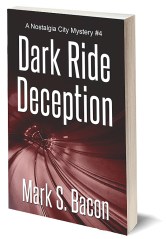
Dark Ride Deception novel beats Disney to new ride

3

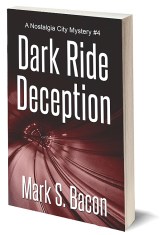
“Dark Ride Deception,” published in September, describes a technology that gives visitors a virtual reality experience—without goggles.  The Walt Disney Company received a patent for such technology three months later.

According to The Los Angeles Daily News, the Walt Disney Company was granted a patent on Dec. 28 by the U.S. Patent and Trademark Office for a technology that enables users to experience a 3D world without glasses, goggles or digital devices.

“Dark Ride Deception,” describes an advanced technology that is stolen from Nostalgia City, an Arizona theme park. The stolen secrets allow park guests to experience virtual reality without goggles.

VR Goggles no longer needed?

The Disney technology, according to the Daily News story, is called a Virtual World Simulator.  The stolen Nostalgia City tech is called the Perception Deception Effect.

Since my first Nostalgia City novel I’ve been following the development of amusement park attractions.  I never read anything about this new Disney technology, however; but it’s the next logical step in virtual reality.  Inventing the Perception Deception Effect just made sense.

In the book, a brilliant theme park engineer disappears, along with details of his ground-breaking technology—before the plans can be patented. Nostalgia City employee and ex-cop, Lyle Deming, is tasked with finding the missing engineer and recovering the secrets.

Critical details of the Perception Deception Effect are known only to the missing engineer, Tom Wyrick.  Deming speculates that Wyrick was either kidnapped or killed to obtain the secrets or that he plans to sell his inventions to the highest bidder.

“What’s he going to do,” Deming asks, “start his own theme park?”
When I wrote the book, I thought theme park rides needed to be bumped to a higher technological level.  Apparently, so did Disney.

—————–

Looking for the second half of Hitchcock’s Sabotage?

The first half of my review of the Hitchcock film had a bunch of words unnecessarily underlined in the email version. Distracting.  It doesn’t show up in the WordPress editor or in the web version of the story.

The second half of the review will be published soon.  And it will be linked to the online version of the first half. Stay tuned.
Hitchcock’s ‘Sabotage’ – A look back at terrorism

0

Movie review Part I

Alfred Hitchcock preferred suspense to shock. Shock, he said, was a bomb going off killing people yet producing only a few moments of surprise for an audience. But, he said, tell the audience that a bomb was going to go off and they would be held in suspense for as long as the film director pleased.

Creating suspense, according to Hitchcock, was letting the audience know more than the protagonists know. In his 1936 film, Sabotage, he does that with nail-biting precision.  Despite its age and the technological limitations of film in the mid-1930s, the movie still retains the admiration of critics and Hitchcock fans. More about that later after a look at the plot.

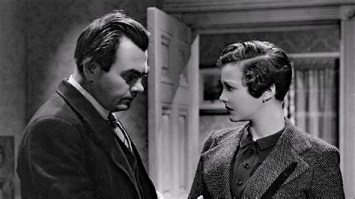
The Verlocs, Oscar Homolka and Sylvia Sidney. A happy couple?

Karl Verloc (Oscar Homolka) runs a small movie house in London. He lives in an apartment at the rear of the theater with his wife (Sylvia Sidney) and her school-age brother.  Verloc is a terrorist, a saboteur.

Before he sabotages power generators throwing London into temporary darkness at the beginning of the film, Verloc is already under police surveillance. Detective Sergeant Ted Spencer (John Loder) poses as a clerk in a greengrocer next to the theater. With a winning smile he chats up Mrs. Verloc in front of the theater during the blackout.  Amid the confusion , Spencer sees Verloc return to the theater, something Verloc later denies, claiming he was home all afternoon.

Later that evening, Spencer visits Scotland Yard and his boss tells him to find out whatever he can about Verloc as the government has become concerned.

“Now listen, Spencer, the Home Office have been on, and they’re scared something worse than tonight’s job may happen.”

“What’s the idea, sir? What’s the point of all this wrecking?”

“Making trouble at home to take our minds off what’s going on abroad.  Same as in a crowd. One man treads on your toe. While you’re arguing with him his pal picks your pocket.”

The next day Verloc meets a shadowy figure in an aquarium. As the two men stand in the dark, staring at fish tanks, Verloc’s contact tells him the blackout produced only laughs from Londoners. He tells him he will not be paid until he accomplishes a job that will put the fear of death in people, not make them  laugh.

The title was changed from ‘Sabotage’ when the film was released in the US.

“I once read a sign in Piccadilly Circus calling it the center of the world,” the stranger says.  “I think you’d better pay a visit there in a couple of days’ time, and leave a small parcel in the cloakroom at the underground station.”

Verloc says he won’t be involved in deaths so his contact urges him to get help from friends. The contact then tells Verloc to visit a bomb maker.  “He’s a very nice old gentlemen, and he makes lovely fireworks.”

As the stranger leaves, we get a close-up of Verloc, his lower lip slightly extended as he peers out from below the shadow of his hat brim. He stares into an aquarium tank and instead of seeing fish, he imagines the bustling streets of Piccadilly Circus with buildings collapsing as if they were melting into a pit. The vision has an obvious effect on him as I suspect this early cinematic special effect had on audiences 86 years ago. 

Next time, a non-spoiler discussion of the film’s jolting climax and information on where you can find the movie today.

Writing right & kudos acknowledged & more

1
How to write good

Only occasionally do I write about the mechanics of writing here, but this decades-old advice is worth passing along. While going through old (paper) files recently I came upon something I’d copied off the web in the mid-1990s.

This is one of those less-than serious posts that have flourished in the online world since the Internet began. I wondered if this short article was still in online circulation. It is.  I offer an abbreviated version here of “How to Write Good,” attributed to Sally Bulford. Among the 22 “rules” for good writing, these are my favorites.

1. Avoid alliteration. Always.

2. Contractions aren’t necessary.

3. One should never generalize.

4. Comparisons are as bad a clichés.

5. Don’t be redundant by using more words than necessary; it’s extremely needless and also superfluous.

6. Be more or less specific.

7. Analogies in writing are like glue on an apostrophe.

8. The passive voice is to be avoided.

9. Exaggeration is a million times worse than understatement.

And while I’m passing along English advice, let me be serious for a moment.  I wish everyone would stop saying (or writing) “going forward.”  You can use it when you’re describing the direction your car is moving, but in almost all other instances it’s redundant and can be eliminated without changing the sense of the sentence. Think about it.

Dark Ride Deception named a favorite book

My latest mystery was just named to the list of Favorite Books of 2021 by Kings River Life Magazine. Here’s what they said:

Dark Ride Deception

A noirish look at industrial espionage and murder in the world of amusement parks. Lyle, an ex-cop, drives a cab at a 70s theme park and does some detective work for the boss. Kate, an ex-basketball player, is in charge of public relations. A severed finger in his cab and feuding actors filming a movie in the park set off a chain of mysterious events in this fast-moving quest for the truth

Terrorist bombs

Stay tuned.  The next article (post) on this website (& email) will be a look back at a terrorism on the screen.