Nostalgia City Mysteries

Mark S. Bacon

Nostalgia City trivia quiz: music, Vietnam, Happy Days

1

Newly released Dark Ride Deception, like the previous novels in my series is based in Nostalgia City, a sprawling theme park that recreates an entire small town from the 1970s.

This latest book travels to Florida where Lyle uses a variety of false identities to investigate other theme parks and try to recover high-tech secrets stolen from Nostalgia City.  To maintain the park’s theme—and authenticity—I use news items, songs, product names and other touchstones of the 1970s.

In that spirit, here’s the second installment of my 1970s trivia quiz. Answers, of course, can be found on the pages of Nostalgia City mysteries.  But you’ll also find them on the next post here in your mailbox or at Baconsmysteries.com

(No fair looking these up on the internet.)


  1. In 1975 which automotive company introduced the Pacer, “the first wide, small car.”

a. Ford
b. American Motors
c. Plymouth
d. General Motors

2.  Which 1970s product was advertised as featuring “rich Corinthian leather”?

a. Lazy Boy recliners
b. Members-Only jackets
c. Chrysler Cordoba
d. Bloomingdale’s bell bottoms

3.  When did the US’s Vietnam War officially end?

a. 1969
b. 1975
c.  1978
d.  1972

4.  The song Evil Ways hit #9 on Billboard’s Hot 100 the week of Mar. 21, 1970. Name the artist.

a. Fleetwood Mac
b. Dire Straits
c. Frank Zappa
d. Santana

5.  Who played The Fonz on the Happy Days TV series 1974-1984?

a. Henry Winkler
b. Scott Baio
c. Donny Osmond
d. Bill Bixby

6.  What beer advertised, “tastes great, less filling.”

a. Bud lite
b. Coors
c. Miller Lite
d. Hamm’s

7.  What novelty gift became a craze in the late 1970s and sold in the millions.

a. Chia Pets
b. Beanie Babies
c. Hula Hoop
d. Pokemon Go

8.  David Cassidy starred in what 1970s sitcom?

a. The Brady Bunch
b. Family Ties
c. All in the Family
d. The Partridge Family

9.  If your car had an eight-track, it meant it had,

a.  A  V-8 engine
b. Four-wheel drive
c. A tape player
d. GPS

10.  Which event did not take place in the 1970s?

a. The 55 MPH National Maximum Speed Law was enacted.
b. Girls were first permitted to play Little League baseball.
c. A terrorist bomb destroyed a Pan Am flight over Lockerbie, Scotland.
d. The Sting won the Oscar for best picture of the year.

11.  Midnight screenings of which motion picture helped make it a cult classic?

a. The French Connection
b. Willie Wonka and the Chocolate Factory
c. Zardoz
d. The Rocky Horror Picture Show

12.  Which baseball player surpassed Babe Ruth’s career home run record in 1974?

a. Mickey Mantle
b. Jackie Robinson
c. Hank Aaron
d. Reggie Jackson

Murder solved by 1950 version of CSI

1
Movie review: Mystery Street

Blonde floozy Vivian Heldon (Jan Sterling) is talking on the wall phone in the shadowy hallway of her Boston boarding house. Her landlady, appropriately named Mrs. Smerrling, (Elsa Lanchester) makes no pretense about listening in while she prods Heldon for back rent.

“Please honey,” Heldon says into the phone’s wall-mounted mouthpiece. “You gotta. I’m in a jam.”

Soon, Heldon gets herself killed but not before she involves a nervous expectant father she meets in a bar. So far, the 1950 film is a predictable B movie with noir overtones and few expected surprises.  

But Heldon’s murder is not discovered until six months later when a beachcomber finds her skeleton protruding from the sand on Cape Cod. The lack of fingerprints, or other obvious means of identifying the skeleton, lead the detective lieutenant on the case to enlist the aid of Dr. McAdoo (Bruce Bennett), a professor from the Department of Legal Medicine at Harvard Medical School. The film then develops into a CSI story 50 years before the Las Vegas crime lab TV series.

Some of the tools and techniques used by Dr. McAdoo seem a bit rudimentary today, but the scientific angles and the solid acting of Lanchester and the detective on the case—Richardo Montalban—make this relatively unknown film worth watching.

A New York Times review when the movie debuted said, “There is more science than mystery in this cops-versus-killer number, but it is an adventure which, despite a low budget, is not low in taste or its attention to technical detail, backgrounds and plausibility.”

This is not the say it’s perfect. It’s slow moving at times, and in one scene a murder suspect escapes a little too easily from a police chase thus extending the suspense.  For the most part, director John Sturges, who would go on to acclaim directing pictures such as The Magnificent Seven and the classic noir Bad Day at Black Rock, elevates the film past its meager budget.  The movie was shot on location in Boston and Cape Cod.

From the get-go, Montalban, as Lt. Peter Moralas, suspects the unidentified skeleton is a murder victim.  He delivers a box of bones, including the skull, to Dr. McAdoo who provides a surprising amount of information on the victim.

As Moralas looks at the bones arranged on a gurney, Dr. McAdoo tells him the skeleton was a woman.

“I suppose you’d like to know her age,” McAdoo says.

“I’d also like to know her height, weight, occupation and the name and phone number of the person who murdered her.”

“I think I can answer all those questions, except the last,” the confident doctor says.

Armed with that information and McAdoo’s guess at when the woman died–based on plants found with the body–Moralas reviews missing persons’ files for women in their early 20s. Thanks to further lab work at Harvard, Moralas thinks he’s found the victim’s name. That leads him to Mrs. Smerrling’s and the intrigue begins. You can see wheel’s turning in the landlady’s head as she remembers details about the victim’s circumstances.

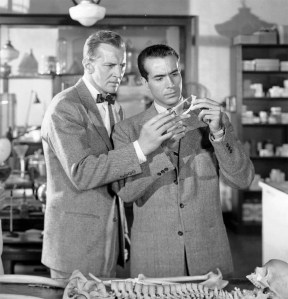
Ricardo Montalban, left, and Bruce Bennett examine a human bone at the Harvard School of Legal Medicine.

With the victim identified as Vivian Heldon, Moralas locates some of her possessions, including a little black book.  The names and phone numbers of 86 men in the book give Moralas a long list of suspects, but he needs one more bit of scientific evidence to prove the death was murder. Again, Dr. McAdoo provides the necessary information, and Moralas is left to hunt for motives. 

Meanwhile, the gin-tippling Mrs. Smerrling, who admits she wasn’t actually married, dreams of ways to cash in on her tenant’s demise.

Although she rates only fourth billing, Lanchester is perfect as the scheming landlady. You know from her expression that she’s only looking out for herself.

Montalban, a star in Mexican films before he was signed by MGM in the late 1940s, was one of a few Hispanic leading men in US films at the time. According to Wikipedia, he was the first Hispanic actor to appear on the cover of Life Magazine. The Times review of Mystery Street said Montalban was “natural and unassuming.” He handled the detective role well and never reminded you of his later, most popular TV role. (You know the one.) 

Late in the investigation, Dr. McAdoo has another tidbit for Moralas, but the detective has already discovered it for himself.

 “Professors work with their heads,” he tells McAddo. “Cops work with their feet.

Hitchcock’s suspense and terrorism in ‘Sabotage’

0

Movie review Part II

Here’s a link to Part I:    https://baconsmysteries.com/?s=at+terrorism

Halfway through Alfred Hitchcock’s 1936 suspense film Sabotage, the villain, Karl Verloc, played by Oscar Homolka, is contemplating the bombing of London’s busy Piccadilly Circus intersection with untold loss of life. 

At the same time, undercover police sergeant Ted Spencer, played by John Loder, is buying lunch for Mrs. Verloc  (Sylvia Sidney) and her school-age brother who lives with the Verlocs.  She’s telling Spencer what a peach of a guy her husband is.  Unaware of her husband’s part-time job as a terrorist, she says he has been very kind to her and her brother. “Very kind” sounds like the way you’d describe a benevolent aunt.

John Loder, as Sgt. Spencer, chats up Mrs. Verloc, Sylvia Sidney.

“He’s the quietest, most harmless, home-loving person,” she says.

Her description is slightly at odds with Homolka’s Verloc whose heavy-browed, malevolent facial expressions and short temper seem to dominate their home, an apartment at the rear of the theatre Verloc operates.

When the movie was filmed, Homolka was 38, Sidney 26, although they seem even farther apart, Homolka’s Austrian accent adding to his menace, especially in pre-war England.

The title was changed from ‘Sabotage’ when the film was released in the US.

Later while Spencer watches the theater from his one-man command post in a street-front vegetable stand, he sees several suspicious characters enter, not to see a film, but to visit Verloc. The sergeant snoops inside the theater  and we’re given a behind-the-movie-screen view.  But in his awkward eavesdropping  Spencer is exposed as a cop, scaring off Verloc’s potential accomplices.

Verloc confers with the next-door greengrocer who admits to permitting the detective to use his shop for surveillance. Verloc asks the store owner if he knows what the police are looking for.

“You must have been showing some funny sort of films, I daresay,” the greengrocer tells Verloc. “You know, perhaps a bit too hot.”

Deserted by his fellow saboteurs, Verloc realizes he must now transport the bomb himself.  When the bomb is delivered to Verloc at the theater the next day in a brown paper parcel, an attached note tells  him it’s  set to explode at 1:45 p.m. that afternoon.

The last thirty five minutes of the film is a dash to the end while putting the leading characters at peril. It includes the most suspenseful ten minutes of this film and perhaps of any Hitchcock movie. Writing on TurnerClassicMovies.com, Jeff Stafford calls the scenes “a visual tour-de-force, employing montage to powerful effect and presenting a breathtaking example of Hitchcock’s emerging technique.”

Stafford also questions whether the climax “blurs the line between the director’s typical use of suspense versus shock.”

I think it combines both elements. It’s an amazing sequence. But Hitchcock has more in store besides the anxious ten minutes, and the ending is a mixture of noir bleakness with hope for a little Hollywood-style happiness.

Oscar Homolka, husband, movie theatre operator, terrorist

According to Stafford, Hitchcock expected Robert Donat and Peter Lorre to be the male leads, but wound up settling for Loder and Homolka. Although Lorre was a master of disreputable and downright evil characters, Homolka’s Verloc is sufficiently ominous. Loder overplays his undercover role becoming a jolly, garrulous and inquisitive vegetable vendor but partially redeems himself with a passing moment of despair late in the film. Donat would have been ideal for the part, and in fact, had just completed The 39 Steps for Hitchcock the year before.

But I’m a fan of Donat and The 39 Steps.  I think it’s the best of Hitchcock’s early works. I’m a sucker for the scenes of Donat handcuffed to co-star Madeleine Carroll as they check into a country inn posing as newlyweds to escape foreign spies.

But I digress.

Possibly of greater interest to film buffs, Sabotage is packed with suspense and offers a blueprint for many Hitchcock films to come.  It also reminds us that terrorist bombs are not a 21st century creation.   The film receives a 100% rating from 11 critics on Rotten Tomatoes and a 7.1 rating on IMDB.com.

The film is available for streaming on Amazon Prime for $1.99 or $3.99 for an HD version.  It’s not available on Netflix, but no surprise.  I’m not sure they understand the concept of noir. A free, although slightly grainy version of Sabotage is available from BjgTjme Free Movies (correct spelling) via YouTube.

– – – – – – – – –

Free version of Sabotage:  
https://www.youtube.com/watch?v=IbwC71cglyI

Jeff Stafford’s article on Tuner Classic Movies:
https://www.youtube.com/watch?v=IbwC71cglyI