Book Review
Dark Passage (1946)
David Goodis
Library of America 2012
247 pages
Kindle, Apple Books $5.99
Vincent Parry’s wife was an ungrateful, unloving bitch. But he didn’t kill her.
A jury said he did, and the judge gave him life in San Quentin.
This seemed like it would be the last chapter in Parry’s unremarkable life. An only child and orphan in central Arizona he stole food when he was hungry and found himself in a reformatory being punched in the face by a guard. 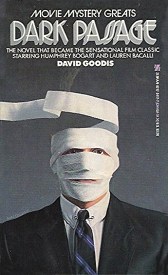 During World War II his draft board labeled him 4-F due to sinus and kidney problems. The 145-lb, five-foot-seven-inch Parry found work as a clerk in a San Francisco securities investment house, a position he took because it would permit him to smoke at work. He earned $35 a week and smoked three packs a day.
Early in their marriage, at her insistence, Parry bought his wife Gert a ring with a flame opal, her favorite stone. She told him it was flawed, that he paid too much and she threw it at his face. Less than a year and a half after they were married, she started seeing other men.
One day he came home to find police cars parked in front of his apartment building. Gert had been murdered, her skull smashed by a heavy glass ashtray. A witness told police the wife’s dying words were that Parry had killed her.
Parry’s attorney asserted that Mrs. Gert Parry simply tripped and hit her head, but no one was buying it.
Dark Passage is a story of lonely, sad, miserable people. The book envelopes the reader in an atmosphere as cheery as a rainy night in a graveyard.
In San Quentin Parry worried about the guards, remembering his experience in the reformatory. But he thought this might be different.
He had an idea that he might be able to extract some ounce of happiness out of prison life. He had always wanted happiness, the simple and ordinary kind. He had never wanted trouble.
 Eventually, however, he again met up with a brutal guard. During the ensuing pummeling, Parry sobbed, a reaction that would revisit him more than once in the coming weeks.
When he was placed in solitary confinement temporarily, and permanently removed from his prison accounting job, he decided to escape.
He made it, and once outside the prison grounds a young woman in a new Pontiac convertible offered him a ride, telling him she heard of his escape on the radio and came to help him. “You’ll stay at my place,” she tells him.
Vincent Parry’s life was about to turn around. And around.
Once safe in the expensively furnished San Francisco apartment Parry learns his blonde savior’s name, Irene Janney.
The way her lips were set told him she didn’t get much out of life. One thing, she had money. That grey-violet [her clothes] was money. The Pontiac was money.
She tells him she attended his trial and that Madge Rapf, the woman who found Gert’s body and heard her dying words, is an acquaintance of hers.
Parry knows Rapf, a friend of his wife’s who visited them frequently. Too frequently.
She was miserable and the only thing that eased her misery was to see other people miserable. If they weren’t miserable she pestered them until they became miserable. Parry had a feeling that one of the happiest moments in Madge Rapf’s life was when the foreman stood up and said that he was guilty.
Parry’s fate begins to look promising when Janney buys him new clothes and gives him $1,000 in cash for the road.
He leaves her, hales a cab and is identified as a fugitive by the driver. But instead of turning him in, the driver tells Parry about a doctor friend of his, a plastic surgeon, who could give him a new face—no questions asked. Continue Reading →
 The chief suspect appears to be medial epicondylitis, a form of tendinitis. Ten minutes at the keyboard and mouse makes my arm painful for hours. Using my laptop and its palm rest, rather than my desktop PC, is marginally less unpleasant. If I stay away from the keyboard entirely the pain seems to hide for hours at a time, sometimes a day.
 found near the body, and initially the police surmise that Dexter was the victim of a logging accident. Or was it suicide? Or murder? Regardless, McKenna has a deaf eight-year-old on his hands.
 Nostalgia City Mysteries