Nostalgia City Mysteries

Mark S. Bacon

Category Archives: craft of writing

Will a fire sale for ebook buyers        become the authors’ pyre?

Ramifications, realizations spread in wake of used marketplace news

Second in a series

From the first, ebooks promised to transform the publishing business.  Ebooks joined music and movies as a popular item to be hijacked and distributed by torrent websites.  Now the possibility of a marketplace where “used” or previously owned ebooks can be resold  has authors, publishers and book lovers wondering what will happen as Amazon and Apple proceed with patents for such a system.  Authors’ biggest fear is that a used marketplace will cause new ebook prices to deflate faster than the Hindenburg.

Amazon’s patent was granted two months ago; Apple’s is pending.  The two giant online retailers have not said what they plan to do with the patents.  In contrast to websites such as Pirate Bay, run by thieves who ignore copyright, new ebook marketplaces outlined in the patents promise controls that will reduce unauthorized duplication of ebooks.  A relatively new online “used” music seller,  Redigi, has already set up a resale system the company says is similar to a conventional used book or record store.  The system for used ebook sales will get rolling, pending the outcome of a lawsuit.

According to news reports, the Redigi system will permit people who have purchased ebooks to offer them for sale online.   Like the Amazon and Apple proposals, an ebook will only be sold once and then it disappears from the previous owner’s files.  Redigi CEO John Ossenmacher told Time Magazine the company has validation tools that let them determine if digital material has been legitimately purchased, if it has been transferred between computers and other information.  Pirated digital merchandise will not be sold, according to Ossenmacher.

The company designed the tools to protect copyrights, Ossenmacher told Time.  He said Redigi will suspend the accounts of people who don’t follow the rules.

One side benefit of a used marketplace like Redigi’s or Apple’s is that it might reduce piracy. “By enforcing old-fashioned rules of physical ownership onto modern, non-physical objects, Apple’s patent might support the company’s goal of combating piracy,” Charles Pulliam-Moore wrote recently in Slate.  “In creating a used digital store, Apple would provide an easier, safer, quicker alternative to pirating media…,” he said.readers  b&w  3578
Perhaps the biggest (encouraging) surprise in the Redigi plan is that, unlike in the sale of used paper books, publishers and authors can receive compensation.  Trade magazine Publishers Weekly recently reported that Ossenmacher appeared at a roundtable discussion with publishers and told them income from the resale of ebooks “represents billions of dollars on the table.”

Billions of dollars into publishers pockets likely will not assuage the doubts of authors as to any potential benefits from a used ebook marketplace.   But then, contrary to popular opinion, most writers get paid very little for their books.

“The vast majority of writers are not like Stephen King or J.K. Rowling or Suzanne Collins,” said best-selling sci fi author John Scalzi.  “The average author makes a four-figure salary a year from their writing,” Scalzi told Jenny Shank, writing in NPR/Mediashift.

“People don’t see creative people as they are in reality,” Scalzi told Shank.   “Ninety-nine percent of everybody in a creative field is barely eking by. Also, when it comes right down to it, people like getting bargains. They’re not following the product chain back to the initial starting point.”

Scalzi said part of the job today is to remind readers that books are created by human beings who have to pay rent and feed their children.

To be sure, writers do not get rich.  The most successful book I’ve written sold about 60,000 copies in all editions over several years.  That was enough for my publisher at the time to call me a “mid-list author.”  What I made from that at 10-15% royalty plus advance was certainly not enough for my family to live on, even at poverty level.  And many authors never even make mid-list, let alone best seller status.  Most authors have day jobs and working spouses–or should.  (Fortunately for me, my day jobs have always been in writing: commercials, direct mail, journalism.)

So, as a used ebook marketplace threatens to remake the book business and further erode authors’ income, questions remain.  Several conclusions–perhaps at odds with public perception–seem clear however.   We’ll look at those next time.

Notes/Hyperlinks

Redigi’s tools to protect copyright   
Apple’s system might reduce piracy

Authors have doubts

Publishers could profit from “used” sales

Humor, point of view, endings;            They’re all important in flash fiction

(Second in a two-part series)

“Look at me and my cat Miss Priss. They put us down on a planet named ‘Betty.’ It was a stupid joke at first, but nobody could think of anything better.”

This line from flash fiction writer Doug Mathewson’s quirky sci fi story, Planet Betty, The New World, provides a glimpse into the style of the Connecticut poet/flash fiction writer.  Recently, he says, his stories have tended to include bittersweet humor.

What flash fiction writers write about and why, are two of several issues examined in recent email interviews with Mathewson and two other writers.   Jim McCormick of Nevada says he likes to let a story or idea sit overnight to give him a fresh perspective.  Madeline Mora-Summonte, a Florida FF writer, says she never knows where a story idea will come from.

“In On Writing, Stephen King says he believes ‘…stories are found things, like fossils in the ground.’ That’s what it feels like for me,” says Mora-Summonte.  “I just never know what’s going to strike me–a news story, an overheard conversation, a stack of old postcards–and make me start digging for the whole story.”

“The sources of many of my FF pieces are rooted in past experience,” says McCormick, a retired art professor.  “It may be an old pet peeve like accordions,” he says alluding to one of his a recent stories.  “I took lessons on that dreaded instrument of destruction in my early teens, and have never recovered from them.”

Funerals are another topic for McCormick’s humorous, macabre (or both) stories,  related he says, to his long association with a funeral consumers alliance.

Flash fiction topics sometimes come from feelings, says Mathewson.  “You write about what you’re thinking about, what you’re feeling, what you’re doing.

“A lot of times I will write about something going on in my head that I have to resolve.  I have to decide how I feel about it.”

Humor as a purpose or device characterizes many of McCormick’s and Mathewson’s worksMathewson’s The New Job is a good example.  His work includes both first- and third-person stories.

The New Job

by Doug Mathewson

Everybody had photos in the cubicles of loved ones, pets, and friends.
Having none of the above I cut out an old magazine picture of Courtney Love and put it in a cheap frame. She looked great in this smokey live concert shot. Her hair whacked-out, lipstick badly smeared, cigarette upthrust like FDR, and mayhem in her eyes. She had ripped the broken-strapped tacky sequin bra far from one shoulder, slick with sweat her bare breast exposed, nipple defiant.

The department supervisor made his courtesy visit, saw the photo, and conversationally inquired, “So, ah… is that the Mrs.?”

An elderly protagonist’s third-person point of view has been a feature in some of Mora-Summonte’s recent work.  “Many people have told me that my best characters are older folks or children,” she says.

Older people and children, “are more on the outside looking in,” she says, “and to me, the outsider’s point of view–however you want to define outsider–is usually the most interesting.”

In addition to point of view, other traditional elements of fiction generally apply to flash fiction.  For example, Mathewson believes a story, no matter how short, should have a beginning, a middle and an end.  Mora-Summonte says she likes her stories to have a sense of those elements plus other features of fiction.

“I might choose the element I think is most important to the story,” she says, “the one that will get center stage–the setting? the protagonist?– but I try not to sacrifice any of them.”

And how does a flash fiction writer know when her or his story is finished?

“I know it when I feel I am straining for something more to say,” McCormick says. “When a piece seems tired to me, increasingly lacks punch. Time to get out.”

———-

Hyperlinks to stories.  In some of the links below you will need to scroll down to find the stories.

Doug Mathewson

Planet Betty, The New World

Smartest Man on Earth

Jim McCormick

Reliquary

Moma

Madeline Mora-Summonte

Delicates

Back Roads


Great reviews gratefully accepted

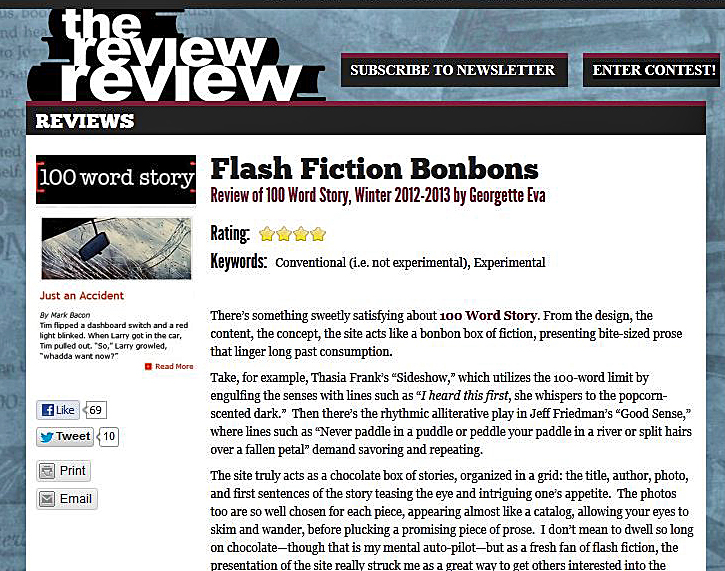
The new issue of The Review Review contains a review of the literary magazine, 100 Word Story.  The four-star review says the magazine “offers an amazing set of bite-size fiction that will inspire you….”  And the reviewer talked about my story, Just an Accident, that appeared in the issue: “One of my favorites on the site because of how Bacon uses the limit of 100 words, utilizing the idea of the unsaid, enabling the reader to fill in the gaps….”

Read the full story at http://www.thereviewreview.net/reviews/flash-fiction-bonbons

And of course you can follow 100 Word Story   

Review review