Picture a PI’s office in the late 1930s. It’s a third-floor walk-up. There’s a bottle in the gumshoe’s bottom drawer and a .38 just out of sight. If you’re picturing a Sam Spade type character behind the desk, you’d be right—except for her gender.
Maggie Sullivan is a savvy, resourceful private detective who walks the mean streets and privileged neighborhoods of Dayton, Ohio. She’s the creation of author M. Ruth Myers and her latest caper, Don’t Dare a Dame, recently earned a Shamus award from the Private Eye Writers of America. It’s a dandy PI tale with enough surprises to keep you guessing and Myers’s steady hand to tell the engrossing story in rich, nuanced tones.
The story starts with two “old maids” hiring Sullivan to find out what happened to their father 25 years ago when he disappeared during a great 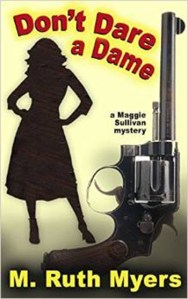 flood. Records were lost during the flood, many of the buildings in the area where the father disappeared are long gone and memories of the events are fading.
Sullivan tells her clients that chances of finding the truth are slim. But in the course of her investigation, Sullivan stirs up old animosities, turns up at the site of a suspicious death that might be related to the father’s disappearance and runs afoul of enough menacing figures to make you wonder what will happen to her in the next chapter.
Authentic depression-era descriptions and language put the reader firmly in the past. For example, her years-gone-by vocabulary includes snazzy and moxie. She describes a man as having “a leading-man moustache.” And Sullivan sometimes gets information by calling people and pretending to be someone she isn’t, a technique that an investigator could use easily in a time long before cell phones and caller ID.
Another feature of pre-war America (still around if you look under the glass ceiling) that Myers uses to good effect, is prejudice. Sullivan is a woman doing a man’s job. The quick detective usually handles slights and snide remarks with aplomb, sometimes letting the reader in on what she really thinks: He shot me a smile that was probably meant to suggest we gals were bright as buttons.
Humor also plays a part in the entertainment value of the book and to get Sullivan’s (Myers’s) gender equity points across.
As Sullivan questions a witness who is walking her dog, the person reveals startling information.
“That wrenched my attention away from her little dog, who was sniffing my ankle and some nearby bushes with equal enthusiasm.”
When someone tries to pick her up on the street, Sullivan has an answer:
“That’s some hat, sweetheart. Want to show it off over a beer and a sandwich?”
“Hey, thanks for the nice offer, but I’m looking for someone.”
“What’s he got that I haven’t?”
“V.D.,” I said.
He took off fast.
Myers handles little details that give a story depth and realism. For example, Sullivan wants to talk to a store clerk when the clerk’s boss is gone. Sullivan waits outside until the boss leaves, but rather than rush in, Sullivan tells us she waited ten minutes more in case he forgot something.
Sullivan enters the variety store and approaches the clerk who was interested in disclosing important facts, however, “[The clerk’s] eyes made a businesslike sweep of the store first, making sure everything was under control.”
I think these are little details make a story come alive. And Myer’s prose is alive with gritty dialog, unusual characters and the first-person emotions and thoughts that have us following Sullivan into every dark alley. This gritty PI novel is part of the Maggie Sullivan series. You’ll want to hunt for more.
As a parting shot, here are a few of my favorite noir lines:
“The pub in the bottom drawer of my desk was always open.”
“Because of my work I’d seen more than my share of ugliness that hid in life’s corners. Nonetheless, the Warren’s marital arrangement made my skin crawl.”
“The St. George Hotel fell somewhere between the Ritz and a roach farm. It inclined toward the latter.”
 (It’s a different, yet equally dishonest countenance he bore as Lt. Tom Keefer in The Caine Mutinty.)
 Nostalgia City Mysteries