Nostalgia City Mysteries

Mark S. Bacon

Category Archives: flash fiction

Preview my book, but buy it anyway

My Kindle died.  It was just two years old.  If you lose a paperback you’re reading, you can buy a new one.  Lose a well-used Kindle and it’s like losing a library.

I know, all my books with my highlighting and extensive annotations are safe in the cloud somewhere–I hope–and I can retrieve them on my computer via Kindle software.  But I don’t want to sit at my desk to read a book; that’s why I bought a Kindle.

My Kindle was a second-generation model, now called a Kindle Keyboard.   It died when I abandoned it temporarily to read a printed book, what a friend calls a tree book.  It seemed to be frozen, so I charged it for hours but to no avail.  I discovered a simple procedure that can sometimes resuscitate a frozen Kindle.  You slide the on button and hold it in position for 20 seconds.   That didn’t work either.Kindle bare type Es  3368

Naturally, after two years the warranty was as dead as my Kindle.  When I reported the death to Amazon they offered me a couple of new models (that carry advertising) at a modest price reduction.  I will just buy a new advertising-free one.  The Paperwhite model offers a lighted screen and a purported two-month battery life.  But it doesn’t have any buttons.  Touch the side of the screen and the pages turn.  Touch it at the top and you get a menu.  Often I accidentally turned pages on my Kindle that had dedicated buttons.  Will eliminating buttons make it easier?

Actually, I don’t mind having to buy a new one.  Considering the hours of pleasure I had reading dozens of books on my old one, an e-reader is a pretty good deal.  The biggest cost comes from the books themselves.  Recently I read a column by someone who compared e-readers to Gillette razors.  For many decades, the company’s strategy was to price the razors low to sell as many as possible.  The profits came from the sale of blades.   The same marketing strategy probably applies to inkjet printers.

E-readers are marvelous machines, but many have limitations.   Wonderfully convenient for reading novels and biographies,  they are ill suited for reading how-to books or any book that relies heavily on charts, tables, graphs or illustrations.   When I bought a new single lens reflex camera, I purchased a manual for it on my Kindle.  The book’s many charts, illustrations and sample photos were muddy and indecipherable.   I wound up buying the book in paperback.  Newer generations of color e-books and tablets have come close to solving this problem.

The other limitation lies in the awkwardness of flipping back to end notes or a glossary.   I read Doris Kearns Goodwin’s Team of Rivals on my Kindle, even though I had a paper-bound edition.  At 944 pages, Rivals is not nearly as portable as an e-reader, but trying to access the author’s notes (all 754 of them) as you read invites Valium-level stress.   I was glad to have the printed book.

One reason I’m eager to get a  new Kindle–and possibly one of its greatest advantages– is book previews.  (Nook also offers previews.)  Positive reviews, recommendations from friends and a familiar author’s name are still no guarantee that you’ll enjoy a book.  A preview lets you get comfortable with a story as the author tries to hook you with the first chapters  Even reading a synopsis is not as useful to me as reading a sample.  An author’s style, point of view, and treatment of a subject are all important.

With more indy books competing with the big publishing houses today, competition is keen.  Book acquisition editors and consumers both look for a story that grabs them early on.  I’m guessing that the prevalence of e-book previews is further spurring writers and editors to look for beginnings that grab you by the lapels and impel you to keep turning pages.

I’m a heavy user of previews.  Sometimes my Kindle home page will have a half-dozen or more preview titles.   I can fill an evening reading free previews.   And I can be a tough sell.  I once downloaded a preview of a promising suspense novel.  The story began with protagonist frantically trying to evade someone following his car.  The hero finally raced across a bridge, crashed through a barrier and plunged into a swiftly flowing river.   The car began to sink.  I can’t tell you what happened next; I didn’t’ get hooked.

When I’m the author rather than the reader, the situation can become a bigger problem.   Packing some powerful samples at the beginning of a book of flash fiction should be enough to hook a reader into becoming a buyer.  That was my theory.   In practice it didn’t work out that way.

The Kindle preview of Cops, Crooks & Other Stories covers about 10 per cent of the book.  The preview lets you read the copyright page, the lengthy table of contents (there are 101 stories to list) and my introduction.  End of preview.  No sample stories.

So, please preview my book, but buy it anyway.
Flash of genius part 2:                            Short attention span theory

It can’t all be blamed on Google, but our attention spans are getting shorter.

What was I talking about? Oh yeah. According to a recent BBC report, university students have a 10-minute attention span. Does that seem like a short time? The Associated Press reported in 2010 that many advertisers were switching from 30-second commercials to 15-second spots in an attempt to hold viewers’ flagging attention.

Still reading? Good. A recent story in the UK Guardian, cited a report showing that up to 32 percent of consumers will abandon a slow-loading website within one to five seconds.

“People have been saying that computers are making us dumber basically since computers existed,” writes Adam Clark Estes in The Atlantic Wire. “Then the Internet came, eventually bringing Google into existence, and any hope for the future of intelligent life spiraled off into cyberspace.”

As Estes notes, in 2008, Atlantic writer Nicholas Carr got everyone’s attention with an article, “Is Google Making Us Stupid.” He followed it up with a book, The Shallows: What the Internet is Doing to our Brains. Both the article and the book provide abundant examples of how otherwise educated, intelligent people are having a hard time maintaining focus on a lengthy piece of writing.

Enter flash fiction? Not necessarily. Tara L. Masih a flash fiction writer and editor of The Rose Metal Press Field Guide to Writing Flash Fiction, thinks that a short attention span is nothing new. “The reality is that our attention span has been getting shorter and shorter for a long time, due in large part to the Industrial Revolution,” said Masih in an email interview. “So…shorter pieces in periodicals did cater to a population that had less time to read and was more literate in general.”

As attention spans grew shorter in the 19th century, says Masih, it created an opportunity for writers such as O. Henry and Edgar Allen Poe to make a living with short stories.

Regardless of when our ability to grasp more than a paragraph or two at one time started to fade, the Internet, cell phones, 15-second commercials and a variety of other electronic distractions seemed to have paved the way for flash fiction. Even though short stories have been around for a century or two, the term flash fiction seems to have arrived just in time. (See previous blog entry.)

Says Grant Faulkner, editor of the flash fiction magazine 100 Word Story. ”I think [flash fiction] is popular because of the distracted nature of our society these days. It’s something people can get their minds around.”

Next: How well do you know writers of short mystery fiction?

Hyperlinks:
Students’ 10-minute attention span
Is Google Making Us Stupid?
the Atlantic Wire
100 Word Story:
The Rose Metal Press Field Guide to Writing Flash Fiction

Flash!  Quick fiction is spreading

It comes in drabbles and dribbles.  Ernest Hemingway perfected it.  Hundreds of publications are devoted to it.  And one young man in Indiana wears his on the back of his jacket.

Introducing flash fiction, short short stories that end almost as soon as they’re begun.   This literature in miniature is a new writing discipline, the subject of writing courses at universities from Stanford to Cambridge and a growing social phenomenon that may owe its popularity to our Google-induced short attention spans.

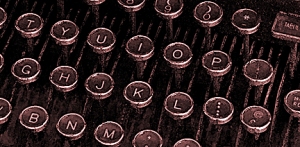
“It’s a really great genre for online reading,” says Grant Faulkner, editor of 100 Word Story, an online fiction magazine.  “Flash fiction can fit on a Facebook page.  It can fit into email newsletters.”sepia typewriter keys

Faulkner started the magazine about 17 months ago with his co-editor Lynn Mundell.   According to Duotrope.com, a website that matches writers with publishers, Faulkner’s magazine is one of hundreds of online and print magazines that publish flash fiction.   Boston Literary Magazine, edited by Robin Stratton, is another.  Stratton uses the terms drabbles and dribbles to refer to the 100- and 50- word stories, respectively, her magazine publishes.

A whole story in only 100 words?  “People do tell a complete story in 100 words,” says Stratton.  “I have some great writers and they can really do it.”

Of course 100 words do not necessarily define flash fiction.  Although many publications limit writers to 100 words, others stipulate different word counts.  There are online magazines that restrict writers to 66 words, 55 words and a few limit writers to a certain number of characters.

“There’s a number of different forms of flash fiction, ways that people have interpreted it,” says Faulkner, “360 words, 500 words or 1000 words, with prominent authors like Lydia Davis and Hemingway himself.  It has a really rich tradition and it’s becoming so popular now.”

One measure of that popularity is the proliferation of flash fiction courses at college and universities.  At Cambridge University the course is called, flash fiction: unlocking the writer within.  At Stanford University the class is, topics in intermediate fiction writing: flash fiction.

Another measure of flash fiction’s popularity is the number of submissions that Faulkner and Stratton receive.  Boston Literary Magazine receives hundreds of submissions every week, says Stratton, so many so that she recently had to stop accepting submissions for a couple of months.  Faulkner, who with Mundell operates 100 Word Story from the San Francisco Bay area, says he receives submissions from all over the United States and foreign countries.  Some of his submissions come from students in creative writing courses.

Flash fiction also is getting around in places other than publications.   Simon Jacobs, a 21-year-old self-described “young writer of no particular renown” edits the Safety Pin Review, a flash fiction journal featuring stories of 30 words or less.   In addition to touting a retweet by writer Margaret Atwood on his website, Jacobs wears flash fiction.

Individual stories from his journal are hand painted on bits of cloth and safety pinned to the back of his jacket.  He wears the story for a week.  Jacobs’ friends and followers also wear Safety Pin Review stories on their backs.

Perhaps the next place you’ll be exposed to this popular fiction genre will be at the check-out line of the supermarket…on the back of the guy in front of you.

——

Note on hyperlinks  –  Hyperlinks can be annoying.   In an upcoming installment  I will talk about how reading on the Internet is contributing to our shorter attention spans and generally making dunderheads out of us.   Hyperlinks are a convenient way to find more information about a topic, discover a new resource, etc., and of course they are an element of SEO, important to bloggers.  But hyperlinks in the middle of stories (posts if you must) invite the reader to abandon his train of thought–weak though it may be–to virtually dash off in another direction, possibly never to return.  I will therefore put all hyperlinks at the end of my stories and invite you to visit the sites and sources I cite.

100 Word Story  Flash Fiction magazine edited by Grant Faulkner

Boston Literary Magazine  Robin Stratton’s Beantown literary magazine

Safety Pin Review  A flash fiction journal with a different approach to the genre