Case Histories
Kate Atkinson
Little, Brown & Company, 400 pages
mass market paperback, $7.99
Kindle edition, $6.99
This British novel lives up to its name as the first chapters present–at length–three separate stories of death and disappearance, all of which happened years ago. It’s not until page 71 (Kindle version) that we meet Jackson Brodie, ex-cop turned PI specializing in finding people. When we meet him he’s tailing Nicola, a flight attendant whose husband suspects her of infidelity. Nicola’s story soon fades into the background and Brodie eventually takes on the three cases already introduced.
In the first case, a three-year-old disappears from a back yard campout and 34 years later is still missing. The second case involves a seriously overweight attorney who wants Brodie to find the person who knifed his daughter to death in his law office 10 years earlier. The third case presents a scene of a husband and wife spat that ends with an ax planted in hubby’s skull.
To solve the crimes, Atkinson doesn’t take us on a procedural trail, rather she explores participants’ souls and secrets while Brodie, appearing now and again, offers solace to members of the emotionally wounded cast and leisurely looks for clues. Brodie’s character links the cases together but it’s polar opposite sisters Julia and Amelia–looking for their lost sister Olivia–who seem to take center stage. Amelia is sexually repressed, Julia not so much, a condition not lost on Brodie. The sisters tell Brodie a tale of four sisters living with a cold, distant, frustrated mathematician father and ineffective mother. “Olivia was the only one she loved, although God knows she tried her best with the others.”
Of Brodie we learn that he’s divorced and angry at his ex-wife who has taken up with a professor. Brodie’s ex has custody of their daughter and is threatening to move to New Zealand and take Marlee with her.
“For the most part, the work he [Brodie] undertook now was either irksome or dull,” Atkinson tells us early on. 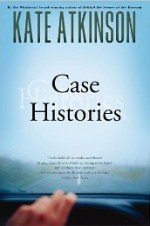 Fortunately, his Case Histories are more than irksome and far from dull although peppered with digressions. When the digressions have digressions it’s a challenge to follow the flow. Some of the digressions or other sections of the book could be short stories themselves. An early murder scene would make a dandy suspense short story.
The clients and their respective troubles are dreary and depressing with a capital D, weighing down Brodie and the reader. “Time did not heal—it merely rubbed at the wound, slowly and relentlessly.” This line, referring to the attorney’s grief over his daughter’s death, could apply to almost any of the characters in the book–including Brodie.
In the latter half of the novel, Brodie is regularly assaulted for reasons that remain unclear until the end. “All the bones in his skull seemed to have been rearranged like tectonic plates slipping and sliding against one another.”
Wounded in more ways than one, Brodie presses on. Ultimately he solves the poignant cases of lost loves–a subject he’s familiar with, details of which are saved for late in the book. The conclusion packs an emotional, touching punch, Brodie solves one of the cases with evidence that seems a little too convenient (but it was originally missed due to sloppy police work) and the end of the story could turn Brodie’s life around.
Video Notes In 2011, a series of three Jackson Brodie mysteries were aired on PBS and are now available on DVD. The series is called Case Histories though only the first episode is based on this novel. Jason Issacs, known to some viewers from the Harry Potter films, plays Brodie as a sympathetic, vulnerable yet rugged PI, giving him as much character as you’ll find in the novel. The video is, of necessity I suppose, faster moving than the book and ultimately satisfying.
 Nostalgia City Mysteries