Nostalgia City Mysteries

Mark S. Bacon

Category Archives: New mystery book

Agatha Christie and the history of the finger

5

If you think writing a novel is challenging, try coming up with a title. Especially one with a finger in it.

The title is critically important to a book, even more than the cover.  I often agonize over my decision. Many years ago, the publisher of my first book changed its title.

My new book, Dark Ride Deception, focuses on the theft of mind-bending technology for theme park dark rides (indoor attractions), but it includes the discovery of a severed finger. It’s not what the story is about. It’s just clue, a loose finger.  But I became enamored with using that in the title, and I remembered an Agatha Christie novel, The Moving Finger.

Christie wasn’t referring to an unattached digit like the one in my book. In fact, she took the title from the translation of Omar Khayyam verse:

“The Moving Finger writes: and, having writ,
Moves on: nor all thy Piety nor Wit
Shall lure it back to cancel half a Line,
Nor all thy Tears wash out a Word of it.”

The moving finger is vaguely referenced in her book, including a clue that anonymous threatening letters were typed by someone using one finger.

Immediately I thought about titling my book, The Unmoving Finger. That’s obviously the state of the finger in my book, and it would be an homage to that most famous mystery writer. But how many people would see the connection? The Moving Finger was published in 1942 and was not one of Christie’s most well-known works.

I thought my literary allusion might be wasted, so I aimed for something slightly less sophisticated. Getting the Finger was my first idea. Then I thought I could attract browsers’ attention even better with Giving the Finger.

References such as—to use the vernacular—flipping the bird, stretch farther back than Christie, even farther back than Omar Khayyam. According to Wikipedia, the middle finger gesture dates to ancient Greece and Rome. Also, there’s a story, probably apocryphal, that flipping the bird came into use at Battle of Agincourt between the British and French in 1415. The French supposedly planned to cut off the middle fingers of British archers so they couldn’t shoot.  When it didn’t happen, the British flipped their middle fingers in contempt.

Regardless of its occasionally obscene history, the finger is a popular word in mystery titles, often referring to, or pointing out, someone’s guilt. That was another of my great title ideas: Finger of Guilt. Author Paul Grossman beat me to it with his 2012 short story. The Amazon description of his Finger of Guilt says that star investigator Hans Fraksa claims the authorities have caught “Kinderfresser, the vicious child eater of Berlin.”

The finger is popular in titles for many, possibly less gruesome mystery/crime stories, including:

—  Finger Lickin’ Fifteen (2009) by Janet Evanovich
 — Finger Prints (2009) by Barbara Delinski
 — Fingerprint (2011) by Patricia Wentworth
— The Three Fingered Hand (2013) by Edda Brigitte Walsleben
— Fingered For Murder (2013) by Rodney Wilson, and
— The Finger: A Novel of Love & Amputation (2014) by David L. Robbins.
In addition to the publishing world, Hollywood keeps its finger on the pulse of its customers, and thus for decades a variety of crime and mystery films have used digital nomenclature in titles. Among the best known is Joseph L. Mankiewicz’s Five Fingers (1952). Based on a true story, James Mason stars as a British spy working for the Nazis and Michael Rennie as a British agent on his trail. Unrelated to the Mankiewicz film, Laurence Fishburne starred in a 2006 thriller called Five Fingers. In addition, a 1959 television series used the same name.

I ran my finger down a long list of similarly-titled films as I struggled to decide what to call my book. A sampling:

— The Beast with Five Fingers (1946) This spooky mystery/horror film takes place in an isolated Italian manor house and stars Robert Alda and Peter Lorre. Based on the trailer, the entire film happens at night.
— Fingers (1978) Harvey Keitel plays Jimmy “Fingers” Angelelli, a talented pianist who is also a part-time collector for his mob-connected father.
— Finger Man (1955) Frank Lovejoy goes undercover to finger a mobster.
— Finger of Guilt (1956) Richard Basehart, a happily married film executive, is stalked by a woman he says he does not know.
— Five Fingers of Death (1972) In the poster for this martial arts movie, a guy has hooked fingers that look like claws.

Probably the most famous movie of the batch was the 1964 film that forever cemented James Bond in the hearts of viewers: Goldfinger.

Finally, after research and rumination, I decided that, because it tells what the book is actually about, Dark Ride Deception would be my best title. Fingers crossed. 
Un-British viewpoint threatened to derail a new thriller

0
By Kevin G. Chapman
Guest Writer

A bowler hat nearly sunk my newest thriller. All British businessmen don’t wear them, I discovered.

No writer is perfect, and once I have completed a second (or third) draft of a book which I think is pretty well finished, I look for help in the form of beta readers, people who agree to read a manuscript and provide comments and suggestions. This is feedback you can only get from the perspective of different eyes.

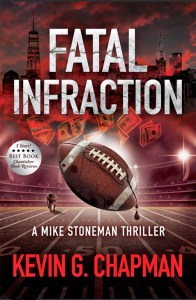
As I worked on book #4, Fatal Infraction, I had my usual batch of beta readers. But I also had a specific issue with which I needed help. I have a character in the story who is British – an investigator from a London insurance company sent to assess whether an NFL quarterback’s death occurred in connection with criminal activity (or was caused by the beneficiary – his team), which would void payment on a $20 million policy.

The character provided some comic relief because he was clueless about American football, which allowed the other characters to explain things to him – and by extension explain it to any of my readers who were similarly ignorant about football issues.

My British character seemed pretty simple at first. He would be very proper and buttoned-down. He would be a bit of a fish-out-of-water trailing along with my New York City homicide detectives. I pictured him as John Cleese in A Fish Called Wanda. I gave him a bowler hat and a series of pressed suits with matching silk handkerchiefs. He wipes the New York grime off chairs before he sits.

He was fun to write and was a hit with my early readers. But one of them, originally from London, flagged some issues. You see, my ear for British dialogue is based on watching movies, mostly comedies. It seemed that I had neglected to consider the language a posh English insurance inspector would actually use in dialogue. If I wanted to keep my UK readers from rolling their eyes at the stupid American author, I needed help.

Kevin G. Chapman
Author

I sent the manuscript out to three fellow authors in the UK and asked them to critique the dialogue – to let me know if anything sounded off. Boy, did I get back a lot of comments! It turns out that my character was a total caricature of an Englishman–and an offensive one at that. I got so much wrong, from his title to his wardrobe to his word usage. To an English reader, he was a joke – and not in a good way. It was an education.

As an example, there is a scene in Fatal Infraction where my detectives and my British inspector are watching security cam video as the suspected murderer puts a body in an elevator, then transfers it to a delivery truck and drives away.

It never occurred to me that an Englishman would never say elevator – he would say lift. And he wouldn’t say truck, he would call it a lorry. Small issues, perhaps, but it would drive an English reader crazy, and likely result in a negative impression of my writing (and a negative review).

Those little details can really make a difference and I was totally blind to them.  At one point I had my inspector putting milk in his cup of Earl Gray tea. Egad!  (Brits use milk in tea, of course, but not in Earl Grey.) There were a dozen (or more) such errors in my draft. Thankfully, I had time to fix them. (And when I narrated the audiobook, I had one UK listener tell me that my British accent did not make her laugh – which was high praise!)

The lesson here is that as much as I like to think I have a good ear for dialogue, my personal experience is limited—especially when it comes to British English.  So, admitting what you don’t know, and getting help, can keep you from being gobsmacked.

————-

Kevin G. Chapman is the award-winning author of the Mike Stoneman Thriller series. Perilous Gambit, the fifth book in the series, will be out this winter. Chapman is an employment lawyer for a major media company.  In Fatal Infraction, controversial quarterback Jimmy Rydell’s body is found naked—on New York’s Central Park carousel. Who killed him? How did he get there two days after he disappeared? Rydell’s football team just wants to move on, but NYPD homicide detectives must find answers to the bizarre facts of the case.

Have you read Lawrence Sanders’ McNally books?

1

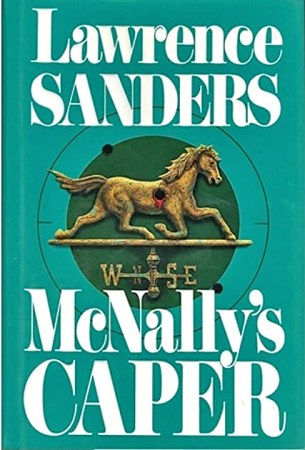
Review: McNally’s Caper  

Mystery and PI novels often feature clever, sympathetic detectives, people you like or at least respect. McNally’s Caper doesn’t. Unless Inspector Clouseau is your idea of a stylish sleuth.

These are harsh words from someone who has never read any other books by this Edgar-winning, million-selling, near-legendary author. Sanders became famous in 1970 with The Anderson Tapes, a crime novel quickly adapted to film. Before his death in 1998 he’d written more than two dozen crime and mystery novels including The First Deadly Sin.

Published in 1994, McNally’s Caper is one of seven books in the McNally series written by Sanders. Another author continued the series after Sanders’ death. The book stars Archy McNally, son of a wealthy Palm Beach, Fla., attorney. Archy dabbles in detection while he pampers himself with the good life in the Florida sun. There’s nothing wrong with dabbling. Many accomplished amateur detectives were dabblers. Jane Marple dabbled. Archy, however, is a different sort.

The book is written in first person so Archy runs the show, and show off he does. Okay, maybe the comparison to Inspector Clouseau is unfair. Archy is not a bumbling fool but a spoiled, smug, part-time PI. He spends an inordinate amount of time describing items in his colorful wardrobe—such as a peony-patterned sport jacket—and the gourmet meals his father’s chef serves up. (Thirtyish Archy lives at home with his parents.)

Archy suffers no inferiority complex, something he demonstrates repeatedly, and his personality so dominates the narrative that the mystery becomes secondary to the protagonist’s preening and his dashing about South Florida from his club to the crime scene and back again, dressed in an ever-changing palette. 

Archy’s style is difficult to separate from the author’s. Halfway through the book I realized exactly what bothered me. I was reminded of an admonition by Strunk and White in the classic writing manual, The Elements of Style.  Reminder #9 Do Not Affect a Breezy Manner:

The breezy style is often the work of an egocentric, the person who imagines that everything that comes to mind is of general interest and that uninhibited prose creates high spirits and carries the day.

That’s a description of Archy’s chronicle. I could only see him as a self-indulgent, foppish ne’er-do-well. Now possibly Sanders was having us on, and he intentionally created a self-indulgent, foppish ne’er-do-well. If so, McNally is a coherent character.  But he’s also insufferable.

Occasionally speaking directly to the reader is a part of Archy’s persona. 

To refresh your muzzy memory [Fern Bancroft] was the twitchy maid who had discovered the half-strangled Sylvia Forsythe…. Do try to pay attention; I hope no more reminders will be necessary.

Inexplicably, women can’t seem to stay away from him.  He beds a few attractive young ladies (one of whom was a suspect in the murder case) while making grandiose pledges of fidelity to his girlfriend Connie.

The plot of this McNally adventure is competently, if predictably, constructed. Archy is summoned by Griswold Forsythe II, a client of Archy’s father, to investigate the disappearance of various valuables from the Forsythe castle-like mansion. Forsythe II suspects someone in the household, servant or family member. The fun-house Forsythes are appropriately dysfunctional as are some of the staff.  When Forsythe II is murdered, his son, Forsythe III, the housekeeper, and a suspicious stable hand are among the suspects.

The denouement is logical and more or less satisfying but hardly worth the journey.

If you have a different opinion of Archy and his hijinks-laden exploits, please let me know.