Nostalgia City Mysteries

Mark S. Bacon

Tag Archives: Cornell Woolrich

Noir notes

1

Reprints from Centipede

Centipede Press of Lakewood, Colo. offers beautiful reprints of classic novels including many noir titles. Cornell Woolrich, Paul Cain and other authors are featured.   The Centipede website says,

“Crime fiction – in particular, the hard-boiled roman noir – has a special place in American literature. We offer a small but growing selection of classic crime novels from some of the most respected names in the genre, including David Goodis, Fredric Brown and Jim Thompson. All of our crime titles feature new introductions by prominent writers in the genre. And nearly every book has bonus features, such as original paperback cover art, one or two bonus short stories or essays, and other goodies.”

http://www.centipedepress.com/books.html


Good definition

Writing in the introduction to Night Has 1000 Eyes by Cornell Woolrich, Francis M. Nevins defines noir this way:

“…the kind of bleak, disillusioned study in the poetry of terror that flourished in American mystery fiction during the 1930s and 1940s and in American crime movies during the forties and fifties. The hallmarks of the noir style are fear, guilt and loneliness, breakdown and despair, sexual obsession and social corruption, a sense that the world is controlled by malignant forces preying on us, a rejection of happy endings and a preference for resolutions heavy with doom, but always redeemed by a breathtakingly vivid poetry of word (if the work was a novel or story) or image (if it was a movie).”


Cornell Woolrich video

Here’s a two and a half minute video tribute to Cornell Woolrich. The short program includes photos, covers of his books and posters from movies made from his novels. http://www.youtube.com/watch?v=5fgQCNGtB-M


Dark beginning

This book site, Biblioklept, has an article on neo noir novels and a video clip of the first scene of the Orson Welles-directed film, “Touch of Evil.” This is a noir beginning to match any film in the genre. http://biblioklept.org/2010/04/13/in-brief-new-and-not-so-new-noir-novels/


Who are the new noir writers?

Flavorwire lists what it says are “10 essential neo-noir authors.” http://flavorwire.com/388913/10-essential-neo-noir-authors/


Does this thriller sound too familiar? Woolrich review and cautionary tale

3
Night Has a Thousand Eyes
By George Hopley
Farrar & Rinehart, hardcover   1945
Kindle book $9.99  368 pages      

Warning: this book review contains a spoiler. No, I’m not going to give away the plot of this Cornell Woolrich thriller (originally published under a pen name), I’m going to alert you to a spoiler of sorts, written by the author himself. But I’m getting ahead of myself.

City homicide detective Tom Shawn is on his way home from work late one evening, walking along a river. As he approaches a bridge, he finds money, loose bills drifting in the breeze like leaves. As he turns across the bridge he finds a diamond ring, then a purse. This shadowy bridge setting and the scenes immediately following exemplify noir as well as anything written during the period and pull you into a twisted tale.

Det. Shawn follows the trail of money, jewelry and other purse contents until he sees high-heel shoes and finally a woman standing on the bridge parapet. With difficulty, he talks her out of jumping and she steps down and out of the shadows. He sees her clearly for the first time. “The arc light gave him a drenching flash of surprise, as it tore the darkness apart and she stepped through the rent into full view.”

He’s surprised to find that she’s a beautiful young woman, barely 20. She tells Shawn she’s afraid of the stars twinkling above, so they make their way to a deserted restaurant where Shawn persuades her to tell her story.Night has a Thousand Eyes
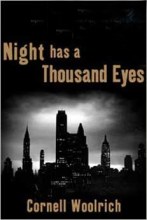
She begins rambling on about “darkness and fear and pain and doom and death.” As she begins to settle down and explain, she soon outlines the theme of the book saying, “…God permits us to look backward, but God has forbidden us to look forward. And if we do, we do so at our own risk.” Her lengthy tale involves her father, a wealthy investor, who has become involved with someone who seems to be able to predict the future.

The predictions bring a promise of riches and fears of death. The story of Jean Reid and her father draw Shawn into a race against time and against capricious, malevolent forces that ultimately mobilize the city detective squad.

Woolrich’s noir style and attention to details highlight the novel. An early chapter focusing on terror is as close to Poe as anything I’ve read by Woolrich and one of the later “police procedure” chapters demonstrates–at length–the finer points of tailing a suspect.

As I read, I was dragged firmly into the heroine’s malaise until it sounded familiar. Too familiar. I had not read the book before, yet after rounding the half-way point in the novel, I knew exactly what was going to happen. Was a book about clairvoyance imparting some of its mystical powers? Was Woolrich a plagiarist?

I found the answer–although I had a notion what the problem was–in the book’s introduction by Woolrich biographer, Francis M. Nevins. He explained the 1945 novel was based on a novella Woolrich had published eight years earlier.   And I read the novella, “Speak to Me of Death,” in a Woolrich collection some time before. Apparently this is not the only short story or novella that Woolrich turned into a novel.

So, my advice for readers who are just getting into Woolrich is to be cautious. Try several novels before you pick up a story collection. If you have already read Woolrich short stories, there’s still hope. Most Woolrich books available today come with introductions by Nevins or others. Scan the intro to see if the novel might be based on a short story you’ve read.

In a cursory online search, I could not find a list of his novels that come from his shorter works. In fact, some of the references in the first search engine list I encountered were to this blog.


This is part of an occasional series on the work of noir thriller writer Cornell Woolrich (1903-1968).


And don’t be fooled by the different names Woolrich used. As mentioned, this book was originally published under a pen name, George Hopley, Woolrich’s two middle names. He also published under the name William Irish.

Meanwhile, back at the Thousand Eyes, the race against time that Shawn and other detectives embark on is typical of Woolrich thrillers and as Nevins says in the introduction, imminent death and the ticking of the clock are as central to this book as any Woolrich novel. (The description is also true of the story, “Speak to Me of Death.” ) Incidentally, the novel title comes from two of the characters’ aversion to stars, i.e. a thousand eyes.

Perhaps due to the novel’s genesis, it has more than one climax. In fact, it has more ups and downs than many mysteries, making it something of a noir rollercoaster. You will cling tightly to the coaster’s safety bar waiting to see if there’s a final descent and crash.

——————-

Video note: Like most, if not all Woolrich novels, this was made into a movie.   Edward G. Robinson, Joan Lund and William Demarest star in the John Farrow-directed film. It retains the title of the novel. Although the first scene makes it look as if the film will follow the book closely, it doesn’t. At all. The movie is based on a relatively creative concept, but one that’s not in the book. Woolrich, rather than George Hopley, receives screen credit for the novel. Apparently he was not involved in the script.  Remarkably, the one-hour, 20-minute film is available on YouTube. http://www.youtube.com/watch?v=RH3bzUF862k

Woolrich novel is campy noir film

0

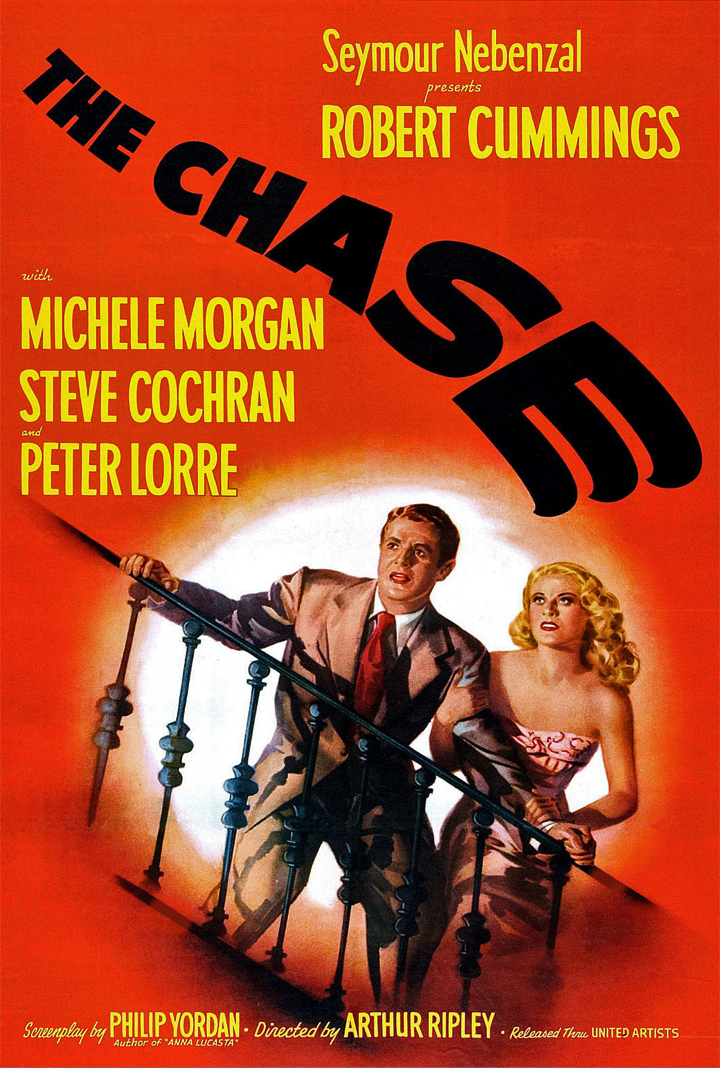
Read a novel, then see the movie and you’re often disappointed.  It’s difficult for a motion picture to recreate a detailed, nuanced book filled with subplots and many characters and do justice to the original story.  This has been true perhaps since the advent of motion pictures.  Case in point: the 1946 production of The Chase, based on the novel, The Black Path of Fear, by Cornell Woolrich. 

In this space I recently reviewed the Woolrich suspense novel, a story of lost love and of desperation in the dark alleys of post-World War II Havana.  Many of the author’s novels and short stories became radio, TV or motion picture dramas and I looked to see if the film version of Black Path, called The Chase, was available on Netflix.  No luck; probably one of those “B” crime movies that have faded away as the celluloid deteriorated. 

Not so.  Checking the cast on imdb.com, I noticed a link to the Internet Archive.  That site had a copy of the movie that could be streamed, so I let it play. 

It’s difficult to discuss details of the plot without spoiling either the book or the movie.  Things that take place in the middle of the book, via a flashback,  form the first scenes of the movie.   And an event in the middle of the movie, happens in the first few pages of the book.

Without getting into too many specifics, Chuck Scott, played by Bob Cummings, is an honest, destitute vet who finds a wallet on a Miami street and returns it to its owner, Eddie Roman, played by Steve Cochran.  It’s obvious that Roman is a ruthless, wealthy hood.  The first evidence of this is a scene when he knocks his manicurist to the floor when she displeases him. The second bit of evidence is that his assistant, aka henchman, is played by Peter Lorre.

Admiring, while mocking Scott’s honesty, Roman gives him a job as his chauffer.  Later, after an unnecessary scene designed to remind viewers—if they had fallen asleep in the previous five minutes—that Roman was really a nasty guy, Scott meets the glamorous Mrs. Lorna Roman (Michele Morgan). 

The majority of the book and a relatively small portion of the movie take place in dingy alleys and flop houses in Havana.  The noirish movie does a fairly good job reproducing the book’s skid-row atmosphere, with some dialog sounding as if it were taken directly from the novel.  But this part of the film story is about as close as it gets to the book.  New scenes and new characters are added and the film makes abrupt, substantial and sometimes laughable changes in the storyline. 

For example, in the book Roman urges Scott, as his chauffer, to drive fast.  In the movie, Roman doesn’t need to tell him to speed up.  He has an auxiliary accelerator and speedometer in the back seat.  The Chase movie To speed up, Roman floors it and tells Scott to steer carefully as they exceed 100 mph in a clichéd race with a locomotive to a railroad crossing.

Critics, including Woolrich biographer Francis Nevins, Jr., criticized screen writer Philip Yordan and director Arthur Ripley for twisting Woolrich’s story, ultimately changing the character and meaning of the novel’s original “chase.”  Roman, a relatively minor character in the book, is on screen too long and Cochran’s mobster portrayal is over the top.  Woolrich’s story is about a hapless guy on the run.  Yordan’s story is partly about a harassed gangster and partly about a guy who falls for a mobster’s wife. 

In  spite of numerous missteps in the script, Cummings comes across as a vulnerable everyman, as Woolrich portrayed him, and keeps the movie alive.  The actor had recently starred in Alfred Hitchcock’s Saboteur, and eight years later would become a protagonist in the Hitchcock classic, Dial M for Murder.   Lorre’s smarmy presence, of course, is a highlight of the film.  In some scenes he seems a bit bored, but that was perhaps part of his character.  Or this perception could be the fault of the grainy, scratchy print with occasional sprocket noise. 

The film is also available on DVD from Amazon but based on some of the online reviews, the DVD quality is no better than what’s available on the web stream.

Driven by a music score that rises and falls melodramatically—to almost humorous proportions at times—The Chase veers from campy gangster fare to classic film noir and back again several times.  If you see the movie before you read the book, it’s worth watching—and it’s so removed from the novel’s plot that the things you learn will not materially spoil the novel.