Nostalgia City Mysteries

Mark S. Bacon

Tag Archives: Cornell Woolrich

Follow Woolrich down this alley

0
The Black Path of Fear
by Cornell Woolrich
Ballantine Books  1982
160 pages
Price varies (available used only)

Bill Scott is honest, though obviously not the brightest guy in the world.  But he can’t help himself.  He’s in love.  Unfortunately Eve Roman, his new love, is married to a Miami mob boss.  But she loves Scott, too, so they runaway together—to Havana.

In the first few pages of Cornell Woolrich’s The Black Path of Fear, Eve is stabbed to death in a Cuban nightclub and the police blame Scott.  We get the backstory of how Scott and Mrs. Roman got together in a long flashback, but the majority of  the book—which hour-by-hour covers no more than a day and a half—describes Scott’s desperate attempts to find the murderer and clear himself.  His chances look dim.  He doesn’t speak Spanish, the police are combing the city for him, he knows no one in Havana and when it comes down to it, a big part of him doesn’t really care.  Eve is dead.

I’m working my way through Woolrich novels and short stories.  It’s a rewarding journey although Black Path is not his best.  My 1982 printing of the book (it was first published in 1944) reads almost as if it lacks a final edit.   The dialog occasionally sounds a bit off, Scott’s hat mysteriously appears in one scene—after he’d dropped it somewhere else—and he doesn’t use his love for the dead woman as an argument for his innocence.

That’s the bad news.  The good news is Woolrich takes a certainly unoriginal plot (though undoubtedly copied many times since) and builds it into a succession of nail-biting scenes in some of the most Black Path of Fearmemorably ugly, foreboding settings you can imagine.   In one scene Scott is escorted by police down a suffocatingly narrow  alley—too small to accommodate a car—in a run-down portion of Havana’s Chinatown.  The alley smelled “like asafetida and somebody burning feathers, and the lee side of a sewer.”  It was also dim.

It wasn’t of an even darkness; it was mottled darkness.  Every few yards or so an oil lamp or kerosene torch or a Chinese paper lantern, back within some doorway or some stall opening, would squirt out a puddle of light to relieve the gloom.  They were different colors, these smears, depending on the reflector they filtered through: orange and sulphur-green, and once even a sort of purple-red, were spewed around on the dirty walls like grape juice.

In another scene Scott is feeling his way in pitch darkness across a silent and seemingly empty skid-row office when something pricks his ear.  It’s a clever, suspenseful set-up that leads to a creative result.

Scott is similar to many Woolrich protagonists, an ordinary guy dumped into extraordinary circumstances and challenged to save someone else, himself, his sanity, or all three.  Emotions, not only of fear, but loneliness, disgust and hopelessness often drive his plots.

She had the look on her face of someone who has just been granted a quick glimpse down into the bottommost depths of hell from the top of the stairs.  And didn’t turn away quickly enough.

Woolrich was a noir master.  Although he’s not as well known as Raymond Chandler or Dashiell Hammett, according to his biographer Woolrich influenced not only the French Roman noir novels but the bleak Hollywood crime dramas, film noir.

To me, noir represents not only a grim, dark setting or plot, but a style of writing. And Woolrich’s style is unmistakable: “Silence fell, and we kicked it around between us for a while.”

Like the majority of Woolrich’s novels and short stories, Black Path was dramatized, in this case, many times: One of several radio versions starred Cary Grant (1946), the movie version (1946) starred Robert Cummings and Peter Lorre and a TV drama (1954) had James Arness as Scott.

Black Path was one of Woolrich’s “black” series in the 1940s, when the author was in his prime, cranking out so many thrilling novels that he released some under two pen names, William Irish and George Hopley.  Biographer Francis Nevins, Jr. called Woolrich the Poe of the Twentieth Century.  Black Path is an entertaining, compelling read, but stick with Woolrich titles for the whole dark ride through the 1940s.

‘As inconspicuous as a privy on the front lawn’ –a sample of Raymond Chandler

0

Raymond Chandler, creator of Philip Marlowe, one of the best-known detectives to ever make his way down a dark alley, was born in 1888.  His novels were made into movies and he wrote screenplays for acclaimed motion pictures including “Double Indemnity”–likely the best film of the noir period–and “Strangers on a Train.”

He moved to England with his mother at an early age, attended school there and later studied in Germany and France.  He became a naturalized British citizen and served in World War I.  After the war he was a journalist in London for a time then he moved back to the US, eventually living in southern California where he went to work as a bookkeeper for an oil company.  When he lost his job in 1932 he returned to writing and published his first crime story in 1933 in “The Black Mask,” a pulp journal that also published Cornell Woolrich and other up-and-coming detective writers.

For all his influence and prominence, his output was relatively modest compared to many other crime novelists, this owing to the fact he was in his 50s when he wrote his first novel, “The Big Sleep,” in 1939.   He wrote seven novels–almost all household names to mystery readers–and about two dozen short stories and novellas.

James Bond author Ian Fleming said that Chandler offered, “some of the finest dialogue written in any prose today.”

Recently I read one collection of his long short stories, “Trouble Is My Business.” Here’s a sample of his distinctive prose from that book:

From a description of an over-weight corpse:  “…his neck had as many folds as a concertina.”

A bright yellow convertible stood out from a row of other cars.  It was, “about as inconspicuous as a privy on the front lawn.”

Describing a suspicious character: “His voice had the quiet careful murmur of the cell block and the exercise yard.”Trouble is My Business

A brunette speaks to Marlowe in, “a voice as silky as a burnt crust of toast.”

Later he says, “She was looking at me now as if I had come to wash the windows, but at an inconvenient time.”

One of my favorite Chandler character sketches:  “She just stood and looked at me, a long, lean, hungry brunette, with rouged cheekbones, thick black hair parted in the middle, a mouth made for triple-decker sandwiches….”

And finally this observation from Marlowe, “Clammy hands and the people who own them make me sick.”

Sources/links:

http://www.biography.com/people/raymond-chandler-9244073

http://chandlersite.blogspot.com/

http://home.comcast.net/~mossrobert/

http://en.wikipedia.org/wiki/Raymond_Chandler

Cornell Woolrich’s 110th birthday; Dark stories, fast pacing

1

Master of the noir suspense story, Cornell Woolrich was born 110 years ago today.  Having created one of the greatest collections of suspense novels and short stories ever written, he died in 1968, depressed and wheelchair bound.

My Nov. 20 blog article summarized his work: He wrote more than 25 novels, numerous screen plays, dozens of short story collections and his stories and novels were the source for more than 125 movies and TV dramas.   His most well-known work, the short story, Rear Window, was the basis for a 1954 Alfred Hitchcock film of the same name.   Another short story, The Boy Cried Murder, was the basis for three movies: 1949, 1966 and 1984.

Sadly, many of his works are out of print and nearly forgotten.  The latest movie taken from a Woolrich novel was the 2001 production “Original Sin,” based on the novel, “Waltz Into Darkness.”   Many of his movies are unavailable on DVD although some occasionally show up at film festivals.

A few websites provide information on Woolrich and the availability of his movies and books.  A primary source is CornellWoolrich.com.  That’s the name of the site, but not its web address.  See the link below hosted by toast.net and avoid going to the site with his name on it. (It seems to originate somewhere in Asia.)

The toast.net site has a beautiful collection of vintage Woolrich book covers, posters for a sampling of his movies, a brief biography and links to buy a selection of his books on Amazon.  Some of the books are pricy, some not.  Most are used.  When looking for Woolrich novels and short story collections, take note that he also wrote under two pen names: George Hopley (his middle names) and William Irish.

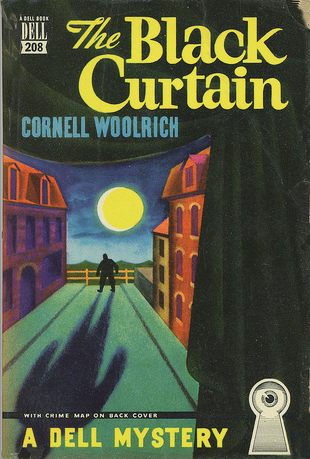
Cornell Woolrich was not a prose stylist with the sledgehammer metaphors of Raymond Chandler.  Black CurtainThe secret to Woolrich’s stories is the tension, the unanswered questions, the average guy who finds his world turned upside down and begins a headlong search for reality.

His “Black” novel series from the 1940s includes “The Black Alibi,” “The Bride Wore Black,” “The Black Path of Fear,” “The Black Angel” and “The Black Curtain.”   In the latter title, Frank Townsend suffers a nasty blow to the head when a portion of a building’s brick roof coping falls on him.  He dusts himself off and walks home only to find that his apartment is vacant and that his wife moved months before.   He manages to track down his wife who is overjoyed–and a little shocked–to see him because he’s been missing for three years.  The balance of the book puts a unique twist on an amnesia tale.  It’s a story of love and murder moving at a breakneck pace.

Woolrich’s stories, set in dark urban surroundings of the 1930s and 40s, hook you at the beginning and pull you into worlds that he imagined and you can live in for as long as the story lasts.

Links:

http://members.toast.net/woolrich/black.htm

Essentially a fan page, titled CornellWoolrich.com, this site has book covers, movie posters, Woolrich archive materials and more.

http://www.escape-suspense.com/cornell_woolrich/

Many of Woolrich’s stories became radio dramas.  This site has collection of the programs in audio format.   Cary Grant and Joseph Cotton are among the famous names giving voice to the suspense shows.

http://www.detnovel.com/Woolrich.html

This biography of Woolrich calls his work “endlessly descriptive.”

http://www.tv.com/people/cornell-woolrich/

Listing of episodes of TV dramas such as “Alfred Hitchcock Presents” featuring Woolrich stories.  The shows are available for download/viewing.

https://www.facebook.com/pages/Cornell-Woolrich/10491472214

The Woolrich page on Facebook has some colorful pictures of his book covers and 945 “likes,” but nothing’s been posted for nearly three years.