Nostalgia City Mysteries

Mark S. Bacon

Tag Archives: Rear Window

Woolrich: novels or short stories?

0

Last week, a reader, intrigued by my recent articles, asked if I could recommend a starting point for reading Cornell Woolrich. Although I’m just beginning to explore this little-known author myself, I have a suggestion or two.

The Woolrich works I’ve read thus far are best considered for the journey, rather than the destination. Each scene, each page drags you deeper into the protagonist’s miasma as he or she races against the clock or death or both. The idea that every scene in a detective story should be as important and as involving as the conclusion–when the mystery is solved–was a priority for Raymond Chandler. And in his novels, each chapter and each dark, gritty scene created more trouble for Philip Marlowe. Finding out whodunit was just the final step in a perilous journey. The same can be said for Woolrich.

Therefore, I recommend the 1941 novel, The Black Curtain, as an introduction to Woolrich. In it, Frank Townsend gets a bump on the head and suddenly three years of his life disappears–or reappears. He searches for his home and discovers his apartment is vacant and that his wife has moved out.   He finally finds her and she tells him she hasn’t seen him for three years.

So starts this different version of an amnesia story. After he’s been back with his wife a short time, Townsend discovers someone is following him. The more dangerous the pursuit becomes, the more Townsend realizes he must figure out what happened during the missing three years.

His struggle to discover his past leads him through a threatening world of suspicious looks and dead ends. The fast-paced story includes a case of murder and a decrepit, isolated mansion.The Dancing Detective
Like most roman noir novels, there isn’t exactly a Hollywood ending. The plot twists at the end leave some unanswered questions, but each step along the quick trip through Townsend’s cloudy world is worth the effort and then some.

To be picky, Woolrich uses terminology that refers to a semi-automatic pistol after he has already identified a gun as a revolver. The difference between the two types of handguns is significant in several ways and they look nothing alike.   But confusing revolvers for semi-autos is so common in mysteries that I didn’t even notice the first time through.

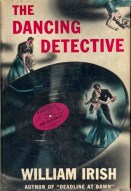
The other way to get an introduction to Woolrich is through one or more of his numerous short stories. The best one I’ve read is “The Dancing Detective” written under the pen name, William Irish. The protagonist’s first person voice is unique and so strong she captures you from the first paragraph. “Dancing Detective” appears in several mystery/suspense anthologies and in Woolrich collections. Of course for short stories it’s hard to beat “Rear Window,” Woolrich’s most famous creation. Even if you’ve seen the movie, the story is still compelling.

Discover Cornell Woolrich, author of “finest suspense novels ever written”

1

If you’re a mystery or suspense fan and have never heard of Cornell Woolrich, let me introduce you to one of the most prolific, stylistic and ingenious writers of the noir era.  His life was in some sense a tortured one containing successes and failures and dominated by his overbearing, wealthy mother.   Perhaps best known for his short story, Rear Window, which became an Alfred Hitchcock movie, Woolrich wrote more than 25 novels, numerous screen plays and dozens of short story collections.   According to IMDB.com Woolrich novels and short stories were used as the basis for more than 125 movies and TV dramas.

Woolrich died in 1968; few people attended his funeral.

Born in New York City in 1903, he struggled throughout the late 1920s and early 1930s writing short stories and (uncredited) screenplays for feature films in Hollywood.  While in California he married a producer’s daughter, but the marriage was short-lived and Woolrich returned to New York and his mother.  During the 1930s he wrote three novels and many short stories which appeared in pulp mystery magazines.  Gradually through his inventive plots and swift pacing he gained recognition and soon started cranking out superb noir suspense novels, many of which–if not all–became movies or TV dramas.

Eleven novels Woolrich published during the 1940s are “unsurpassable classics in the poetry of terror,” writes Francis M. Nevins, mystery writer, editor and Woolrich scholar.  Writing in the introduction to a Woolrich collection, Nevins says, “These [eleven] titles, all published between 1940 and 1948, make up the finest group of suspense novels ever written.”

The 1940s novels earned Woolrich a substantial living and a reputation on par with the best at work in noir.

Nevins says Woolrich’s world, “is a feverish place where the prevailing emotions are loneliness and fear and the prevailing action a race against time and death.”

“Woolrich’s fictional world is more discordant and threatening, and therefore perhaps more contemporary than that of either [Dashiell] Hammett or [Raymond] Chandler,” says Richard Rayner in the introduction to the 1988 Simon and Schuster collection, “Rear Window and Other Stories.”

Rear Window

This is one Woolrich collection that’s available, not the one mentioned in this article.

Rayner describes the situation one of Woolrich’s protagonists finds herself in as “something which might have been invented by Kafka on a bad day.”

The Woolrich novels are compelling but so are his short stories–his short crime tales from the 1930s are an excellent introduction to this author.  Originally this article was going to be a review of the “Rear Window” collection, but not only is it out of print, it seems to have disappeared.   In fact, many of Woolrich’s books are becoming rare.  Amazon and ebay prices for many used novels and story collections can reach more than $100 although many are available (used) in the $10 to $50 range.

There are other Woolrich collections called “Rear Window” available online but no listings I found provide the names of the stories included.  Thus, let me introduce you to a few of the master’s tales that you may find in more than one collection.

Woolrich stories often find average citizens stuck in impossible situations.  Such is the case in I Won’t Take a Minute (1940).  Protagonist Kenny is walking his fiancé home from work one evening and she has to stop at an apartment building to drop off a package that her boss asked her to deliver.  Kenny waits outside and she goes up in the elevator after telling him she won’t take more than a minute.  Of course she never returns, and the balance of the story is Kenny’s attempt to find her.

The Corpse Next Door (1937) is reminiscent of Poe’s Telltale Heart but Woolrich’s tormented main character is obsessed by the contents of a Murphy bed.  In, You’ll Never See Me Again (1939) , Ed Bliss has an argument with his wife who storms out supposedly heading for her mother’s house.   After two days Bliss is told that “Smiles” never made it to her mother’s and he runs afoul of the police in a frantic attempt to find his wife.  The 41-page story is filled with nighttime car chases, resourceful amateur sleuthing and repeated searches through a sinister house in the country.

In Dead on Her Feet (1935), rookie detective Smith is sent to investigate a nine-day old dance marathon and locate one Toodles McGuire, a 16-year-old whose mother has called police.   Detective Smitty, who flips over his jacket lapel to flash his badge, locates the missing girl but then finds himself investigating a murder.  His method of solving the case is macabre but effective.

Woolrich died at the age of 64 after many years of ill health and depression following the death of his mother.   According to Nevins, in a fragment of his papers found after his death Woolrich wrote, “I was only trying to cheat death.  I was only trying to surmount for a little while the darkness that all my life I surely knew was going to come rolling in on me some day and obliterate me.”