Nostalgia City Mysteries

Mark S. Bacon

Unknown's avatar

About mbaconauthor

Mystery writer and journalist; former newspaper police reporter.

New offerings in mystery and suspense

0

Louisiana intrigue

River of Secrets: A Wallace Hartman Mystery
Roger Johns
Minotaur Books  304 pages
August 2018
Kindle $14.99    Hardback $27.99

Herbert Marioneaux, a Louisiana state legislator with a reputation for changing his mind on sensitive issues, has been murdered. DNA evidence points directly at Eddie Pitkin, a social justice activist who furthers his causes by using confrontation and social media to make powerful, wealthy people very uncomfortable with their past.

Based on a long, well-documented history of conflict between Marioneaux and Pitkin, many in the court of public opinion are quick to call for Pitkin’s conviction. Wallace Hartman, the homicide detective assigned to the investigation, is also the childhood best friend of Pitkin’s half-brother so, in the eyes of some, her objectivity is in question from the beginning.
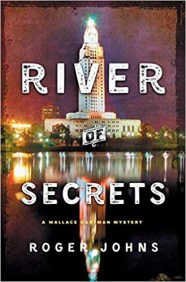
Wallace discovers an iffy alibi witness along with evidence of a troubled relationship between Marioneaux and his son that puts a cloud of suspicion over the son. Questions about the source of the DNA evidence begin to surface, Pitkin’s supporters and enemies square off in the street, and what began as an open and shut case becomes murky and politicized, sparking waves of violence across Baton Rouge.

And, at her time of greatest need, the prospect of sabotage from an unknown leaker within the police department forces Wallace to go it alone as she digs deep into the dark heart of the political establishment to untangle a web of old, disturbing secrets.

Roger Johns is the 2018 Georgia Author of the Year (Detective ▪ Mystery Category) for his debut novel, Dark River Rising, which has also been nominated for a Killer Nashville Reader’s Choice Award.  Along with four other crime fiction writers, he co-authors the MurderBooks blog at http://www.murder-books.com.  His website is www.rogerjohnsbooks.com.


Book giveaway

Enter the 10-copy giveaway of River of Secrets on Goodreads at: https://www.goodreads.com/book/show/36742974-river-of-secrets?from_search=true. The giveaway ends September 3.


Spine tinglers for middle schoolers

Scream and Scream Again
Mystery Writers of America
Harper Collins  416 pages
July 2018
Kindle $9.99  Hardback $12.59

A harrowing array of scary stories for middle-grade readers that all have one thing in common: each either begins or ends with a scream!

R.L. Stine, the godfather of Goosebumps, and some of the most popular authors today bring an unrivaled mastery of all things fearsome, frightening, and fantabulous to this terrifying anthology of all-new scary short stories.

Scream and Scream Again! is full of twists and turns, dark corners, and devilish revenge. Collected in conjunction with the Mystery Writers of America, this set includes works from New York Times bestselling authors telling tales of wicked ice-cream trucks, time-travelling heroes, witches and warlocks, and of course, haunted houses.

It includes twenty never-before-published scary stories from some of the most popular authors today—including Alison McMahan’s Kamikaze Iguanas.

Alison McMahan grew up in Spain.As an adult she trudged through the jungles of Honduras and Cambodia, through the favelas of Brazil and from race tracks to drag strips in the U.S. in search of footage for her documentaries. Her most recent film is Bare Hands and Wooden Limbs (2010) narrated by Sam Waterston.

Online book prices vary depending on the day you order and the bookstore or website.

Join Eddie Collins, actor-turned PI, on a back-lot tour with laughs, deaths and Hollywood tales

0
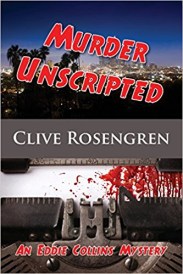
Murder Unscripted
Clive Rosengren
Coffee Town Press, Oct. 2017
240 pages
$5.95Kindle  $13.41 Trade paper

Passing by the famous Hollywood sign in the hills above tinsel town, Eddie Collins drives his Olds Cutlass though an uncharacteristically rainy Southern California afternoon.  “As the wipers droned back and forth like two annoying metronomes, I began to feel an emptiness oozing into me.”

He’s just learned that his ex-wife, movie actress Elaine Weddington, died in her trailer at Americana Pictures, a bottle of medicine lying next to her.  Accident or murder?  Although it’s been more than eight years since they split, as her career started to take off and Collins’ acting opportunities flattened out, he harbors good memories.

Weddington was in the middle of filming Flames of Desire and her death puts the movie’s future in jeopardy.  Since Americana Pictures had taken out a completion bond to protect the studio’s investment, the bond company hires a private investigator: Eddie Collins.

As his acting jobs became more hit or miss, he opened Collins Investigations to keep him “sane and solvent.”  Since he had worked for the bond company before, he is hired to look into the murder at the Flames of Desire set, regardless of his connection to Weddington.

Mixing crime and the movie biz, author Clive Rosengren starts his Eddie Collins mystery series with the Weddington case in Murder Unscripted.  Two other novels are in print, another is due out later this year and the author is working on book #5.  A Hollywood actor himself for many years, Rosengren knows his way around a movie set and treats readers to insider tidbits that make the story all the more realistic. 

After the rain, Rosengren says, “patches of water on the street…reflected the light like movie streets invariably do.  One never sees a dry street at night in the movies, even during the sweltering heat of the summer.”

A second murder complicates the case.  Collins is led all over the movie lot and outside to dingy bars as he questions, Sam Goldman, the studio head, along with movie stars, assistant directors and various hangers on, most with secrets that aren’t in the PI’s script.

The story progresses in a relaxed, comfortable style with Collins sharing reminiscences of films and actors of the past as he tries to establish the whereabouts of various suspects at the times the murders were committed.  Rosengren fills the book with Collins’ light-hearted observations that kept me smiling. 

“A lot of people stand around at a movie set.  The most popular place is the craft [catering] services tables.  Munchies abound, the bill of fare running the gamut from squeaky-clean to double-bypass.”

Collins is occasionally reminded of scenes from old movies.
“…I saw a bearded old man who looked like Walter Huston peering at me through the window.  His beady little eyes followed every move I made.  The spines of the cacti must be protecting his own Treasure of the Sierra Madre.  Since I didn’t look like either Bogie or Tim Holt, he probably couldn’t figure out who the hell I was.”

Collins is 41, unmarried, tall and describes himself in Hollywood terms as a cowboy type.  He’s not a full-time shamus and an early chapter shows him dressed in western duds, acting in a TV commercial for Chubby’s Chicken.  After Collins and a partner have gone through 17 on-camera takes, including biting into the chicken, we learn the necessity of an actor’s spit bag. 

The PI side of Collins’ life is complete with a secretary loaded with moxie, a small office and tiny attached apartment, a fondness for Jim Beam and beer chasers and an occasional eye for attractive women.

“She always dressed in richly colored blouses that gave the faint suggestion of a woman who didn’t mind staying out late.”

Rosengren has an enviable knack for phrasing:

“She looked as uncomfortable as Gidget sitting in the middle of an Elk’s convention.”

“As lonely as an Orange County Democrat” referring to one of California’s few right-wing enclaves.

Searching for a wandering dog, Collins observes: 

“There was no sign of Clyde, other than what he had deposited on the lawn.”

Collins has such a smooth, somehow familiar narrative voice—a term usually applied to authors, but I’m applying to the first person point of view character here—he sounds like someone you would like to know.

Just as life is a journey, not a destination, you read Rosengren to follow Collins’  intriguing, at times idiosyncratic—and wholly entertaining—life as he pokes around his Hollywood haunts in search of the truth.   Naturally, he ultimately solves the murders, but getting there is the most fun.  Then, of course,  you crave another case with Eddie.

——-

Book prices vary depending on the day and the bookstore or website.

Gosh, is profanity the right word?

0

Obscenity and profanity in mystery novels

Second of two parts

Swear words, no matter how the hell you look at them, can be a challenge for mystery writers.  Use foul language and you risk alienating or offending some readers.  Studiously avoid profanity and your dialog, especially in scenes of stress, could sound implausible.

But gosh darn, now that I’m two columns into this discussion, I discover—thanks to an article by novelist Elizabeth Sims in Writer’s Digest online—that I’ve been using an imprecise word for naughty language.  Even naughty is not quite right.

If you do a Google search for profanity in mystery novels, one of the first results you’ll see is a link to my 2016 column on this subject.  Regardless, I’m not trying to be the Internet’s expert on mystery writers’ swear words.  And before we go further, we need to define terms.

Profanity, as Sims points out, is the word frequently used to denote any objectionable word, but  profanity literally means words prohibited by religious doctrine. In other words, terms that are profane.  Generally this would cover Jesus Christ or God as epithets, but not necessarily f**k, etc.  The term blasphemy comes to mind.

Obscene and obscenity are better, more exact terms to describe most cuss words or coarse language.  Merriam-Webster’s Ninth New Collegiate Dictionary defines obscene this way: “disgusting to the senses: repulsive.” This could be an eye-of-the-beholder situation, depending on the words’ use, but let’s not split hairs.   Sims notes that obscene words often refer to sex.  The f-word is the most objectionable example, she says, and she concludes with understatement,  “Adding mother as a prefix ups the ante.”

Returning to the pros and cons of potentially offensive language, several authors (in addition to John Sandford, mentioned in my previous post) have written reasoned defenses of  “writers who dare to swear,” as mystery writer Christina Larmer puts it.

In a 2015 Huff Post article she wrote:

“Adding profanity is just a natural, fluid part of the writing process. I hear the character’s voice, I spew it out. Sometimes, when I read back through the copy and the language feels jarring or overdone, I remove it, just as I remove clichés and adjectives that don’t work. But I never remove it so my readers can feel more comfortable or content. This ain’t Chicken Soup for the Soul, guys.”

I agree.  Before I’d finished my first mystery, I decided I would use profanity, but  judiciously. Some of my characters are bad people.  They rob and kill for money. They don’t watch their language. They are not likely to say, “Excuse me sir but I believe we may have a slight disagreement. I feel your attitude does not reflect sincerity.”

In addition, when my ex-cop protagonist, Lyle Deming, faces a troublesome situation, I want him to be able to say, “Oh s**t.” Maybe that’s because it’s the way I often react to adversity.  Perhaps writers who don’t swear themselves, don’t have their characters tell anyone to f**k off.  As academics say, this is a sub-topic that warrants further study—but not here.

Then there’s the comparison of violence and inhuman acts vs. obscenities.  Larmer says she’s baffled by people who take exception to profanity but “make absolutely no mention of the fact that in one book, for instance, I leave someone in a dank basement to be devoured by rats.”

“Writers don’t use expletives out of laziness or the puerile desire to shock or because we mislaid the thesaurus,” writes Kathryn Schulz in the June 5, 2011 issue of the New York Review of Books.  “We use them because, sometimes, the four-letter word is the better word—indeed, the best one.”

In contrast, author Mark Henshaw says profanity is usually a sign of weak writing.   Writing on his website in June of 2014 he said,  “Profanity has become so common in modern media that I feel its inclusion almost never adds anything to an artistic work. Profanity has lost its shock value, rendering it useless as a literary device for character development or delivering emotional impact.”

It is common, and it can easily be overdone.  But still.

Some of the best arguments for not using profanity come from writers who penned novels when damn was considered foul language and four-letter words never found their way into polite print. Yet some writers still got the point across.

Here’s how Dashiell Hammett described one of Sam Spade’s explosions,  “He cursed Dundy for five minutes without break, cursed him obscenely, blasphemously, repetitiously in a harsh guttural voice.”

He didn’t even need to call him a bastard; we understood.

One of my favorite writers of the past is Ross Macdonald.  His novels spanned the period when profanity was unacceptable to the early 1970s when many of the restraints came off.

In his 1958 novel, The Doomsters, he used hell 22 times,  damn 13 times, Christ 4 times and Jesus twice.  No other profanity.  In his 1951, The Way Some People Die, he was a little more careful, but no less effective:

“Blaney and Sullivan escorted me to the car. In order to keep their minds occupied, I swore continuously without repeating myself. ”

To conclude, for now:  Mystery writers don’t use obscene language today for shock value as Henshaw indicates. We use it because, like it or not, it’s become a big part of life.  We use swear words occasionally for the same reason we don’t use “forsooth” or “verily.”  We want our dialog to be contemporary and realistic.

Editor’s note:  In the first article in this series I attempted to include a link to the profanity article I wrote two years ago.  Instead, the link simply brought the reader back to the latest article.  It’s been corrected online, but if you read the post in email and missed the earlier article link, here it is: https://baconsmysteries.com/?s=do+you+hate+f**

Links