Washington State mystery author Elena Hartwell is today’s guest writer.
Fiction writers have to juggle many elements, the plot, the characters, the narrator’s point of view, the characters’ motivation. And sometimes, just as important, where the story takes place. In real estate it’s called location, location, location.
One of the nicest compliments I ever got in a rejection letter read, “…the location is described so well it functions like another character.” It may seem strange that I’d remember—and love—a line from a rejection letter, but it was an incredibly important moment for me as a writer.
My writing life began as a playwright. I described atmosphere in my scripts, but not specific details, which was something I left up to set and lighting designers. Turning my hand to fiction, I had to learn the art of bringing a specific location alive on the page.
One Dead, Two to Go is about a private eye named Eddie Shoes. She lives in Bellingham, Washington, and I loved bringing our little corner of the country into the spotlight. As far as I know, there aren’t any other mystery series located in Bellingham. It’s a college town of 80,000 people not far from the Canadian border. Though I don’t live there, I’m not far away.
I live in North Bend—made famous by Twin Peaks, filmed in town and the surrounding area. My lovely little hamlet has a population of 6,000 people. We had a double murder/suicide about four years ago and another one eight years ago (which makes for a scary cycle), but homicides are relatively rare and it didn’t feel right to start killing off my neighbors in such a small community. I didn’t want anyone to label me the “JB Fletcher of Snoqualmie Valley.” Cabot Cove might have been a hotbed of murder and mayhem for Murder She Wrote, but it wasn’t the right choice for me.
I also didn’t want to set my series in Seattle, as that didn’t interest me as much as somewhere more unique to fiction. Washington State is filled with marvelous towns, from La Conner to Walla Walla and Omak to Yakima. I spent a lot of time thinking about where to place my private eye. First, I wanted a town less than a two-hour drive from home. Preferably not east of the Cascade Range, in case I needed to do “homework” there in the wintertime, when snow can close the pass. I didn’t want to “commit murder” in our capital city, so Olympia was out, and the towns on the Olympic Peninsula, though stunningly beautiful, involved a ferry ride and a similar problem population-wise to North Bend.
Bellingham felt perfect. I wanted to have a little bit of a small town feel, which it does, with enough population that everyone doesn’t know everyone else, which they don’t.
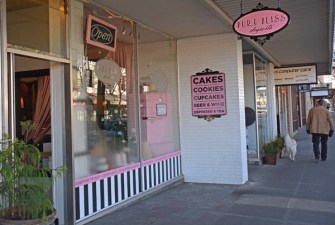
Bellingham eatery
Research is one of my favorite things. And location visits are one of my favorite aspects of research. I love to visit places to learn about the architecture, the scenery, the people, and the nightlife. I sprinkle real places such as Pure Bliss, a fabulous and very real dessert shop, with locations inspired by real places, throughout the books. When a crime takes place, I fabricate the setting. In those instances, I take characteristics of multiple places I’ve visited and mash them together into an unrecognizable, but still representative, locale from Bellingham.
Bellingham has a diverse population, spectacular scenery, and roughly one homicide a year. So it fit the bill to a “T.”
The first book, One Dead, Two to Go, takes place in December. The second book, Two Dead Are Better Than One, is set in March, and while it starts in Bellingham, it concludes in Spokane, Washington. That gave me roughly one homicide a year. Book three takes place with Eddie Shoes on vacation.
She deserves it. She worked hard in books one and two. But trouble follows her wherever she goes, and a simple vacation turns deadly.
I can’t wait to do my site visits for Three Dead, You’re Out; travel for work is one of the great perks of a writer’s life.
We might find book four located in a tropical paradise.
—————
Elena Hartwell was born in Bogota, Colombia, while her parents were in the Peace Corps. Her first word was “cuidado.” At the age of nine months, she told two men carrying a heavy table to be careful—in their native tongue. She’s been telling people what to do ever since. After almost twenty years in the theater, Elena turned her playwriting skills to novels. The result is her first book, One Dead, Two to Go. The Eddie Shoes Mystery Series debuted last month, to be followed by Two Dead Are Better Than One and Three Dead, You’re Out. Visit Hartwell at elenahartwell.com.

Elena Hartwell, author


 Nostalgia City Mysteries