Nostalgia City Mysteries

Mark S. Bacon

Unknown's avatar

About mbaconauthor

Mystery writer and journalist; former newspaper police reporter.

Award-winning 1930s private eye is ready for anything

0

Picture a PI’s office in the late 1930s. It’s a third-floor walk-up. There’s a bottle in the gumshoe’s bottom drawer and a .38 just out of sight. If you’re picturing a Sam Spade type character behind the desk, you’d be right—except for her gender.

Maggie Sullivan is a savvy, resourceful private detective who walks the mean streets and privileged neighborhoods of Dayton, Ohio. She’s the creation of author M. Ruth Myers and her latest caper, Don’t Dare a Dame, recently earned a Shamus award from the Private Eye Writers of America. It’s a dandy PI tale with enough surprises to keep you guessing and Myers’s steady hand to tell the engrossing story in rich, nuanced tones.

The story starts with two “old maids” hiring Sullivan to find out what happened to their father 25 years ago when he disappeared during a great Don't-Dare-a-Dameflood. Records were lost during the flood, many of the buildings in the area where the father disappeared are long gone and memories of the events are fading.
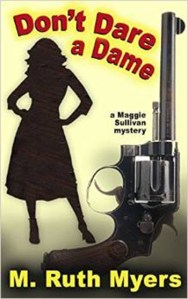
Sullivan tells her clients that chances of finding the truth are slim. But in the course of her investigation, Sullivan stirs up old animosities, turns up at the site of a suspicious death that might be related to the father’s disappearance and runs afoul of enough menacing figures to make you wonder what will happen to her in the next chapter.

Authentic depression-era descriptions and language put the reader firmly in the past. For example, her years-gone-by vocabulary includes snazzy and moxie. She describes a man as having “a leading-man moustache.” And Sullivan sometimes gets information by calling people and pretending to be someone she isn’t, a technique that an investigator could use easily in a time long before cell phones and caller ID.

Another feature of pre-war America (still around if you look under the glass ceiling) that Myers uses to good effect, is prejudice. Sullivan is a woman doing a man’s job. The quick detective usually handles slights and snide remarks with aplomb, sometimes letting the reader in on what she really thinks: He shot me a smile that was probably meant to suggest we gals were bright as buttons.

Humor also plays a part in the entertainment value of the book and to get Sullivan’s (Myers’s) gender equity points across.

As Sullivan questions a witness who is walking her dog, the person reveals startling information.

“That wrenched my attention away from her little dog, who was sniffing my ankle and some nearby bushes with equal enthusiasm.”

When someone tries to pick her up on the street, Sullivan has an answer:

“That’s some hat, sweetheart. Want to show it off over a beer and a sandwich?”

“Hey, thanks for the nice offer, but I’m looking for someone.”

“What’s he got that I haven’t?”

“V.D.,” I said.

He took off fast.

Myers handles little details that give a story depth and realism. For example, Sullivan wants to talk to a store clerk when the clerk’s boss is gone. Sullivan waits outside until the boss leaves, but rather than rush in, Sullivan tells us she waited ten minutes more in case he forgot something.

Sullivan enters the variety store and approaches the clerk who was interested in disclosing important facts, however, “[The clerk’s] eyes made a businesslike sweep of the store first, making sure everything was under control.”

I think these are little details make a story come alive. And Myer’s prose is alive with gritty dialog, unusual characters and the first-person emotions and thoughts that have us following Sullivan into every dark alley.  This gritty PI novel is part of the Maggie Sullivan series.  You’ll want to hunt for more.

As a parting shot, here are a few of my favorite noir lines:

“The pub in the bottom drawer of my desk was always open.”

“Because of my work I’d seen more than my share of ugliness that hid in life’s corners. Nonetheless, the Warren’s marital arrangement made my skin crawl.”

“The St. George Hotel fell somewhere between the Ritz and a roach farm. It inclined toward the latter.”

 

So what kind of mystery is it?

0

That’s a good question and one I hear frequently when I tell people I’ve published a mystery novel. Mysteries come in so many varieties that telling someone you wrote a mystery is only slightly more informative than saying you wrote a novel.

Yes, there are certain conventions–dead bodies, for example–that mysteries have in common, but the characters, style, language, length, point of view and many other elements differ from one mystery to another and especially from one sub-genre to another. And sub-genres are plentiful, from hard-boiled PI novels to cozy, drawing room mysteries.

But to answer the question of how to categorize Death in Nostalgia City, let me begin with Agatha Christie.   She was the first mystery author I read as I was growing up. I liked the short stories in Alfred Hitchcock’s and Ellery Queen’s mystery magazines, but the mystery novel was defined for me by Christie. I loved the complex puzzles, the multiplicity of clues and the usually large cast of characters. It made me think. But Miss Marple and Hercule Poirot almost always figured out whodunit before I did.

Gradually, however, my taste changed and I wanted a little more action, a little more suspense to keep me turning the pages. I read, not only to find out who were the bad guys, but to follow imperiled protagonists and see them safely through the story. In sum, I like Two-brochuresWeb-opti--5902mystery stories with intricate puzzles, twists and turns that challenge my cognitive abilities (such as they are), but also those with swift action and continuing threats to the detectives (amateur or professional) that appeal to my emotions.

Raymond Chandler, the famous detective novel writer–creator of Philip Marlowe–said he didn’t care for manor-house mysteries because the entire value of the book is contained in the final chapter, the denouement. He said each chapter of a mystery should be rewarding itself, without regard to whodunit.

One of the ways a mystery novel can do that, in addition to providing compelling characters, believable dialog and necessary action, is to include secondary mysteries and physical challenges for the protagonists. I like to read mysteries that continually throw obstacles in the way of the main characters so they must solve intervening questions before they can ultimately succeed.

To me then, the best mystery stories appeal to the head and to the heart.

That’s what I tried to do in Death in Nostalgia City. The book has 74 chapters in just more than 300 pages. Each chapter is not self-contained, but it includes something unique, something that puzzles, challenges, or startles the reader or keeps the plot moving quickly forward.  Anxiety ridden–some say crazy–ex-cop Lyle Deming and Kate Sorensen, the gutsy theme park PR director and former college basketball player, are constantly tested and their progress hindered by circumstances and the mystery they’re trying to solve. At times they’re also in physical jeopardy.

There’s always something happening.

———–

Next time: Checklist of elements for a good mystery

My love affair with Fat Ass Sammy Grick

9

by Patricia Stoltey, mystery writer and guest columnist

Thanks so much for letting me visit your website, Mark. You’ve given me a chance to tell your readers about a bittersweet experience I had while writing Dead Wrong.

When I recruited Fat Ass Sammy Grick to be the bad guy in my first standalone suspense novel, I had no idea I was going to become so attached I’d have a hard time letting him go.

Many women, of course, are drawn to bad boys. But we think of devilish risk-taking characters–handsome guys with bedroom eyes, a little dangerous but not bad enough to do us harm, except perhaps to our hearts.

Patricia Stoltey

Patricia Stoltey

Sammy? Sammy wasn’t handsome. He had an ugly glare and a temper that flared at whoever was handy when he made one of his frequent stupid mistakes. To tell the truth, he was a nasty good-for-very-little thug. And I loved him from the very beginning.

I decided to write a multiple point of view novel and give Sammy a voice. He seemed a worthy adversary for Lynnette, a woman already on the run. She had no idea she was about to tangle with such a despicable lowlife.

And I had no idea I was going to get so attached to Sammy. He was like my inner creep who needed to get out and flex his muscles. When I wrote Sammy’s chapters, I became one with Sammy.

Sammy cussed. He cussed a lot. I began to mumble his dialogue as I typed. It felt good.

Some of Sammy’s actions caused Lynnette to react in unpredictable ways. I liked seeing her handle those twists and turns, so I gave Sammy free rein.

When Sammy’s gangster boss interrupted the action and sent Sammy into a tailspin, I watched and marveled as the big lug figured out what to do next.

DeadWrongFront 264x408As the story progressed, I began asking, “What would Sammy do?”

Wait! Sammy was not supposed to be the main character of Dead Wrong.

The story was about Lynnette. I should have been asking, “What would Lynnette do?”

I finally came to my senses. I had fallen in love with the antagonist. It was time to break it off before I ended up with a manuscript worthy only of cross-cut shredding.

I wanted to let Sammy down easy, but with a temper like his, I had to be careful. I tiptoed around and hinted a little, then finally cut the ties. It was as hard on me as it was on him.

I’m well into a new manuscript now, and so far I’ve managed to control myself and my characters a little better. I hope this means less revising when the first draft is finished. I’d hate to go through another breakup like the one with Sammy. I still miss him. I miss him a lot.

~~~~~~

Patricia Stoltey is the author of two amateur sleuth mysteries from Five Star/Cengage, The Prairie Grass Murders and The Desert Hedge Murders, now available as ebooks. Dead Wrong (www.amazon.com/Dead-Wrong-Patricia-Stoltey/dp/1432829866/) was released by Five Star Nov. 19, 2014.

 Hyperlinks:

To learn more about Patricia and her novels, visit her website (http://patriciastoltey.com) and blog (http://patriciastoltey.blogspot.com/). She can also be found on Facebook (https://www.facebook.com/patricia.stoltey), Twitter (https://twitter.com/PStoltey), Google+   (https://plus.google.com/u/0/115494264819086899639/posts), and Goodreads (https://www.goodreads.com/author/show/1105939.Patricia_Stoltey).