Nostalgia City Mysteries

Mark S. Bacon

Category Archives: Cornell Woolrich

“Deadline at Dawn” uneven Woolrich adaptation

0

Deadline at Dawn, the movie version of the book of the same name by William Irish, is an uncertain attempt at film noir with Susan Hayward, Paul Lukas and Bill Williams dashing about city streets–that are obviously soundstages–looking for a murder suspect and running into seedy types portrayed by a cast of familiar character actors who provide the darkest scenes and the darkest dialog.

The first scene of the 1946 movie is promisingly noire as Marvin Miller, looking a little like Peter Lorre, knocks on the door of an apartment where a semi-intoxicated Edna Bartelli (Lola Lane) is asleep with a fly crawling across her face. When she finally staggers to the door she says, “Why, it’s Sleepy Parsons. Aren’t you dead?”

Susan Hayward and Paul Lukas

Susan Hayward and Paul Lukas

Later, Bartelli picks up innocent-looking sailor Alex Winkley (Williams) and brings him back to her apartment. Winkley drinks too much, passes out, and eventually discovers that Bartelli has been murdered. First, he thinks he may have done it after he blacked out but June Goth (Hayward), a taxi dancer he meets, persuades him that he could not have committed the crime.   Since people saw Winkley go up to the victim’s apartment, he knows he’ll be accused of the murder and he has to catch a bus in a few hours to get to his navy ship. Goth tells him that to clear himself he must look for clues and find out who did kill Edna Bartelli.

That’s the improbable setup. The goal: With little or nothing to go on, they must find the murderer before the 6 a.m. bus.

Hayward is obviously the brains of the duo and she pushes the plot along with beauty and spunk while Williams, in his sailor suit, is the gee-willikers, guileless young seaman. (He actually delivers a line, “Gee, look at the time.”) The first clues lead the young duo to dead ends, but soon they’re joined by a cab driver (Lukas) who decides to help the struggling couple. The cabbie finds some additional evidence the youngsters missed and that leads them to the meat of the film when they encounter suspects played by Jerome Cowan, Osa Massen and the ever-menacing Joseph Calleia. The latter trio have the truly noir scenes in rooms with stark lighting contrasting with deep shadows.

Joseph Calleia

Joseph Calleia

Later, in a private club, Lukas gets a noirish line, courtesy of screen writer Clifford Odets. “The city is full of men like that. Nerves and worry. Living on cigars and bicarbonate of soda. Wrung out by sleepless nights.” Shortly thereafter, the mood shifts in a corny good-cop, bad-cop scene in a police station.

Miller makes another appearance as well, and the ending, although a surprise, does not save the picture. Directed by Harold Clurman, the film bears little resemblance to the mystery novel written by Irish, a penname for noir master Cornell Woolrich. Had I not seen the movie right after reading the book I might not have noticed similarities which are pretty much limited to Goth’s occupation and the 6 a.m. deadline. Certainly not A-list noir but worth watching if you’re a Hayward fan or a fan of the character actors of that era.

The film is part of a series, Film Noir Classic Collection, on DVD and available from Netflix.
Christie, Woolrich, Grafton and 37 more cook up short stories of crime and puzzlement

0
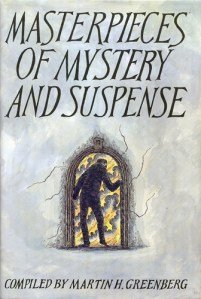
Masterpieces of Mystery and Suspense
Compiled by Martin H. Greenberg
International Collectors Library
651 pages  1988
See below for prices and availability

Note to regular readers: This review originally appeared in the mystery books review section of this website that has now been merged into the weekly blog page. The blog will continue to include new reviews of mystery/suspense books and movies now that past pages have been incorporated here.

It’s the late 1950s, Ginger works in a dime-a-dance joint in a rundown part of town, and someone is killing taxi dancers.

When two police detectives show up at the dance hall one night, Ginger falls for the taller one.  “…if I’d had any dreams left, he coulda moved right into them.”

The cops only know the killer’s favorite song, the kind of ring he has on one finger and the bizarre way he leaves the dancers’ bodies.  With nothing more to go on, they try a stake out.   Luckily, Ginger is one sharp cookie and a step ahead of the police.  Question is, will she be a step ahead of the serial killer?masterpieces of mystery

This carefully crafted tale, The Dancing Detective, is classic noir by Cornell Woolrich and it’s one of 40 short stories in Masterpieces of Mystery and Suspense, a must for the library of every mystery and short story lover.  The stories are short, 10-20 pages, but they clearly demonstrate how a skilled mystery/suspense writer can weave a tale, create characters with depth and have you guessing right up to the end–all in a tiny package.

Woolrich’s story is a good example, combing rich characters and dialog with a snappy plot.   Aspiring mystery writers: read this story.  See how Woolrich creates a thick, gloomy atmosphere and tells us so much about his characters through the way they talk in addition to what they talk about.  Woolrich, like many of the authors in the anthology, were or are known as much for novels as well as short stories.  And again, like other authors, many of Woolrich’s stories became movies.  One of his most famous was Hitchcock’s 1954 Rear Window.

I discovered this collection of gems in a used book store.   It can be found easily online.  See the note at the end of this review.

Writers from Poe to Sue Grafton and Lawrence Block are represented here.  Stories of suspense, mystery and those featuring hard boiled detectives fill the pages.  The collection’s anthologist, Martin Greenberg, introduces each story with a brief biographical sketch of the author and a few words about the selection.

The usual suspects are all here: Dorothy Sayers, Earl Stanley Gardner, Agatha Christie, Ngaio Marsh, P.D. James, Ross Macdonald, Ellery Queen, Dick Francis and John Dickson Carr.  A few writers not known for mysteries also provide fascinating stories.  Greenberg included Mark Twain, Ray Bradbury and Stephen King in the collection.

King’s Quitters, Inc. has Dick Morrison run into an old friend in an airport lounge, back when you could smoke in an airport.  The friend has quit the habit for good, he tells Morrison, with the help of an organization that guarantees its results.  In this suspenseful story, the method is the mystery and Morrison’s trials trying to stay off cigarettes can be most appreciated by ex-smokers.

In Arthur Conan Doyle’s The Copper Beeches, Holmes and Watson are approached by a  governess who lives in a country house and works for an eccentric gentleman.  She becomes fearful when her employers ask her to pose for them in certain ways.

Frederick Forsyth’s contribution is, There Are No Snakes In Ireland, a creepy tale of revenge set in Ireland and India.

Rex Stout offers, Help Wanted, Male.  One of the longest entries in the collection, the story begins with a man who has received an anonymous letter saying he is about to die.  He goes to Nero Wolfe for help.  Archie Goodwin figures the man would need to look elsewhere:

“In the years I had been living in Nero Wolfe’s house…I had heard him tell at least fifty scared people, of all conditions and ages, that if someone had determined to kill them and was going to be stubborn about it, he would probably succeed.”

The next day, of course, the man is killed and the police want to know what Wolfe and Goodwin know about it.

If you’re looking for a collection of new crime and detection stories, obviously this isn’t it.  The book is 25 years old and many of the stories are decades older than that.  If, however, you want to be challenged and entertained by some of the best mystery and suspense writers who ever pounded a typewriter, this is the collection for you, if you can find it.

Note on availability:  The book is out of print, but used copies are available from many online sellers.   I purchased my hardbound copy (International Collectors Library edition, listed above) from our local library’s  book store.   A check of listings for the book at Amazon and other online stores yielded the names of three other publishers and page lengths.  Most common was an edition from St. Martin’s Press at 672 pages.  Minotaur and Doubleday are also listed as the publisher on some sites.   Most available copies are paperback going for $1 or less; shipping charges vary.

Next week: In the late 1940s, film director Harold Clurman attempted to create a cinema version of Deadline at Dawn, the noir suspense novel by Cornell Woolrich (writing as William Irish and reviewed here last week). Susan Hayward headed a cast of many notable character actors of the period. Did Clurman succeed in creating a class ‘A’ roman noir? See my review next time.

‘Deadline at Dawn’ is nonstop noir

0

New York City has Bricky Coleman in its clutches. The small-town girl came to the city to become an actress, but it didn’t work out. Now she’s a dime-a-dance girl living in a dingy walk-up, bereft of spirit and hope. One evening she dances with Quinn Williams, another small-town transplant with equally dismal prospects. Somehow Quinn manages to erode Bricky’s layers of cynicism and suspicion and they become friends and allies in solving a dangerous puzzle.

Like most Cornell Woolrich novels, this one is dark and fast moving. The entire book occupies only a few early morning hours. Getting around a burglary and solving a murder stand in the way of the two young protagonists’ escape from their dismal lives.   An early coincidence and one or two later plot twists require a significant suspension of disbelief, but you sign on quickly because the dark corners of the city and its malevolent denizens are easily accepted as Woolrich draws you and his young protagonists into a race against the clock.Deadline at Dawn

The atmosphere is thick. Bricky looks up a dark street.   “Three anemic light-pools widely spaced down its seemingly endless length did nothing to dilute the gloom; they only pointed it up by giving contrast.” For Bricky, the main enemy isn’t a lurking murderer, it’s the city itself. It wants to possess her and grind her down. The young protagonist’s unhuman nemesis is similar to a lead character’s unnatural fear of the stars in the sky in Woolrich’s Night Has a Thousand Eyes. Merciless, mysterious forces conspiring to thwart success is a common Woolrich theme.

Looking for a murderer so they can put a regrettable event in Quinn’s life behind them and escape to small-town paradise, the two split up and dash about the city at night. In back-and-forth chapters each amateur sleuth thinks he or she is on the right trail, but of course there are complications, dead ends and unexpected dangers. We move quickly from Quinn’s perilous encounter with a stranger who he follows around the city, to Bricky’s capture by a pair she thinks did the murder.

I have a copy of the first printing of the “Tower Books Motion Picture” edition illustrated with photos of the 1946 film based—very loosely—on the book. Instead of chapter numbers or titles, there are faces of a clock, and each chapter heading has the hands moving closer to the 6 a.m. deadline Quinn and Bricky are racing toward. That’s when they hope to catch the interstate bus and escape New York City. The photos from the movie don’t match the novel. Quinn is represented as a sailor—in uniform—by Bill Williams.

Note that Deadline at Dawn is an example of Woolrich’s practice of recycling scenes, characters and events from short stories into novels. The first scene of Bricky’s dance hall dysphoria is similar to the beginning of a short story, Dancing Detective, that focuses on another cynical taxi dancer with moxie. After this first scene, however, the novel departs completely from the short story.

Like so many Woolrich stories, Deadline at Dawn looks at the many faces of fear. “And the man who says he’s never been afraid is a liar,” Woolrich says. Later he tells us, “Fear rots the faculties.” Unlike the movie version, the novel maintains the pessimism, the dread and the eerie notion of noir.

Deadline at Dawn
Cornell Woolrich (writing as William Irish)
The World Publishing Co. 1946
219 pages

Now available in a new edition from Centipede Press
300 pages   $14.52

Hyperlinks:

Centipede Press
Deadline at Dawn (film)