You’ve seen the movie, now read the book. Or vice versa. What’s the difference? Guest writer Nina Sadowsky, author of the new novel, JUST FALL, explains how her career in film and television prepared her to write the book. Her background taught her what she knew, what she didn’t and where she was willing to take risks.
Writing for film and writing a novel are profoundly different experiences, while also markedly the same. For both, one needs a compelling story, strong characters, a powerful conflict, and ultimately, a satisfying resolution.
But the two disciplines also differ in significant ways. One is the collaborative nature of creating filmed content, versus the relative solitude of writing a novel.
Writing a novel is a far more solitary process than writing for media. Not entirely, of course, as every writer gets input from his or her inner circle of readers as well as their editor. But making filmed content is entirely 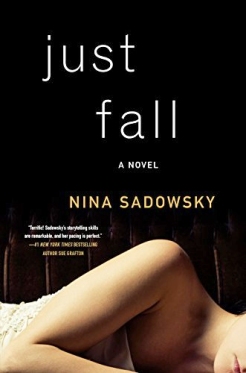 dependent on collaboration. From the very beginning of the process, the writer is asked to factor in the perspectives and opinions of agents, producers and development executives, and as the project moves forward into production, the clamorous voices of a director, production designer, cinematographer, costume designer, composer, editor, sound team, etc., all chime in to the narrative mix.
When functioning at its ideal, this is the beauty of filmmaking—all these creative people working toward the same goal can be quite glorious. On the other hand, the writer knows she or he not only has to satisfy many other voices in the script development process, but also knows that the finished script is not an end in itself, but only a road map for others to follow and contribute to in pursuit to the ultimate product.
Another crucial difference between writing a novel and writing for film and TV is the import and impact of structure.
Film and TV scripts usually conform to fairly rigid, codified rules of structure. There are good reasons for these structures, based on a combination of creative, psychological and business factors. Studies have shown that audiences instinctively respond to the rhythm of a three-act structure in film, for example. And advertising-driven TV requires breaks to allow for ads (while creating cliffhangers to encourage viewers to return to the show after the commercial breaks).
If one is writing for film, one is trained to think about three acts. Act One is exposition, the set up of the world and characters, establishment of the protagonist’s objective, and the event that propels the protagonist’s story forward. Act Two is devoted to “rising action,” in which the protagonist is thwarted in achieving his or her goal and acquires the skills needed to achieve their desire. Act Three is the story’s climax and resolution. While there are proponents of a five-act structure, most films contain three. In television, a writer may find herself conforming to different structural requirements at every network.
There are certainly guidelines that apply to novel structure, but when I embarked on my first novel, JUST FALL, I decided I wanted to throw all structural rules out the window. I began the book as a purely personal exercise. I’d felt my love of writing eroding and wanted to reinvigorate that love outside of an “assignment” or a job. My sole goal when I started the book was to finish it, so I figured why not play with structure?
The book is told in alternating chapters, entitled NOW and THEN. The NOW chapters are all linear.

Author Nina Sadowsky
The THEN chapters are completely non-linear and are juxtaposed against the NOW chapters in order to best illuminate character. This worked creatively on multiple levels, (not the least of which is that we meet my protagonist, Ellie Larrabee, in an island hotel room with a dead man in her bed. The structure I settled on allowed me to then contrast that grisly opening with Ellie on the day of her wedding, a moment filled with hope, beauty, optimism and cultural and social resonance).
I wrote the forward story and the backstories separately and then index carded every chapter. For months we had to eat dinner around the cards that lived in constant rotation on our dining room table. I threw structure out the window and then created a new one all my own. It was liberating and thrilling to do so.
My take away? There are always rules to writing. And also rules just waiting to be broken.
————
Nina Sadowsky has worked in film and television in various capacities virtually her entire career. She was a producer, an executive, a director, a film professor and a screenwriter. As a result, she looked at creating filmed content from a variety of perspectives. Those experiences were part of her preparation for writing her first novel, JUST FALL.
She is the author of many original screenplays and adaptations, was executive producer for “The Wedding Planner,” starring Jennifer Lopez and Matthew McConaughey, and produced “Desert Saints,” an independent film starring Kiefer Sutherland. She has worked for The Walt Disney Company, Working Title Films, Signpost Films and Lifetime Television. She is a member of the adjunct faculty at USC’s School of Cinematic Arts.
 strange phone calls. But, he says, “It can’t have anything to do with Gil [the missing employee]. It can’t have anything to do with me.”
 Nostalgia City Mysteries