Here’s a chapter from my latest Nostalgia City mystery, Dark Ride Deception.
Max Maxwell, the CEO of Nostalgia City theme park, is holding an emergency meeting to discuss park secrets for new ride technology that have been stolen. The scientist who created the technology is missing.
Chapter 7
Maxwell roamed the conference room. Lyle often thought of him as an energetic, impulsive teenager housed in a short, wiry 75-year-old body. Or was he older? “When did we discover the hack?” Max said looking at Owings.
The senior vice president sounded matter-of-fact: “We went through the logs and access files Friday,” he said. “It’s routine. But after we found discrepancies, we reviewed all our systems over the weekend and we knew something was wrong.”
“Sort of an understatement, isn’t it Kerry?” Maxwell said. “We’ve spent millions on these plans already. Millions. We created programs, engineering studies, simulations, drawings, models. Yup, something is wrong all right.”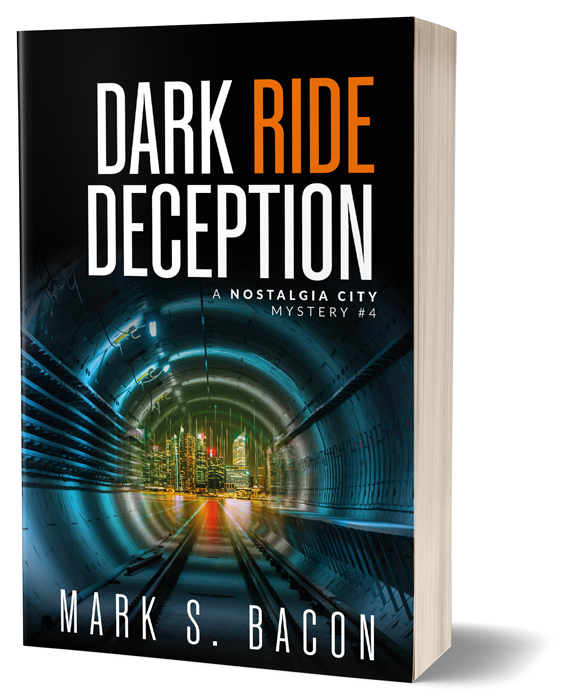
Lyle glanced at the woman seated across from him. Somewhere in her early forties, she parted her hair in the middle and it hung ragged on the sides. Jane Fonda in the ’70s? Or maybe something new. She sighed and lowered her head as Maxwell spoke. Was she to blame?
“I contacted the FBI,” Howard said. “Agents who specialize in economic espionage and computer crimes are coming out.”
“That’s fine Howard, but we have other problems too, don’t we? Our patents.”
Max looked at a man in a dark tailored suit and charcoal tie who could either be the park’s chief legal counsel or a mortician. “Usually we file for protection as we go along,” the man said, “and we have done this for some initial elements of the project we’re calling PDE. But there are issues.
“First, artificial intelligence is a complex and evolving element of the law. It’s not like seeking a patent for a new type of can opener. And software is challenging, too. If it’s tied to particular apparatuses or engineering creations, obtaining a patent is not as problematic. But we’re not just seeking a patent for a specific ride, are we?”
“So much for the jargon,” Max said. “Are you saying you couldn’t do it?”
“Of course not, but work on the project slowed for a while, and then it received a top priority. The innovation continued yet the legal department did not receive enough information, things we need to draft patent applications.”
“Max,” Owings said, “as you know, PDE was not finished. We were getting close, but there are a few challenges left and now we’re—”
“So you’re both saying our ass is hanging out. Our secrets are gone, and we don’t even have the ideas patented.” Max’s stare, always penetrating, seemed to bore through Owings and the attorney. Lyle wondered if they might soon be looking for work. Continue Reading →
 The Marijuana Murders (as in the previous Nostalgia City books) I use the names of real songs (and artists) to establish the decades-past setting of the park and sometimes to contribute to the mood of individual scenes or chapters.
 and the sound of Ravi Shankar’s sitar.
 The books ends with the light touch of Olivia Newton-John singing “Magic.” The song sat at #1 on Billboard’s pop chart for four weeks in 1980. Other groups and artists mentioned include The Village People, Barry White, The Monkees, The Who, Captain and Tennille, and The Animals.
  Deming. His wife divorced him then he was dismissed from the police department, in part for his erratic behavior. Anxiety is his default setting. Desperate for a stress-free job that has nothing to do with consoling murder victims’ families, Lyle becomes a cab driver—in a theme park.
 Nostalgia City Mysteries