Nostalgia City Mysteries

Mark S. Bacon

Category Archives: film noir

Help, I have writer’s block; do I need surgery?

1

I’m writing this with two fingers.  How embarrassing.

Having begun my writing career as a newspaper reporter, I’ve never worried about writer’s block.  Composing on the fly is built-in.  You can’t tell a city editor, “Look, I need to wait for inspiration.”

Indeed, I’ve always joked that the only true form of writer’s block is a broken arm.

No, I don’t have a broken arm, just a painful one.  Typing even for a short time makes my right forearm feel as if someone has put out a cigarette on it. Make that a cigar.  Physical therapy didn’t help. The heavy-duty prescription anti-inflammatories only moderate the pain.  I see an orthopedist in two days.

In the meantime, I’m going to recycle an article I posted here years ago.  Cornell Woolrich is of my favorite noir authors and this novel from1944 is one of his best.

In this Woolrich classic the city is only one of the enemies

Deadline at Dawn
Cornell Woolrich (writing as William Irish)
American Mystery Classics (Penzler Publishers), June 2022
288 pages
Kindle 6.99   Trade paperback $11.95

New York City has Bricky Coleman in its clutches. The small-town girl came to the city to become an actress, but it didn’t work out. Now she’s a dime-a-dance girl living in a dingy walk-up, bereft of spirit and hope. One evening she dances with Quinn Williams, another small-town transplant with equally dismal prospects. Somehow Quinn manages to erode Bricky’s layers of cynicism and suspicion. They become friends and allies in solving a dangerous puzzle.

Like most Cornell Woolrich novels, 1944’s Deadline at Dawn is dark and fast moving. The entire book occupies only a few early morning hours. Getting around a burglary and solving a murder stand in the way of the two young protagonists’ escape from their dismal lives.   An early coincidence and one or two later plot twists require a significant suspension of disbelief, but you sign on quickly because the dark corners of the city and its malevolent denizens are easily accepted as Woolrich draws you and his young protagonists into a race against the clock.

The atmosphere is thick. Bricky looks up a dark street.   “Three anemic light-pools widely spaced down its seemingly endless length did nothing to dilute the gloom; they only pointed it up by giving contrast.”

For Bricky, the main enemy isn’t a lurking murderer, it’s the city itself. It wants to possess her and grind her down. The young protagonist’s nemesis is similar to a lead character’s unnatural fear of stars in the sky in Woolrich’s Night Has a Thousand Eyes. Merciless, mysterious forces conspiring to thwart success is a common Woolrich theme.

Looking for a murderer so they can put a regrettable event in Quinn’s life behind them and escape to small-town paradise, the two split up and dash about the city at night. In back-and-forth chapters each amateur sleuth thinks he or she is on the right trail, but of course there are complications, dead ends and unexpected dangers. We move quickly from Quinn’s perilous encounter with a stranger who he follows around the city, to Bricky’s capture by a pair she thinks did the murder.

I have a copy of the first printing of the “Tower Books Motion Picture” edition illustrated with photos of the 1946 film based—very loosely—on the book. Instead of chapter numbers or titles, there are faces of a clock, and each chapter heading has the hands moving closer to the 6 a.m. deadline Quinn and Bricky are racing toward. That’s when they hope to catch the interstate bus and escape New York City.

Note that Deadline at Dawn is an example of Woolrich’s practice of recycling scenes, characters and events from short stories into novels. The first scene of Bricky’s dance hall dysphoria is similar to the beginning of a short story, Dancing Detective, that focuses on another cynical taxi dancer with moxie. After this first scene, however, the novel departs completely from the short story.

Like so many Woolrich stories, Deadline at Dawn looks at the many faces of fear. “And the man who says he’s never been afraid is a liar,” Woolrich writes. Later he tells us, “Fear rots the faculties.” Unlike the movie version, the novel maintains the pessimism, the dread and the eerie notion of noir. It’s a gem.
Mitchum and Greer keep you guessing

0
Noir movie review

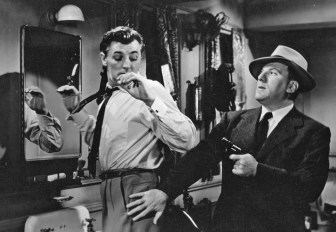
William Bendix crashes into Robert Mitchum’s steamship stateroom flashing a gun.

“Where is it Halliday?”

William Bendix gets the drop on Robert Mitchum in the first seconds of The Big Steal.

We don’t know who or what Bendix is looking for, but Mitchum slugs him, steals his ID identifying him as Army Capt. Vincent Blake and scrams down the gangplank into the bustling dockside crowd of Veracruz, Mexico.

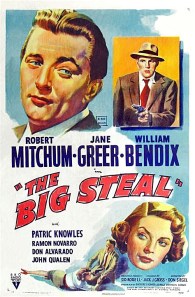
Action in the 1949 film The Big Steal starts quickly and confusingly. Halliday maneuvers his way through the crowd berating souvenir hawkers and other locals for getting in his way.

Another debarking passenger, Joan Graham (Jane Greer), chastises him for throwing his weight around, especially when he doesn’t speak Spanish.

   “It’s men like you who make people like them contemptuous of tourists. Doesn’t it occur to you they don’t understand?”

When Halliday is blocked by an insistent peddler selling a caged parrot, he relents and buys the bird. With an insistent squawk, it swears in Spanish.  He hands the bird to Graham and ducks out when he sees Blake at the top of the gangway.

Graham gets a cab to a hotel where she surprises Jim Fiske (Patrick Knowles) in his room.  After he proposed to her in the States, he ran off with $2,000 she loaned him. Now that she’s caught up with him, she wants it back.

When he tries to sweet talk her, she slaps him in the face and demands the money. She wants the money, not him.

“Come on.  Hand it over. I was saving that money for my trousseau,” she says in mock distress.

“Oh, darling, your pride’s been hurt because I went away without a word.”

“And stayed away without several.”

“Will you try to believe there was a reason, a good one.”

“Sure, you wanted to surprise me. By not coming back.”

Continue Reading →

Murder solved by 1950 version of CSI

1
Movie review: Mystery Street

Blonde floozy Vivian Heldon (Jan Sterling) is talking on the wall phone in the shadowy hallway of her Boston boarding house. Her landlady, appropriately named Mrs. Smerrling, (Elsa Lanchester) makes no pretense about listening in while she prods Heldon for back rent.

“Please honey,” Heldon says into the phone’s wall-mounted mouthpiece. “You gotta. I’m in a jam.”

Soon, Heldon gets herself killed but not before she involves a nervous expectant father she meets in a bar. So far, the 1950 film is a predictable B movie with noir overtones and few expected surprises.  

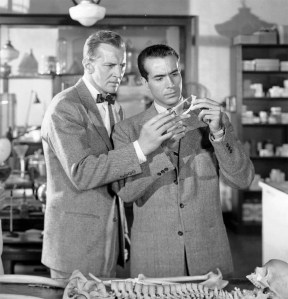
But Heldon’s murder is not discovered until six months later when a beachcomber finds her skeleton protruding from the sand on Cape Cod. The lack of fingerprints, or other obvious means of identifying the skeleton, lead the detective lieutenant on the case to enlist the aid of Dr. McAdoo (Bruce Bennett), a professor from the Department of Legal Medicine at Harvard Medical School. The film then develops into a CSI story 50 years before the Las Vegas crime lab TV series.

Some of the tools and techniques used by Dr. McAdoo seem a bit rudimentary today, but the scientific angles and the solid acting of Lanchester and the detective on the case—Richardo Montalban—make this relatively unknown film worth watching.

A New York Times review when the movie debuted said, “There is more science than mystery in this cops-versus-killer number, but it is an adventure which, despite a low budget, is not low in taste or its attention to technical detail, backgrounds and plausibility.”

This is not the say it’s perfect. It’s slow moving at times, and in one scene a murder suspect escapes a little too easily from a police chase thus extending the suspense.  For the most part, director John Sturges, who would go on to acclaim directing pictures such as The Magnificent Seven and the classic noir Bad Day at Black Rock, elevates the film past its meager budget.  The movie was shot on location in Boston and Cape Cod.

From the get-go, Montalban, as Lt. Peter Moralas, suspects the unidentified skeleton is a murder victim.  He delivers a box of bones, including the skull, to Dr. McAdoo who provides a surprising amount of information on the victim.

As Moralas looks at the bones arranged on a gurney, Dr. McAdoo tells him the skeleton was a woman.

“I suppose you’d like to know her age,” McAdoo says.

“I’d also like to know her height, weight, occupation and the name and phone number of the person who murdered her.”

“I think I can answer all those questions, except the last,” the confident doctor says.

Armed with that information and McAdoo’s guess at when the woman died–based on plants found with the body–Moralas reviews missing persons’ files for women in their early 20s. Thanks to further lab work at Harvard, Moralas thinks he’s found the victim’s name. That leads him to Mrs. Smerrling’s and the intrigue begins. You can see wheel’s turning in the landlady’s head as she remembers details about the victim’s circumstances.

Ricardo Montalban, left, and Bruce Bennett examine a human bone at the Harvard School of Legal Medicine.

With the victim identified as Vivian Heldon, Moralas locates some of her possessions, including a little black book.  The names and phone numbers of 86 men in the book give Moralas a long list of suspects, but he needs one more bit of scientific evidence to prove the death was murder. Again, Dr. McAdoo provides the necessary information, and Moralas is left to hunt for motives. 

Meanwhile, the gin-tippling Mrs. Smerrling, who admits she wasn’t actually married, dreams of ways to cash in on her tenant’s demise.

Although she rates only fourth billing, Lanchester is perfect as the scheming landlady. You know from her expression that she’s only looking out for herself.

Montalban, a star in Mexican films before he was signed by MGM in the late 1940s, was one of a few Hispanic leading men in US films at the time. According to Wikipedia, he was the first Hispanic actor to appear on the cover of Life Magazine. The Times review of Mystery Street said Montalban was “natural and unassuming.” He handled the detective role well and never reminded you of his later, most popular TV role. (You know the one.) 

Late in the investigation, Dr. McAdoo has another tidbit for Moralas, but the detective has already discovered it for himself.

 “Professors work with their heads,” he tells McAddo. “Cops work with their feet.