Nostalgia City Mysteries

Mark S. Bacon

Category Archives: Kindle

Dark ride, dark story: the mystery begins

0

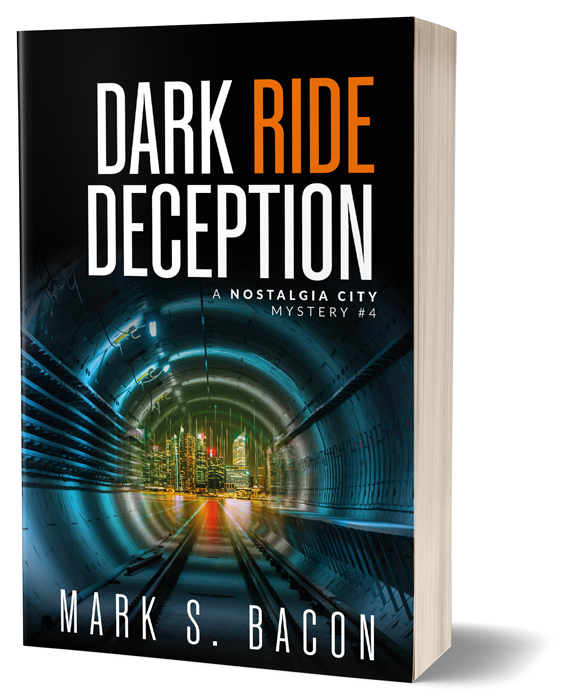
Here’s a chapter from my latest Nostalgia City mystery, Dark Ride Deception.

Max Maxwell, the CEO of Nostalgia City theme park, is holding an emergency meeting to discuss park secrets for new ride technology that have been stolen. The scientist who created the technology is missing.    

Chapter 7

     Maxwell roamed the conference room. Lyle often thought of him as an energetic, impulsive teenager housed in a short, wiry 75-year-old body. Or was he older? “When did we discover the hack?” Max said looking at Owings.

The senior vice president sounded matter-of-fact: “We went through the logs and access files Friday,” he said. “It’s routine. But after we found discrepancies, we reviewed all our systems over the weekend and we knew something was wrong.”

“Sort of an understatement, isn’t it Kerry?” Maxwell said. “We’ve spent millions on these plans already. Millions. We created programs, engineering studies, simulations, drawings, models. Yup, something is wrong all right.”
Lyle glanced at the woman seated across from him. Somewhere in her early forties, she parted her hair in the middle and it hung ragged on the sides. Jane Fonda in the ’70s? Or maybe something new. She sighed and lowered her head as Maxwell spoke. Was she to blame?

“I contacted the FBI,” Howard said. “Agents who specialize in economic espionage and computer crimes are coming out.”

“That’s fine Howard, but we have other problems too, don’t we? Our patents.”

Max looked at a man in a dark tailored suit and charcoal tie who could either be the park’s chief legal counsel or a mortician. “Usually we file for protection as we go along,” the man said, “and we have done this for some initial elements of the project we’re calling PDE. But there are issues.

“First, artificial intelligence is a complex and evolving element of the law. It’s not like seeking a patent for a new type of can opener. And software is challenging, too. If it’s tied to particular apparatuses or engineering creations, obtaining a patent is not as problematic. But we’re not just seeking a patent for a specific ride, are we?”

“So much for the jargon,” Max said. “Are you saying you couldn’t do it?”

“Of course not, but work on the project slowed for a while, and then it received a top priority. The innovation continued yet the legal department did not receive enough information, things we need to draft patent applications.”

“Max,” Owings said, “as you know, PDE was not finished. We were getting close, but there are a few challenges left and now we’re—”

“So you’re both saying our ass is hanging out. Our secrets are gone, and we don’t even have the ideas patented.” Max’s stare, always penetrating, seemed to bore through Owings and the attorney. Lyle wondered if they might soon be looking for work. Continue Reading →

Dark Ride Deception: Where did it come from?

1

I love theme parks.  Four years ago I took my grown daughters to Disney World. I’d talked about such a trip for years, but we finally managed to find a time when both of them could take off work, bid their spouses adieu for a few days and jet off to Florida with old dad.

A trip of a lifetime for me and the best part, of course, was just spending time with the two of them. In addition, we were treated to all the distracting attractions the Magic Kingdom, Epcot and Disney’s Hollywood can throw at you. We plummeted in an out-of-control elevator, rocketed into space and strolled along a peaceful lake while munching food from different countries.   

Although I grew up in Southern California, I live out of state and had not visited Disney’s Anaheim park in more than 20 years, so the Florida adventure was all the more exciting.  As my girls and I enjoyed each park, we saw construction, evidence that engineers were working to expand ways to tickle your fancy or even subvert your senses.

Over the past two generations, people have grown up watching movies and TV shows featuring increasingly sophisticated special effects.  CGI, for computer generated imagery, is a part of our twenty-first century vocabulary.  Theme park rides had to follow suit, and in fact, the latest additions to Disney World are Star Wars extravaganzas.

So I thought that Nostalgia City theme park, the setting for my mystery series, needed a technological boost.  More special effects, more imaginative rides for guests.

Tom Wyrick, a computer genius in Nostalgia City’s Park Attractions Development Department, created just what the park—and my new book, Dark Ride Deception—needed. His Perception Deception Effect (PDE) surpasses anything at any theme park. 

Just how mind-bending is his invention?  Here’s how a Nostalgia City engineer describes it in the book: “Unless someone invents a transporter room or time machine, once it’s finished, PDE could be the vanguard for more than a decade…it’s a technological game-changer.”

Unfortunately, before Wyrick’s plans could be finished, he disappears, along with his secrets. Is he dead? On the run? Trying to sell his creation to the highest bidder?

Dark Ride Deception is now available for pre-order at the places linked below.   The book will be released Sept. 30.

Amazon US

Barnes and Noble

iBooks

Kobo

Amazon UK

Amazon Canada

Heard any good books lately?

0

How a talented author/actor gives his PI a voice

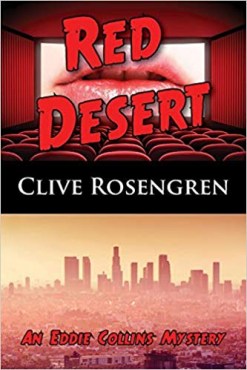
Red Desert (An Eddie Collins Mystery Book 2)
Clive Rosengren
Coffeetown Press   186 pages
September 2017
Audible $17.95, Kindle $5.95, Trade paperback $14.95

I have mixed feelings about audio books.  They’re convenient when you’re driving, flying, walking or doing something that precludes reading.  The spoken words of a good actor or announcer can carry you away as when you’re engrossed in the printed page.  But sometimes the narrators sound as if they were auditioning for a Broadway play and their intonations  overwhelm the story.   This can be especially true of male actors doing female voices and vice versa. 

Another popular option for recorded books is to have the author read.  Authors know where their stories should speed up or slow down and which words require emphasis.  But authors are not trained announcers.  Some do a remarkably good job, others, not so much.  I recently listened to a book read by an acclaimed Australian author.  His heavy down-under accent added authenticity, but you had to listen closely to catch every word.

Now comes Clive Rosengren and his Eddie Collins mysteries.  Rosengren is a retired actor, Ed Wood, Soapdish, Seinfeld, Cheers, who writes PI novels.  A good combination for an audio book?  I read his debut mystery, Murder Unscripted.  It’s original, engaging and funny. So when I faced a long driving trip and thought about listening to a book, I downloaded Rosengren’s Red Desert from Audible. 

Rosengren reads the book like he wrote it. Because he did.  The first person point of view, common for PI novels, lets Rosengren talk directly to us as Collins.  He often sounds as if he’s telling us a story, recounting something that’s happening to him, rather than reading a book.  He renders the voices of the various other characters with enough difference in tone or pitch—and sometimes speed—so you know someone else is talking, but he doesn’t try to do impressions like Dana Carvey. 

Actors reading others’ books can recognize an argument or fight scene and ramp up the vocal tension, but an author who wrote the novel should have a good idea of how to voice the entire book.  Thus, for example, Rosengren is able to deliver Collins’ offhand observations and asides with the appropriate deadpan or enthusiasm depending on the circumstances.

And the story here is not beside the point.  It is the point.  Collins is a part-time Hollywood actor who started a detective agency to supplement his on-again, off-again show business career.

When someone breaks into the home of Mike Ford, a top leading man, Ford’s girlfriend is killed—drowned in the swimming pool—and the actor’s Oscar is stolen.  Ford taps his friend Collins for help.   He shows Collins anonymous, threatening letters he’s received and says he has no idea who might have sent them or what the motive might have been.

Collins’ investigation takes him from his Hollywood office to Venice, Calif., a seaside suburb developed after the turn of the 20th century with canals serving as residential streets. 

As Collins tries to determine why Ford is being hounded, a fire is burning in the San Gabriel mountains above LA. “A bloodshot moon hovered over Burbank. The air was pungent with the smell of smoke from fires burning in the hills—a yearly occurrence.”  The fire casts a pall over the city and colors the story.

During his investigation, Collins comes across Reggie, an old Army buddy who is now homeless and on the street.  Collins tries to rehabilitate his old friend, offering him a job doing surveillance on the case.  Reggie turns out to be one of the strong, likable support characters in the book in addition to Collins’ secretary, Mavis.

One thread in the case leads Collins to Red Desert, a film Ford directed and starred in.  Ford recalls his remake of a 1949 pot boiler as a “tough shoot: heat, script problems, casting snafus, you name it.”   

When Reggie is watching Ford’s home, a photograph he snaps turns into a valuable clue. Then things get hot. As the fire rages in the mountains, an assault and a kidnapping raise the stakes and Collins and Reggie find themselves on the defensive.

The affable Collins with his porkpie hat and lack of tech savvy is a PI with a sense of humor and a knowledge of Hollywood he uses to good effect.  Following him and Reggie around is a kick, and Red Desert is a delight that will keep you entertained from start to finish.

—————

Clive Rosengren was an actor for nearly 40 years, 18 of them pounding many of the same streets as does his fictional actor/PI Eddie Collins.  Rosengren is a multiple Shamus Award nominee by the Private Eye Writers of America.  His other Eddie Collins books include Murder Unscripted, Martini Shot and Velvet on a Tuesday Afternoon. He lives in southern Oregon.