Nostalgia City Mysteries

Mark S. Bacon

Category Archives: Mystery novels

Help! How can I get this thing started?

0

Where, or, more accurately, how do you start a mystery novel? Certainly not with the familiar dark and stormy night, the now-cliched beginning penned 185 years ago by British novelist Edward Bulwer-Lytton.

When I began writing my mystery/suspense novel, Death in Nostalgia City, I, like many authors, agonized over the first few sentences.   I tried one thing then another, turning to help from writer friends and finally settling on something, only to change it just before I submitted the manuscript to my publisher.

First sentences are something like first impressions when you meet someone. Writers try to impress, intrigue, attract. They have a story to tell and they want to begin in a way that encourages you to dig in.

With a mystery, there’s usually murder involved.  Why not start with that?

“Hale knew, before he had been in Brighton three hours, that they meant to murder him.” That’s how Graham Greene began his dark 1938 tale, Brighton Rock.

Jonathan Kellerman used a short murder sentence to begin The Murder Book, his 2002 novel.  “The day I got the murder book, I was still thinking about Paris.”Web-opti-gun-&-paper-Es5914

Short, declarative sentences. That gets your attention and draws you into the story. Here’s another one, this from noir master James M. Caine. He began his famous, The Postman Always Rings Twice this way: “They threw me off the hay truck about noon.”

First sentences can do more than just attract attention. Some writers and editors suggest first sentences that introduce readers to a character, a setting, or both.

An excellent example of this comes from an acclaimed, but non-mystery writer, William Kennedy. The beginning of his 1983 Ironweed accomplishes these objectives with grace.

     Riding up the winding road of Saint Agnes Cemetery in the back of the rattling old truck, Francis Phelan became aware that the dead, more than the living, settled down in neighborhoods.

Elmore Leonard famously said, “Never open a book with weather,” but that’s exactly what many authors have done, including Raymond Chandler in The Big Sleep:

     It was about eleven o’clock in the morning, mid-October, with the sun not shining and a look of hard wet rain in the clearness of the foothills.

Mystery writer Lilian Jackson Braun used weather to begin The Cat Who Tailed a Thief in 1997: “It was a strange winter in Moose County, 400 miles north of everywhere.”

Leonard himself was no slouch with beginnings. In his 1988 novel, Freaky Deaky, he introduces his character and setting in one sentence that has you immediately engrossed in the story:

     Chris Manowski’s last day on the job, two in the afternoon, two hours to go, he got a call to dispose of a bomb.

I don’t think there’s a single formula for a successful beginning, but I think some of the most successful have discernible objectives.

In his 2007 mystery, Tahoe Silence, writer Todd Borg uses his first sentence not only to introduce the title character of the book, but also to draw us into the world of the autistic girl named Silence.

     At the first roar of the motorcycles on Pioneer Trail, Silence shut her eyes, tucked her sketchbook under her left arm and plugged her ears with her fingers, turning inward, retreating to her safe zone.

The objective of just attracting your attention quickly can be effective and a quotation can be an easy way to do it.

      “Not a bad-looking burglar,” he said. “I don’t suppose you’d happen to have a decent alibi?”

That’s the way Lawrence Block began, The Burglar Who Traded Ted Williams (1994), using a light touch. Humor can put a reader in a good mood to continue reading and, at the same time, introduce a setting or character as Nevada Barr does in the beginning of 2001’s Blood Lure:

     With the exception of a nine-week-old Australian shepherd puppy, sniffing and whining as if he’d discovered a treasure chest and sought a way inside, everyone was politely pretending Anna didn’t stink.

I wanted to use a light touch to introduce my story and my protagonist, ex-cop Lyle Deming. The book’s retro focus comes from the theme park, Nostalgia City, a re-creation of an entire small town from the late 1960s / early 1970s. Lyle, who drives a cab in the park, fits in due, in part, to his view of modernity. I wanted to show this, and introduce him in the beginning.

     Whose idea was it to replace the chrome knobs and push buttons on car radios with touch screens?   Lyle didn’t have a clue.
Award-winning 1930s private eye is ready for anything

0

Picture a PI’s office in the late 1930s. It’s a third-floor walk-up. There’s a bottle in the gumshoe’s bottom drawer and a .38 just out of sight. If you’re picturing a Sam Spade type character behind the desk, you’d be right—except for her gender.

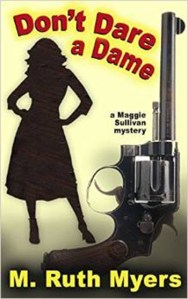
Maggie Sullivan is a savvy, resourceful private detective who walks the mean streets and privileged neighborhoods of Dayton, Ohio. She’s the creation of author M. Ruth Myers and her latest caper, Don’t Dare a Dame, recently earned a Shamus award from the Private Eye Writers of America. It’s a dandy PI tale with enough surprises to keep you guessing and Myers’s steady hand to tell the engrossing story in rich, nuanced tones.

The story starts with two “old maids” hiring Sullivan to find out what happened to their father 25 years ago when he disappeared during a great Don't-Dare-a-Dameflood. Records were lost during the flood, many of the buildings in the area where the father disappeared are long gone and memories of the events are fading.

Sullivan tells her clients that chances of finding the truth are slim. But in the course of her investigation, Sullivan stirs up old animosities, turns up at the site of a suspicious death that might be related to the father’s disappearance and runs afoul of enough menacing figures to make you wonder what will happen to her in the next chapter.

Authentic depression-era descriptions and language put the reader firmly in the past. For example, her years-gone-by vocabulary includes snazzy and moxie. She describes a man as having “a leading-man moustache.” And Sullivan sometimes gets information by calling people and pretending to be someone she isn’t, a technique that an investigator could use easily in a time long before cell phones and caller ID.

Another feature of pre-war America (still around if you look under the glass ceiling) that Myers uses to good effect, is prejudice. Sullivan is a woman doing a man’s job. The quick detective usually handles slights and snide remarks with aplomb, sometimes letting the reader in on what she really thinks: He shot me a smile that was probably meant to suggest we gals were bright as buttons.

Humor also plays a part in the entertainment value of the book and to get Sullivan’s (Myers’s) gender equity points across.

As Sullivan questions a witness who is walking her dog, the person reveals startling information.

“That wrenched my attention away from her little dog, who was sniffing my ankle and some nearby bushes with equal enthusiasm.”

When someone tries to pick her up on the street, Sullivan has an answer:

“That’s some hat, sweetheart. Want to show it off over a beer and a sandwich?”

“Hey, thanks for the nice offer, but I’m looking for someone.”

“What’s he got that I haven’t?”

“V.D.,” I said.

He took off fast.

Myers handles little details that give a story depth and realism. For example, Sullivan wants to talk to a store clerk when the clerk’s boss is gone. Sullivan waits outside until the boss leaves, but rather than rush in, Sullivan tells us she waited ten minutes more in case he forgot something.

Sullivan enters the variety store and approaches the clerk who was interested in disclosing important facts, however, “[The clerk’s] eyes made a businesslike sweep of the store first, making sure everything was under control.”

I think these are little details make a story come alive. And Myer’s prose is alive with gritty dialog, unusual characters and the first-person emotions and thoughts that have us following Sullivan into every dark alley.  This gritty PI novel is part of the Maggie Sullivan series.  You’ll want to hunt for more.

As a parting shot, here are a few of my favorite noir lines:

“The pub in the bottom drawer of my desk was always open.”

“Because of my work I’d seen more than my share of ugliness that hid in life’s corners. Nonetheless, the Warren’s marital arrangement made my skin crawl.”

“The St. George Hotel fell somewhere between the Ritz and a roach farm. It inclined toward the latter.”


Your vote: what are the best noir films?

2

Anyone who thinks of Fred MacMurray mainly as the jovial father on the 1960s TV series My Three Sons or the screwball title character in The Absent Minded Professor film, doesn’t know the real Fred MacMurray.

The real Fred MacMurray was the scheming insurance salesman and murderer in the 1944 film, Double Indemnity. In so many scenes, from his first meeting with Barbara Stanwyck, the wife of the man he would ultimately kill for his life insurance money, to a secret rendezvous in a grocery store, MacMurray has an undisguised devious look in his eyes yet a guarded set to his lips.Crow-gun-Web-opt-w-title619 (It’s a different, yet equally dishonest countenance he bore as Lt. Tom Keefer in The Caine Mutinty.)

Combine MacMurray’s persuasive performance with his two assured costars, Stanwyck and Edward G. Robinson plus a script by Billy Wilder and Raymond Chandler, based on the James M. Cain novel, and you have what many people think is the finest noir film ever made.

What do you think?

What are the best noir films?

Mystery fiction scholar Francis M. Nevins defines noir as, “…the kind of bleak, disillusioned study in the poetry of terror that flourished in American mystery fiction during the 1930s and 1940s and in American crime movies during the forties and fifties. The hallmarks of the noir style are fear, guilt and loneliness, breakdown and despair…” Although many noir films were stylish, often featuring avant garde cinematography, as Nevins points out, happy endings were rare.

If you do a Google search for “favorite noir movies” you immediately see a spread of movie posters in this order:

  1. Double Indemnity
  2. The Maltese Falcon
  3. The Third Man
  4. Out of the Past

It would be difficult to argue with that selection. The Internet Movie Database says Sunset Boulevard and Night of the Hunter edge out Out of the Past and Double Indemnity, though the latter film is ranked number five.

Films based on novels by the leading detective writers of the period rank high in many ratings. In addition to Double Indemnity, Cain’s The Postman Always Rings Twice is another highly rated noir flick. The Maltese Falcon novel was written by noir master Dashiell Hammett and Chandler novels also became classic noir films such as The Big Sleep and Farewell, My Lovely.

The writer who I would count as the fourth of the great noir authors, Cornell Woolrich, had more than two dozen of his novels and stories made into movies, many, unfortunately were forgettable adaptations. His most famous, Rear Window, was a superb suspense movie with many noir elements, not the least of which was the villainous Raymond Burr.

Other films I think you should consider for your top ten include: Brighton Rock, Lost Weekend, Touch of Evil and Kiss Me Deadly. Sydney, Australia, blogger, Tom D’Ambra, has one of the most comprehensive noir film websites you can find. Among his many suggestions: Journey Into Fear, I Wake Up Srcreaming and The Seventh Victim.

Many noir fans have favorite lines from films. One of mine comes from Sidney Greenstreet in The Maltese Falcon. He stares at Humphrey Bogart as he says, “By gad, sir, you are a character.”

So, think of some noir characters yourself, and let me know your favorite films of the noir era.

Hyperlinks:

IMDB/noir

Tom D’ambra on noir films