Nostalgia City Mysteries

Mark S. Bacon

Category Archives: New mystery book

Finding inspiration from spies

0

Every writer is influenced, perhaps inspired, by what he or she has read growing up.  Guest writer, M.A. Richards, author of the new espionage novel, Choice of Enemies, traces his interest in the genre back to some classic tales.

The first spy I novel I remember reading was The Counterfeit Traitor by Alexander Klein. I snuck it from my father’s bookcase when I should have been doing my homework. Years later, I watched the film version of the novel with William Holden and Lilli Palmer. First tastes are so important, especially when they are forbidden (yeah, I remember the book but not my homework assignment); they are sweet with deceit and skullduggery. Their memories linger, sometimes so deeply buried you don’t realize how fulsomely they’ve influenced you. 
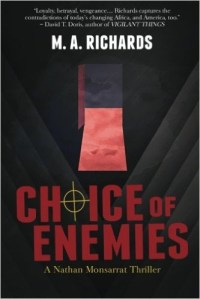
Chpoice-of-enemies

Nathan Monsarrat is a retired CIA deep cover operative, faced with a dangerous dilemma that will drag him back into Africa in a story of greed and betrayal. This is the first in M.A. Richards’ spy thriller series.

My debut espionage novel, Choice of Enemies, drew on influences of The Counterfeit Traitor in at least two ways: (1) a steady supply of Nigeria’s light sweet crude is the holy grail within the novel, and (2) the most enigmatic character in the novel is Mark Palmer.

Regarding the first point: William Holden played Eric “Red” Erickson, an oil executive who pretended to be a Nazi sympathizer while secretly spying for the OSS on German progress in producing synthetic oil during World War II. In Choice of Enemies, Nathan Monsarrat is a CIA deep cover operative working the oil portfolio in West Africa – to secure Nigeria’s light sweet crude for America’s homes.

Regarding the second point: Is Mark Palmer a good guy? A bad guy? Both? Concurrently? Consecutively? He plays different roles at different times in different locales throughout Choice of Enemies. Since I do not believe in coincidences, the choice of his surname surely harks back to the enigmatic character Lilli Palmer portrays in the movie, Frau Marianne Möllendorf.

Klein’s novel, although influential, was a stand alone. Ian Fleming’s James Bond novels were seminal influences, because they introduced not only a towering good guy defeating epic bad guys time after time, but because the books were intertwined in a series. They opened the possibilities of the development of the hero not only within a specific novel, but over a period of time in multiple situations, facing multiple challenges.

Perhaps the most impressive aspect of Fleming’s writing is his ability to pin a reader’s interest with a line or two of dialogue. For example, in Goldfinger, Fleming wrote the following interchange:

James Bond: Do you expect me to talk?

Auric Goldfinger: No, Mr. Bond, I expect you to die!

Foureen words total, far fewer than the allowed 140 Twitter characters.  Far more memorable than any words I’ve ever read on Twitter. What is it, then, that makes Fleming’s dialogue so memorable? Why is this simple interchange between the hero and the villain in a book originally published in 1959 remembered so well today? Continue Reading →

Stay on the edge of your seat with these

0
The Edge of Normal, Reeve LeClaire Series
Carla Norton
Minotaur Books 2014
384 pages
Kindle $7.99 Mass market paperback $7.99Edge-of-Normal

Carla Norton has rewritten the benchmarks for novels about child kidnappers, upping the tension while introducing a new type of leading character—a kidnapping and abuse victim. Reeve LeClaire is really no investigator. Struggling in all areas of her life, but managing to persevere, barely, after being held captive for four years, Reeve is drawn into helping a 13-year-old kidnap victim.

In her early 20s, Reeve has worked to form a life for herself six years after her own ordeal. When Reeve’s therapist is asked to assist in the case of Tilly, a young teen who was abducted and freed, Reeve jumps in to help. Leaving San Francisco for a small northern California town, Reeve discovers Tilly has suffered some of the same cruelties as she did. Police have arrested someone suspected of being Tilly’s tormentor—but there’s more. Much more. Reading through to the edgy, rewarding conclusion you learn Norton has also created new meaning for the word creepy.

Publishers Weekly said, “Norton skillfully keeps the suspense taut with myriad surprises while giving a tender look at victims whose ordeals are rehashed by lawyers, the media, and pop psychologists.”

Spoils of Victory, a Mason Collins Novel
John A. Connell
Berkeley 2016
384 pages
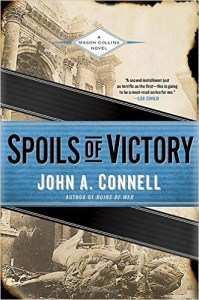
Kindle $12.99 Hardback $21.33Spoils-of-Victory

Former Chicago police detective, soldier, POW, and now-U.S. Army criminal investigator, Mason Collins finds himself in Garmisch-Partenkirchen, a scenic Alpine ski town that managed to escape the destruction of World War II. Months after the Nazi’s defeat, the town is the home of fleeing war criminals, a depository for the Nazis’ stolen riches. With millions of dollars to be made on the black market, murder, extortion, and corruption have become commonplace. Continue Reading →

Hey authors, don’t kill the dog!

8
In this guest article, animal behaviorist and author Amy Shojai examines the peril novelists face if one of their murder victims has four legs.

I’m a dog lover (and a cat lover) and I adore reading fiction that includes unique pet characters or animal plots interwoven in a creative and believable way. But don’t you dare, kill the dog…or I’m liable to lob that book into a dumpster and cross you off my TBR list. And I’m not alone.

My perspective isn’t purely emotional, either. As a certified animal behavior consultant, I deal every day with pet owners who desperately need help understanding and solving their pet peeves. I address these issues directly in my nonfiction pet books, and in my thrillers, animal behavior remains intrinsic to the plot.

My September Day thriller series features an animal behaviorist and her service dog Shadow, a German Shepherd Dog with his own viewpoint chapters. Both September and Shadow go through hell. Shadow even has his own story arc and has such a presence, the series would die should he become a victim of the antagonist. There are other animal characters introduced peripherally, along with veterinary or animal welfare plots, and in the real world, I know all tooShow-and-Tell-pet-novel well bad things happen.

Including pets can be lazy writing

Killing pet characters is a furry line I won’t cross, not just because it hurts my heart. It can be bad business, and too often is simply a lazy shortcut to demonstrate the antagonist’s level of “evil.” At the other extreme, writers may be advised to give their hero a pet to make the protagonist more likeable.

Honestly, I have to argue that it’s not owning the pet, but the relationship with that animal (or any other character) that makes the hero likeable or the antagonist unlikeable and unsympathetic. A pet character in a story opens an opportunity to show a relationship, and that, indeed, will broaden a character’s depth and the reader’s engagement.

But when pets are used as a prop, interjected simply as a label like “red headed killer” or “dog loving taxi driver” or the tired old ploy “serial killer starts by killing pets,” there’s no relationship. You want that relationship, so readers care, and good writers ensure that readers are vested in what happens to their story characters including the pets. Killing the pet, however, after the reader becomes emotionally invested, betrays the reader’s trust in a horrific way. Done purely for shock or as a shortcut, killing pets in novels is a cheap shot pet-loving readers rarely forgive. Here’s why.

Why killing pets backfires

Today, pets are considered to be members of the family, in some cases surrogate children. Just as many readers become offended by fiction that details “on-stage” murder/mayhem directed at children, so too, are they offended by the same directed toward pets. Continue Reading →