Nostalgia City Mysteries

Mark S. Bacon

Category Archives: Reviews of mystery/suspense books

Flash fiction news

Short Mystery Fiction Society

If you’re interested in flash fiction mystery stories, crime/mystery short stories or even tales a bit longer, you ought to check out the Short Mystery Fiction Society website.  It can be a portal to enjoying some of the best short crime fiction today.

The SMFS is made up of writers and mystery fans who regularly exchange comments, via email, on all topics related to the genre.  Much of it centers on the craft of writing mysteries along with comments on recently published stories.

Each year the organization recognizes the best short mystery fiction through its Derringer Awards.  Categories include flash fiction (up to 1,000) words, short stories, long stories and novelettes.  While the winning stories are not usually posted on the site, this is a great place to find the names of talented authors you can follow.Short mystery soc

For example, last year Bill Pronzini earned the Edward D. Hoch Memorial Golden Derringer for Lifetime Achievement.  He’s collected numerous Edgar Award nominations and many nominations for the Shamus Award from the Private Eye Writers of America including one for Cat’s Paw for which he won the Shamus.  He’s the author or co-author of ten short story collections.

Here are two other names you might want to follow: Allan Leverone and Nicola Kennington.   The former is a short story writer and author of five novels, the latter has a skimpy web presence, but both were nominated for Derringers this year in the flash fiction category and both of their  intense, hard-boiled (is that redundant?) stories are available online through links on the SMFS site.   Both great reads.

Flash fiction contest winners selected

The winning stories in author Vanessa Shields’ Mystery Flash Fiction Contest have been selected and the writers’ names will be posted soon.  Ms. Shields and I reviewed all the entries (I judged the stories blind, not knowing the author names), debated their relative merits (or not) and agreed on the top stories.   We hope to make this an annual contest, so spread the word.

Mysteries and Murder is top seller

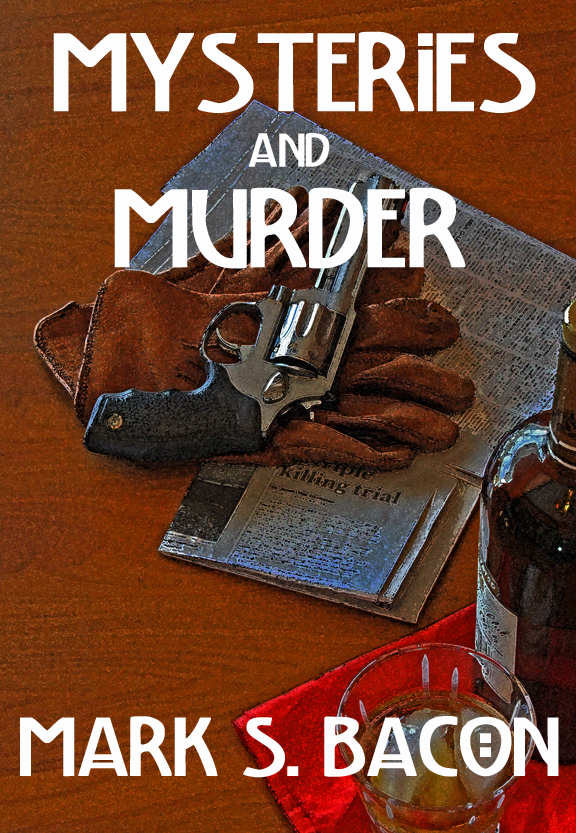
Last month Mysteries and Murder, my small collection of mystery flash fiction stories, made the top ten weekly sales list with Ether Books of the UK.  M&M art  dker bk  2377 copyThanks to all who downloaded the book.   Like all the Ether books, it’s designed to be read on your smart phone.  Simply download the Ether app and you’re ready to go.
Hyperlinks:

Short Mystery Fiction Society

Bill Pronzini

Derringer flash fiction winners

Vanessa Shields

Ether Books

Short mystery fiction

Block’s John Keller series is a hit

Hit Man
By Lawrence Block
HarperTorch; Reissue edition   2002
Kindle $5.69, paperback $12.76, mass market paperback $7.19
384 pages (mass market paperback)


John Keller’s is a sedate existence.  He lives by himself in an apartment on First Avenue in New York City, walks his dog, does crossword puzzles and occasionally flies out of town on business.   When his travels take him to a small town, he frequently wanders about, pondering what it would be like to live in a quaint, out-of-the-way place.  Eventually though, he settles down and does what he’s come to do.  John Keller kills people.

Keller is the creation of Lawrence Block one of the best known and best selling names in crime fiction.  He penned his first story when Eisenhower was in the White House and he’s hardly paused for a breath since.  He’s authored more than 50 books and countless articles and short stories.   He has several book series going; most well-known is the Matt Scudder series.  Scudder, a detective in New York City, is a recovering alcoholic.   Although when the series began Scudder was not recovering, attending Alcoholics Anonymous meetings are now a big part of the character’s life.Untitled-1

Block has won multiple Edgars for novels and short stories (not to mention a raft of other awards), has written scripts for large and small screens and even posts regularly on his blog.  You can read him online and join his 7,600 followers.

Hit Man is the first in a series of five books: one novel and four story collections.  This book contains 10 closely linked short stories in more or less chronological order.  We’re introduced to Keller and his trade in the first installment and learn a little more about him with each story.  As you might imagine, every story revolves around a particular murder assignment, usually taking place in a different city.

Keller receives his assignments from “the old man” who lives in a large house in White Plains, NY.  Usually Keller visits the White Plains house and has iced tea or lemonade with “Dot” a vaguely sketched, middle aged woman and seemingly one of Keller’s only friends.  He then goes upstairs to find out who his next target is.

Each story stands on its own, often with a delightful twist ending–predictably, linked to how Keller accomplishes his objective.  Rarely does he use a gun; flying out on his assignments pretty much precludes taking a firearm along.  He improvises, and in more than one story, the murder weapon is uniquely tailored to the circumstances or the victim.  This is particularly true in “Dogs Walked, Plants Watered”  where Keller’s weapon of choice is ingenious and amusing.

Unlike the Scudder series, the Keller stories are third person but with Keller himself as the only point-of-view character, so we experience the stories solely through his eyes and thoughts.  We  don’t learn much about his private life–such as it is–in any one story.  In several of the stories we see him with Andria, his dog sitter who becomes his short-lived, sleep-in girlfriend.  She discerns what he does for a living and eventually leaves–not necessarily because Keller is a hit man–and takes the dog with her.

Many of the stories contain Keller’s mundane digressions–having to do with stamp collecting, pets or small-town life–that draw you temporarily into Keller’s quiet reveries.  “…you’ve always got this fantasy living the good life in Elephant, Montana,” a girlfriend tells him once.  “Every place you go you dream up a life to go with it.”  But just when Keller’s daydreams lull you into thinking you’re reading introspective chic lit, he strangles an unsuspecting victim and catches a plane home.

“Keller’s Therapy,” the third story in the book, about his relationship with his psychologist, earned Block an Edgar Award.  My favorite story is “Keller on the Spot,” which sees him save someone from death, then form an unusual relationship with his assigned target.

If you haven’t figured it out by now, Keller is not the slick assassin dressed in black, bristling with exotic weapons who dispassionately dispatches his victims.  Morality is an underlying theme for the stories.  Keller’s code prohibits him from petty larceny unrelated to an assignment and he occasionally contemplates the ramifications of his murderous acts.  But ultimately, although lacking in dash, he performs the deadly rites he’s been hired to do.  Afterall, change one vowel in his name and you spell his occupation.

Hyperlink

Lawrence Block’s blog

Return of the Scandinavian sleuth

0
The Keeper of Lost Causes (Department Q)
by Jussi Adler-Olsen
Translation by Lisa Hartford
Plume, reprint edition  416 pages
Paperback $12.09

“Just because somebody is a shit, it doesn’t mean he has no integrity.  Like yourself, for example.”

Carl Morck’s had it tough.  Smart-alecky responses from a guy he’s questioning are nothing.  Weeks earlier he and two fellow Copenhagen police detectives were ambushed as they investigated a crime scene.  One of his team was killed, the other, Hardy Henningsen, paralyzed.  Morck’s physical wound was superficial.

The experience does nothing to soften the generally acerbic detective and his superiors decide that for the good of the force, Morck will be assigned to the basement, in charge of cold cases.

               He actually liked the man, [thinks Morck’s boss] but those eternally                       skeptical eyes and caustic remarks could piss anyone off…

Prior to the shooting, Morck’s wife, Vigga, left him for a succession of young artists, and Vigga’s son Jesper, who loves heavy metal at high volume, decided to stay with Morck.  When Morck visits his buddy Hardy in the hospital, his friend, paralyzed from the neck down, asks Morck to kill him. Keeper of Lost Causes Cover No wonder Morck would be happy sitting in the police department basement doing nothing.

The new cold-case squad, Department Q, consists only of the battered and blue but likable–in an arm’s length sort of way–detective and his assistant Hafez el-Assad, an enigmatic Syrian refugee.   Morck initially limits Assad’s duties to driving him around, mopping the basement floors and generally staying out of his way.

But when Morck’s boss wants to see what case he will be working on first,  Assad suggests a five-year-old missing persons case.  Morck likes it, in part because one of his rivals in the department had failed to solve it.  Soon Morck and Assad are absorbed in the case of a popular, beautiful politician who disappeared.  You will be absorbed too.

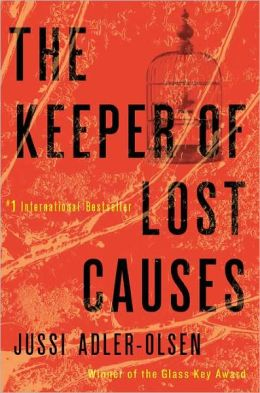
The Keeper of Lost Causes by Danish writer Jussi Adler-Olsen is another in the line of what one reviewer calls “Scandinavian sadism.”  Readers all over the world were hooked on The Girl with the Dragon Tattoo book series by Stieg Larsson, the Swedish writer who died unexpectedly at age 50.  The popularity of Norwegian mystery writer Jo Nesbo has increased since the publication of the Larsson novels.  Adler-Olsen shouldn’t be far behind.  His American publisher even adopted a book cover for him similar in font and layout to the Larsson books.

Adler-Olsen’s story is told in chapters that, for part of the book, jump back and forth between detective work by Morck and Assad and the earlier life of the missing person, Merete Lynggaard.  Sadism is an appropriate description of the treatment Lynggaard receives, but it’s as unique a form of torture as that rendered on, and ultimately by, Larsson’s Lisbeth Salander.   Lynggaard’s strikingly bizarre fate is revealed early in the book, but what keeps the plot lively and surprising is the search for the motivation, the means and the culprit or culprits, not to mention an ingenious plot twist that will not be mentioned here.

Selection of a Muslim sidekick for Morck is curious.  It was a newspaper cartoonist in Denmark who ignited a firestorm of violent protests in the Middle East and elsewhere in 2005 by drawing caricatures of the Prophet Muhammad.   Adler-Olsen doesn’t mention or allude to the controversy and although he has Morck criticize Assad from time to time, the comments are not as derisive as those he uses on other police employees, and none are directly related to Assad’s faith.

For much of the book, Assad, who is not a policeman but simply a civil employee, is treated as a driver and gofer, yet his take on human nature and his powers of observation become useful to Morck.  Assad’s not-quite-perfect mastery of Danish gives him a unique voice and makes for some amusing misunderstandings between him and Morck.

Morck’s relationship with his wife, stepson and with Hardy are not resolved, neither is the reason for the ambush at the beginning of the book.  None of these things are essential to the Lynggaard case and await further exposition in following novels in the series.

The book has an entertaining and believable relationship between the two protagonists, a complex plot and a fast, breathless conclusion.  Assad and Morck, with his many burdens, will be back.