Nostalgia City Mysteries

Mark S. Bacon

Tag Archives: Dashiell Hammett

“In a Lonely Place”- Don’t confuse the novel with the Bogart film

0

Book Review

In a Lonely Place
Dorothy B. Hughes
NYRB Classics Edition, Aug. 2017 (Orig. 1947)
224 pages
$15.95 paper, $11.99 ebook Barnes and Noble

In Dorothy B. Hughes’ intense, ground breaking serial-killer novel, In a Lonely Place, Dix Steele is a scheming ex-GI psychopath. He rapes and murders young women in post-World War II Los Angeles.  A 1950 Humphrey Bogart film of the same name was adapted from the book.
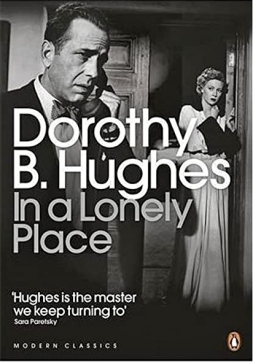
Or was it?

In the film version, Bogart’s Dix Steele is an out-of-luck screen writer with a bad temper. See the resemblance?  Except for the title and the name of the main characters, the film is as close to the Hughes novel as it is to Dr. Seuss. 

Coincidentally perhaps, both works are engaging, well plotted and populated with memorable characters.  I suggest viewing them as separate creations albeit with somewhat similar themes.

According to Wikipedia, Hughes was “not bothered by the changes” made by the film’s director Nicolas Ray and its two script writers. I’d like to know why, given the reaction so many novelists have to films that alter, over simplify and otherwise mangle their original stories.  It could be that Hughes recognized a good movie, even though it was not her idea. Presumably it helped her book sales.

Here first, is a look at the novel.  A movie review follows in the next blog installment.

Dix Steele is stalking a woman in the foggy Pacific Palisades of Los Angeles.  His target is “more than pretty, she was nice looking, a nice girl.”

He follows her cautiously, but not too cautiously. He knows she’s heard him behind her for she quickens her pace.  It’s dark.  She’s alone and afraid.  But he doesn’t want to catch up to her too soon.  He anticipates finally reaching her when she’d “give a little scream.”  Unexpectedly however, cars appear ahead, their headlights bathing Steele and the road in “blatant light” spoiling his pursuit.  “Anger beat him like a drum.” Continue Reading →

F**king profanity in mystery novels: an update

1
First of two parts

Comedian George Carlin had seven words.   Mystery novelist John Sanford has hundreds, but he repeats. John Grisham uses them sparingly.  Many mystery, suspense and thriller writers use them.  But some don’t.

Agatha Christie didn’t.  Neither did a whole generation of cozy authors from Dorothy L. Sayers to Ngaio Marsh to Charlotte MacLeod.

Swear words, dirty words, four-letter words, cuss words or however you describe them are the  way many people—including mystery writers—express themselves.  Are words like f**k and s**t appropriate in mystery fiction?  Or does avoiding profanity altogether make present-day dialog sound tame and artificial?

I’m a little new to mystery writing and the use of expletives still fascinates and puzzles.  I wrote about this topic here when I’d published my first mystery.  Now that I sent the manuscript for my third Nostalgia City mystery to my publisher, I’m still intrigued.  Although I have settled on a profanity policy for my own work, I decided to take another look at the opinions and practices of mystery readers and writers alike.  The result was damn surprising. Continue Reading →

Read this! I have awesome content

5

If you’re looking for quality content, you’ve come to the right place.  I mean, don’t we all want good content?  I like it in hamburger: low fat content and none of that pink slime that was in the news recently.  Some people like adult content in their movies.  Whipped cream lovers like contents under pressure, otherwise the stuff would just stay in the can.   Without a table of contents it’d be difficult to find something in a book, and if you have an alcoholic content higher than .08 you’d better not be behind the wheel.

But perhaps you’re looking for a different type of content.  It’s hard to tell because content, or awesome content, seems to be all it takes to satisfy even the most discriminating online reader today.  This must be true because I’ve read it dozens of times on the Internet.  Looking for advice on how to make more “friends” or get retweeted more often?  Quality content is the answer from every media guru or how-to website.  Do you know what you need to get more readers for your blog or to spiff up your email?  You guessed it: quality content.

Content, as it’s used (overused) on the Web and in most forms of business communication, is more than just a horrifying cliché.  Could you call it a euphemism for bright, witty, original, informative and clear writing?  Possibly, but my sense is that in many instances the word is used without much forethought. The term borders on gibberish, piffle, nonsense.  Here’s a good example:

Bloggers get lots of spam in the “comments” sections of their sites.  God only knows the purpose of these, except to lure you into clicking on a website—a decision you will regret long after you have your hard drive reformatted.  What many of these spammers begin with is praise for the site, using the phrase quality content.  No thinking involved here.  Blanket quality content could refer to a blog about taxidermy, Cartesian philosophy or football.

Inane use of the word, however, is not limited to spammers.  Enter two words into a search engine and you’ll be Awesome content reallyovercome with thousands of websites offering advice on creating awesome content.  Often the advice is bland, generic and silly.  Case in point: The website sitepoint.com offers an article cleverly entitled “How to Generate Awesome Content.”  You need an attention-grabbing headline, accurate information and rich media, we’re told.

“Originality is a key ingredient…” the website says, but “…the ideas themselves don’t have to be wholly original.”  In addition to this site, and thousands more like it, are web pages that tell where to find awesome content that you can simply appropriate.  Other sites offer formatted 140-character content you can easily copy and paste into your tweets.

What I’m getting at here is that not only do I object to the term “content,” the necessity of providing stock material and short-cuts is a sad reflection on education or perhaps on our creative powers.  Certainly websites that provide summaries and indices of material available elsewhere can be useful—I do it myself.  But the notion of just cutting and pasting simply to have something to say is pitiful.

So, if you’re looking for awesome content (we’ll leave the task of dealing with those who misuse the word awesome for later), check out my archives, read Dashiell Hammett, Dickens or pick up a copy of the New York Times.

Next time we’ll get back to talking about books, mysteries and mystery writers.  I read an article once, however, that advised me to keep my blog lively by occasionally posting off topic.  It also advised an occasional rant, but I would never do that.