Nostalgia City Mysteries

Mark S. Bacon

Tag Archives: e-readers

Will a fire sale for ebook buyers        become the authors’ pyre?

Ramifications, realizations spread in wake of used marketplace news

Second in a series

From the first, ebooks promised to transform the publishing business.  Ebooks joined music and movies as a popular item to be hijacked and distributed by torrent websites.  Now the possibility of a marketplace where “used” or previously owned ebooks can be resold  has authors, publishers and book lovers wondering what will happen as Amazon and Apple proceed with patents for such a system.  Authors’ biggest fear is that a used marketplace will cause new ebook prices to deflate faster than the Hindenburg.

Amazon’s patent was granted two months ago; Apple’s is pending.  The two giant online retailers have not said what they plan to do with the patents.  In contrast to websites such as Pirate Bay, run by thieves who ignore copyright, new ebook marketplaces outlined in the patents promise controls that will reduce unauthorized duplication of ebooks.  A relatively new online “used” music seller,  Redigi, has already set up a resale system the company says is similar to a conventional used book or record store.  The system for used ebook sales will get rolling, pending the outcome of a lawsuit.

According to news reports, the Redigi system will permit people who have purchased ebooks to offer them for sale online.   Like the Amazon and Apple proposals, an ebook will only be sold once and then it disappears from the previous owner’s files.  Redigi CEO John Ossenmacher told Time Magazine the company has validation tools that let them determine if digital material has been legitimately purchased, if it has been transferred between computers and other information.  Pirated digital merchandise will not be sold, according to Ossenmacher.

The company designed the tools to protect copyrights, Ossenmacher told Time.  He said Redigi will suspend the accounts of people who don’t follow the rules.

One side benefit of a used marketplace like Redigi’s or Apple’s is that it might reduce piracy. “By enforcing old-fashioned rules of physical ownership onto modern, non-physical objects, Apple’s patent might support the company’s goal of combating piracy,” Charles Pulliam-Moore wrote recently in Slate.  “In creating a used digital store, Apple would provide an easier, safer, quicker alternative to pirating media…,” he said.readers  b&w  3578
Perhaps the biggest (encouraging) surprise in the Redigi plan is that, unlike in the sale of used paper books, publishers and authors can receive compensation.  Trade magazine Publishers Weekly recently reported that Ossenmacher appeared at a roundtable discussion with publishers and told them income from the resale of ebooks “represents billions of dollars on the table.”

Billions of dollars into publishers pockets likely will not assuage the doubts of authors as to any potential benefits from a used ebook marketplace.   But then, contrary to popular opinion, most writers get paid very little for their books.

“The vast majority of writers are not like Stephen King or J.K. Rowling or Suzanne Collins,” said best-selling sci fi author John Scalzi.  “The average author makes a four-figure salary a year from their writing,” Scalzi told Jenny Shank, writing in NPR/Mediashift.

“People don’t see creative people as they are in reality,” Scalzi told Shank.   “Ninety-nine percent of everybody in a creative field is barely eking by. Also, when it comes right down to it, people like getting bargains. They’re not following the product chain back to the initial starting point.”

Scalzi said part of the job today is to remind readers that books are created by human beings who have to pay rent and feed their children.

To be sure, writers do not get rich.  The most successful book I’ve written sold about 60,000 copies in all editions over several years.  That was enough for my publisher at the time to call me a “mid-list author.”  What I made from that at 10-15% royalty plus advance was certainly not enough for my family to live on, even at poverty level.  And many authors never even make mid-list, let alone best seller status.  Most authors have day jobs and working spouses–or should.  (Fortunately for me, my day jobs have always been in writing: commercials, direct mail, journalism.)

So, as a used ebook marketplace threatens to remake the book business and further erode authors’ income, questions remain.  Several conclusions–perhaps at odds with public perception–seem clear however.   We’ll look at those next time.

Notes/Hyperlinks

Redigi’s tools to protect copyright   

Apple’s system might reduce piracy

Authors have doubts

Publishers could profit from “used” sales

Preview my book, but buy it anyway

My Kindle died.  It was just two years old.  If you lose a paperback you’re reading, you can buy a new one.  Lose a well-used Kindle and it’s like losing a library.

I know, all my books with my highlighting and extensive annotations are safe in the cloud somewhere–I hope–and I can retrieve them on my computer via Kindle software.  But I don’t want to sit at my desk to read a book; that’s why I bought a Kindle.

My Kindle was a second-generation model, now called a Kindle Keyboard.   It died when I abandoned it temporarily to read a printed book, what a friend calls a tree book.  It seemed to be frozen, so I charged it for hours but to no avail.  I discovered a simple procedure that can sometimes resuscitate a frozen Kindle.  You slide the on button and hold it in position for 20 seconds.   That didn’t work either.Kindle bare type Es  3368

Naturally, after two years the warranty was as dead as my Kindle.  When I reported the death to Amazon they offered me a couple of new models (that carry advertising) at a modest price reduction.  I will just buy a new advertising-free one.  The Paperwhite model offers a lighted screen and a purported two-month battery life.  But it doesn’t have any buttons.  Touch the side of the screen and the pages turn.  Touch it at the top and you get a menu.  Often I accidentally turned pages on my Kindle that had dedicated buttons.  Will eliminating buttons make it easier?

Actually, I don’t mind having to buy a new one.  Considering the hours of pleasure I had reading dozens of books on my old one, an e-reader is a pretty good deal.  The biggest cost comes from the books themselves.  Recently I read a column by someone who compared e-readers to Gillette razors.  For many decades, the company’s strategy was to price the razors low to sell as many as possible.  The profits came from the sale of blades.   The same marketing strategy probably applies to inkjet printers.

E-readers are marvelous machines, but many have limitations.   Wonderfully convenient for reading novels and biographies,  they are ill suited for reading how-to books or any book that relies heavily on charts, tables, graphs or illustrations.   When I bought a new single lens reflex camera, I purchased a manual for it on my Kindle.  The book’s many charts, illustrations and sample photos were muddy and indecipherable.   I wound up buying the book in paperback.  Newer generations of color e-books and tablets have come close to solving this problem.

The other limitation lies in the awkwardness of flipping back to end notes or a glossary.   I read Doris Kearns Goodwin’s Team of Rivals on my Kindle, even though I had a paper-bound edition.  At 944 pages, Rivals is not nearly as portable as an e-reader, but trying to access the author’s notes (all 754 of them) as you read invites Valium-level stress.   I was glad to have the printed book.

One reason I’m eager to get a  new Kindle–and possibly one of its greatest advantages– is book previews.  (Nook also offers previews.)  Positive reviews, recommendations from friends and a familiar author’s name are still no guarantee that you’ll enjoy a book.  A preview lets you get comfortable with a story as the author tries to hook you with the first chapters  Even reading a synopsis is not as useful to me as reading a sample.  An author’s style, point of view, and treatment of a subject are all important.

With more indy books competing with the big publishing houses today, competition is keen.  Book acquisition editors and consumers both look for a story that grabs them early on.  I’m guessing that the prevalence of e-book previews is further spurring writers and editors to look for beginnings that grab you by the lapels and impel you to keep turning pages.

I’m a heavy user of previews.  Sometimes my Kindle home page will have a half-dozen or more preview titles.   I can fill an evening reading free previews.   And I can be a tough sell.  I once downloaded a preview of a promising suspense novel.  The story began with protagonist frantically trying to evade someone following his car.  The hero finally raced across a bridge, crashed through a barrier and plunged into a swiftly flowing river.   The car began to sink.  I can’t tell you what happened next; I didn’t’ get hooked.

When I’m the author rather than the reader, the situation can become a bigger problem.   Packing some powerful samples at the beginning of a book of flash fiction should be enough to hook a reader into becoming a buyer.  That was my theory.   In practice it didn’t work out that way.

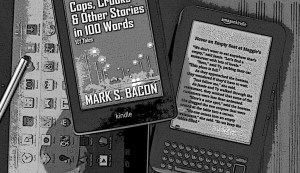
The Kindle preview of Cops, Crooks & Other Stories covers about 10 per cent of the book.  The preview lets you read the copyright page, the lengthy table of contents (there are 101 stories to list) and my introduction.  End of preview.  No sample stories.

So, please preview my book, but buy it anyway.