Obscenity and profanity in mystery novels
Second of two parts
Swear words, no matter how the hell you look at them, can be a challenge for mystery writers. Use foul language and you risk alienating or offending some readers. Studiously avoid profanity and your dialog, especially in scenes of stress, could sound implausible.
But gosh darn, now that I’m two columns into this discussion, I discover—thanks to an article by novelist Elizabeth Sims in Writer’s Digest online—that I’ve been using an imprecise word for naughty language. Even naughty is not quite right.
If you do a Google search for profanity in mystery novels, one of the first results you’ll see is a link to my 2016 column on this subject. Regardless, I’m not trying to be the Internet’s expert on mystery writers’ swear words. And before we go further, we need to define terms.
Profanity, as Sims points out, is the word frequently used to denote any objectionable word, but profanity literally means words prohibited by religious doctrine. In other words, terms that are profane. Generally this would cover Jesus Christ or God as epithets, but not necessarily f**k, etc. The term blasphemy comes to mind.
Obscene and obscenity are better, more exact terms to describe most cuss words or coarse language. Merriam-Webster’s Ninth New Collegiate Dictionary defines obscene this way: “disgusting to the senses: repulsive.” This could be an eye-of-the-beholder situation, depending on the words’ use, but let’s not split hairs. Sims notes that obscene words often refer to sex. The f-word is the most objectionable example, she says, and she concludes with understatement, “Adding mother as a prefix ups the ante.”
Returning to the pros and cons of potentially offensive language, several authors (in addition to John Sandford, mentioned in my previous post) have written reasoned defenses of “writers who dare to swear,” as mystery writer Christina Larmer puts it.
In a 2015 Huff Post article she wrote:
“Adding profanity is just a natural, fluid part of the writing process. I hear the character’s voice, I spew it out. Sometimes, when I read back through the copy and the language feels jarring or overdone, I remove it, just as I remove clichés and adjectives that don’t work. But I never remove it so my readers can feel more comfortable or content. This ain’t Chicken Soup for the Soul, guys.”
I agree. Before I’d finished my first mystery, I decided I would use profanity, but judiciously. Some of my characters are bad people. They rob and kill for money. They don’t watch their language. They are not likely to say, “Excuse me sir but I believe we may have a slight disagreement. I feel your attitude does not reflect sincerity.”
In addition, when my ex-cop protagonist, Lyle Deming, faces a troublesome situation, I want him to be able to say, “Oh s**t.” Maybe that’s because it’s the way I often react to adversity. Perhaps writers who don’t swear themselves, don’t have their characters tell anyone to f**k off. As academics say, this is a sub-topic that warrants further study—but not here.
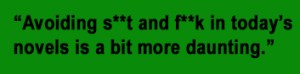 Then there’s the comparison of violence and inhuman acts vs. obscenities. Larmer says she’s baffled by people who take exception to profanity but “make absolutely no mention of the fact that in one book, for instance, I leave someone in a dank basement to be devoured by rats.”
“Writers don’t use expletives out of laziness or the puerile desire to shock or because we mislaid the thesaurus,” writes Kathryn Schulz in the June 5, 2011 issue of the New York Review of Books. “We use them because, sometimes, the four-letter word is the better word—indeed, the best one.”
In contrast, author Mark Henshaw says profanity is usually a sign of weak writing. Writing on his website in June of 2014 he said, “Profanity has become so common in modern media that I feel its inclusion almost never adds anything to an artistic work. Profanity has lost its shock value, rendering it useless as a literary device for character development or delivering emotional impact.”
It is common, and it can easily be overdone. But still.
Some of the best arguments for not using profanity come from writers who penned novels when damn was considered foul language and four-letter words never found their way into polite print. Yet some writers still got the point across.
Here’s how Dashiell Hammett described one of Sam Spade’s explosions, “He cursed Dundy for five minutes without break, cursed him obscenely, blasphemously, repetitiously in a harsh guttural voice.”
He didn’t even need to call him a bastard; we understood.
 One of my favorite writers of the past is Ross Macdonald. His novels spanned the period when profanity was unacceptable to the early 1970s when many of the restraints came off.
In his 1958 novel, The Doomsters, he used hell 22 times, damn 13 times, Christ 4 times and Jesus twice. No other profanity. In his 1951, The Way Some People Die, he was a little more careful, but no less effective:
“Blaney and Sullivan escorted me to the car. In order to keep their minds occupied, I swore continuously without repeating myself. ”
To conclude, for now: Mystery writers don’t use obscene language today for shock value as Henshaw indicates. We use it because, like it or not, it’s become a big part of life. We use swear words occasionally for the same reason we don’t use “forsooth” or “verily.” We want our dialog to be contemporary and realistic.
Editor’s note: In the first article in this series I attempted to include a link to the profanity article I wrote two years ago. Instead, the link simply brought the reader back to the latest article. It’s been corrected online, but if you read the post in email and missed the earlier article link, here it is: https://baconsmysteries.com/?s=do+you+hate+f**
Links
 Desert Kill Switch just received the first prize for fiction in the 2018 Great Southwest Book Festival. An awards dinner will be held in April to honor the winners of the competition.
 Nostalgia City Mysteries