Nostalgia City Mysteries

Mark S. Bacon

Unknown's avatar

About mbaconauthor

Mystery writer and journalist; former newspaper police reporter.

Tiny 72 dpi 3x6

Death in Nostalgia City is now available at online stores and your corner bookstore.

Last week I talked about the various anxiety-producing events I’ve experienced in the production of my mystery novel.  This week I discuss my book launch, such as it was.  But that will have to wait a few days.

Today we look at some of the early coverage the book has received:

OmniMystery News

Marilyn’s Musings

In addition, thanks to those who have already ordered and read the book–that was fast–for their notes and favorable comments.

Stay tuned.


Great moments in the history of anxiety

1

“Fear rots the faculties.”
–Cornell Woolrich, “Deadline at Dawn”

 In a few days, my publisher will release my novel, Death in Nostalgia City. Not my first book but my first novel. A debut mystery is the industry term and it’s appropriate as I feel not unlike a tense debutant taking tentative steps onto a stage, hoping for the approbation of her society.

Writing in general is nervous work. Novelist Shirley Hazzard said, “The state that you need to write in is the state that others are paying large sums to get rid of.” But at least, with any luck, an anxious mystery writer can transfer that feeling, so necessary to the genre, onto paper.Anxious author 3 tiny  6151

I’ve experienced several levels of anxiety during the creation of my book. (See photo.) In this case, it was the production stages and the promotional planning, rather than the writing, that seem to have challenged my sangfroid.

Although I’ve had my writing critiqued and edited thousands of times–dedicated writers crave editing–my publisher’s multiple editing process was a bit unnerving, confusing. Then there’s the two biggest tasks that await a writer whose manuscript has been sufficiently vetted: approving a cover design and obtaining blurbs.

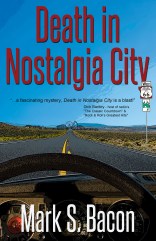
In this case, the cover design was the easy part, though not a short process. Ultimately designer Jacci Wilson created just the right cover.  It conveys the fact (a) that this is a mystery novel–although any title with the word “death” in it is likely a crime story–and (b) that the setting for the crimes is the desert near old Route 66. The cover also shows a hint of a town and an amusement park in the distance. That’s where the story’s headed.Final Cover front +++
The second of the two required tasks is to obtain blurbs. For the uninitiated, a blurb is a flattering quote about a book, preferably from an authority or well-known person, which is plastered on the cover. You’ve seen them.

These days, one or two blurbs seems not sufficient to establish a writer’s credibility. Many books have one or more pages of quotes attesting to the author’s talent, the incredibly involving content of the book and the necessity for readers to cease all productive activities in their lives until they’ve finished the tome.

One of the first places I went looking for a blurb was the Boston Globe. As a large part of my book takes place in Boston, I contacted a respected Globe feature writer offering her my manuscript for review. Turns out, reporter Beth Teitell has written books too, and was wise to my ploy. “You’re on a blurb quest,” she said.

Indeed. Fortunately, I managed to receive good blurb comments not only from other mystery writers, but from people in specialized fields–such as oldies music, theme parks and 60s/70s culture and trivia–that are part of the subject matter of my book.

With those two tasks behind me, I’ll be dividing my time between promoting the book and trying to write Nostalgia City volume II. Either of these tasks can easily be a full-time job. Pass the tranquilizers.

Post script.   My book was supposed to be available for advance orders on Amazon, a couple of weeks prior to its release. Today, in addition to noticing that the thumbnail of my book cover looks cloudy on Amazon (ditto for B&N), I also saw that the print version of the book is available for sale earlier than I expected. Also, the Kindle and print versions are not linked.  I’m told that after the Oct. 4 release date the listings will be combined.

Amazon and my publisher will sort things out. In the meantime,  read the first four chapters of the book here, on my website.  My reluctant investigators Lyle and Kate have some exciting surprises for you.

—–

I’m often asked if I have advice for people just starting out to be writers. My advice: Some less stressful jobs might be worth exploring, like crab fishing in the arctic, testing experimental aircraft or painting radio towers.

“Deadline at Dawn” uneven Woolrich adaptation

0

Deadline at Dawn, the movie version of the book of the same name by William Irish, is an uncertain attempt at film noir with Susan Hayward, Paul Lukas and Bill Williams dashing about city streets–that are obviously soundstages–looking for a murder suspect and running into seedy types portrayed by a cast of familiar character actors who provide the darkest scenes and the darkest dialog.

The first scene of the 1946 movie is promisingly noire as Marvin Miller, looking a little like Peter Lorre, knocks on the door of an apartment where a semi-intoxicated Edna Bartelli (Lola Lane) is asleep with a fly crawling across her face. When she finally staggers to the door she says, “Why, it’s Sleepy Parsons. Aren’t you dead?”

Susan Hayward and Paul Lukas

Susan Hayward and Paul Lukas

Later, Bartelli picks up innocent-looking sailor Alex Winkley (Williams) and brings him back to her apartment. Winkley drinks too much, passes out, and eventually discovers that Bartelli has been murdered. First, he thinks he may have done it after he blacked out but June Goth (Hayward), a taxi dancer he meets, persuades him that he could not have committed the crime.   Since people saw Winkley go up to the victim’s apartment, he knows he’ll be accused of the murder and he has to catch a bus in a few hours to get to his navy ship. Goth tells him that to clear himself he must look for clues and find out who did kill Edna Bartelli.

That’s the improbable setup. The goal: With little or nothing to go on, they must find the murderer before the 6 a.m. bus.

Hayward is obviously the brains of the duo and she pushes the plot along with beauty and spunk while Williams, in his sailor suit, is the gee-willikers, guileless young seaman. (He actually delivers a line, “Gee, look at the time.”) The first clues lead the young duo to dead ends, but soon they’re joined by a cab driver (Lukas) who decides to help the struggling couple. The cabbie finds some additional evidence the youngsters missed and that leads them to the meat of the film when they encounter suspects played by Jerome Cowan, Osa Massen and the ever-menacing Joseph Calleia. The latter trio have the truly noir scenes in rooms with stark lighting contrasting with deep shadows.

Joseph Calleia

Joseph Calleia

Later, in a private club, Lukas gets a noirish line, courtesy of screen writer Clifford Odets. “The city is full of men like that. Nerves and worry. Living on cigars and bicarbonate of soda. Wrung out by sleepless nights.” Shortly thereafter, the mood shifts in a corny good-cop, bad-cop scene in a police station.

Miller makes another appearance as well, and the ending, although a surprise, does not save the picture. Directed by Harold Clurman, the film bears little resemblance to the mystery novel written by Irish, a penname for noir master Cornell Woolrich. Had I not seen the movie right after reading the book I might not have noticed similarities which are pretty much limited to Goth’s occupation and the 6 a.m. deadline. Certainly not A-list noir but worth watching if you’re a Hayward fan or a fan of the character actors of that era.

The film is part of a series, Film Noir Classic Collection, on DVD and available from Netflix.