Nostalgia City Mysteries

Mark S. Bacon

Category Archives: craft of writing

Bogart’s “Lonely Place” gets darker

0

Noir movie review

In a Lonely Place is a profound relationship film of trust and the meaning of love highlighting Humphrey Bogart’s best performance and delivering a moody, heartbreaking story tinged with suspicion and regret.

At least that’s the opinion of critics and film goers alike.  Not exactly mine. It’s a fine picture though. I can explain.

Robert Muller, host of Turner Classic Movies’ “Noir Alley” and author of books on film noir says the 1950 movie is his “all-time favorite film” and marks Bogart’s “unmistakably most personal role.”

The late critic Roger Ebert also gave Bogart high praise in his portrayal of a vulnerable, flawed man and says the film was “a superb example of the mature Hollywood studio system at the top of its form.”

Rotten Tomato’s audience score was 89 percent and reviewers gave 96 percent approval.  The Guardian’s Peter Bradshaw’s review was typical:  “A noir masterpiece.”

I saw the movie many years ago and remembered being unimpressed.  I watched it recently for this review, however, and now appreciate the story and the acting.  Nevertheless, I watched the film this second time after reading the novel of the same name, by Dorothy B. Hughes.  The book is superb and yet so completely different from the film it gave me a case of cognitive dissonance.

But a great movie can be made from a great book, even if it ignores the book, right?   In the book, Dix Steele is a serial rapist and murderer. In the film he’s a depressed movie script writer with a dangerous hair-trigger temper.

The film begins with Steele driving his top-down convertible in Hollywood.  At a stop-light a blonde passenger in the car next to him recognizes Steele:

“Dix Steele! How are you?” she says.  “Don’t you remember me?”

“No, I’m sorry. I can’t say that I do.”

“You wrote the last picture I did at Columbia.”

“I make it a point never to see pictures I write.”

The driver of the car interrupts and tells Steele to “stop bothering my wife.”

Steele then insults him and the driver tells Steele to pull over to the curb.  “What’s wrong with right here,” says Steele.  As he starts to open his door, the other car speeds off.

This scene introduces Bogart’s character, his occupation and his usual disposition.  The second scene is commentary on the plot and rounds out Steele’s circumstances and perhaps his future:

He drives up to a Hollywood restaurant and before he enters, he’s approached by two children.  One asks for his autograph.

“Who am I?” Steele asks.

“I don’t know,” the child replies.

“Don’t bother, he’s nobody,” the other child says.

“She’s right,” Steele says as he’s signing the autograph book.

When he meets his agent at the restaurant bar he tells Steele that he’s got a job for him. A film producer wants him to adapt a novel and the agent gives him the book.

“You’ve got to go to work,” the agent says, “you’ve been out of circulation too long.”

Steele tells him he won’t work on a book he doesn’t like.

“Are you in any position to be choosy,” says a film director seated next to them at the bar. “You haven’t written a hit since before the war.”

Steele seems to relent and as he leaves he hires a coat-room clerk to read the book to him. Continue Reading →
‘Gun Crazy’ shoots ’em up with style

1

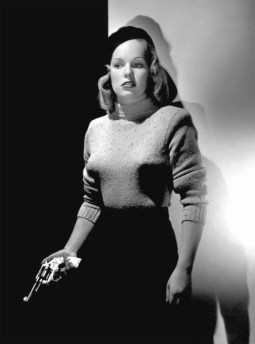
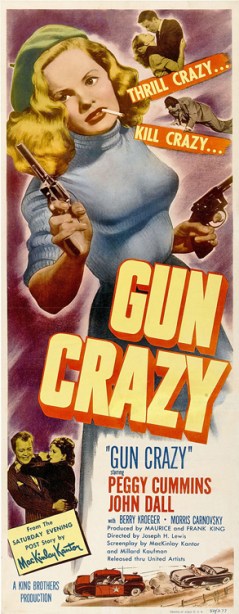
Halfway through the 1950 film Gun Crazy, Bart and Annie, dressed in buckskins and cowboy hats and brandishing shiny revolvers, stick up a bank, clobber a lawman, then jump in their car and make tracks out of town.

Peggy Cummins nearly 20 years before Faye Dunaway’s role

In a subsequent scene, actors John Dall and Peggy Cummins are dressed in street clothes, pulling a robbery and trying to make the best of a noir B movie. And they succeed. Backed by direction from Joseph H. Lewis and solid cinematography, the actors lift the film above its station and its average-at-best plot.

In fact this film, unknown outside of hardcore noir fans, is a critics’ choice breakthrough movie. Eddie Muller, TCM’s Noir Alley host and author of a book on Gun Crazy, says the film “is recognized as one of the most dynamic and subversive films of its day.”  Another critic called it an “impeccably crafted film… with a razor-sharp screenplay.”  I wouldn’t go that far. Yet Gun Crazy can draw you in if you watch closely.

Bart Tare (Dall) and Annie Laurie Starr (Cummins) meet when she’s the trick shooting, western-clad star of a carnival show and he’s an ex-GI World War II vet with a history.  During the performance, the show’s manager challenges audience members to try to outshoot the star and win $500. Having grown up fascinated with guns, Bart accepts the challenge.  He walks on stage smiling and eager.  Is it for the chance to shoot or for the beautiful Cummins’ attractions. He exchanges looks with the sultry shooter then outshoots her, earning himself a permanent place on stage with Annie.

As we learn in the film’s first scene, Bart became a crack shot through years of shooting bb guns and larger weapons as a child. His obsession with guns—despite abject fear of hurting anyone or anything—leads him to steal a revolver from a store window.  He’s caught and sent to reform school before joining the service.

Although his shooting prowess puts him on the stage with the six-gun siren, his job is short-lived. The manager who believes he has a hold on Annie becomes jealous when the two sharpshooters start to date, and he fires them.

On the road together Bart suggests marriage and Annie, who he calls Laurie, agrees.  In classic B movie fashion they drive up to a dark clapboard building housing a justice of the peace.  A large sign proclaims, “Desert justice – Get married.” The building also has signs, “Cocktails, bar, café.” And conveniently next door is the Continue Reading →

Flash fiction: 100 words of crime

2

It’s been a long time since I’ve written about flash fiction here. I’m reminded because my local writer’s organization, High Sierra Writers, asked me to judge its annual flash fiction contest.

This fiction genre is defined generally by length.  But few authorities seem to agree on how long a flash fiction story should be. The 100-word limit I use is common, but a variety of print and online magazines and print anthologies restrict flash fiction stories to 500, 1,000, 2,500 or even 5,000 words. SmokeLong Quarterly, an online journal founded nearly 20 years ago, takes its name from the notion that “reading a piece of flash fiction takes about the same length of time as smoking a cigarette.” The editors limit their fiction to 1,000 words—and note they do not condone smoking.

Twitterature, says Wikipedia, is literature limited to 280 characters, the maximum length of posts on Twitter.com. Writers and editors who try to define or explain flash fiction often cite a six-word story reputedly—although not likely—written by Ernest Hemingway: “For sale: baby shoes, never worn.” Regardless, Hemingway did actually write some longer flash fiction, so has Lydia Davis and Margaret Atwood, among many others.

Obviously, the shorter the word limit the greater the challenge to tell a complete story.  Some of the shorter flash stories are more collections of thoughts, emotions or observations rather than a traditional beginning-middle-and-end fiction. The best tell a complete story, but require you to think, to fill in some blanks—sometimes obvious ones, sometimes not.  Among the finest of the shorter genre appear in the online journal, 100 Word Story.

My flash stories tend to be more literal than literary, philosophical at times, but more frequently with a punch-line or twist ending.  I write cop stories and other dramas.

Here are two samples.  The first is one of my favorites. It’s buried on my website toward the bottom of the “flash fiction” tab.  Both are taken from my book, Cops, Crooks and Other Stories in 100 Words—Revised Edition. Each story contains exactly 100 words.


On the House

Starting her workday baking before sunrise always made Sophie’s concentration sag by 9 a.m., but looking across the counter at a gun barrel got her immediate attention.

“Gimme the money,” the gunman said.

Sophie glanced over the man’s shoulder, moved toward the cash register—then ducked.

The cop standing behind the robber threw him against the counter, as another officer grabbed the gun.

“You gotta be the dumbest crook I ever met,” said the first cop. “Okay, maybe you didn’t see our car in the lot, but really…”

“Thanks, Kelly,” Sophie said. “From now on, doughnuts are on the house.”


Just an Accident

Tim flipped a dashboard switch and a red light blinked. When Larry got in the car, Tim pulled out.

“So,” Larry growled, “whadda want now?”

“You’re abusing her. First, cuts and bruises. Now broken bones?”

“Just an accident. She wants to leave, it’s her choice.”

“She won’t. She’s terrified.”

“Then you stay out of it.”

Tim’s speedometer said 45 mph. He glanced in the mirror, saw no one, then swerved into a concrete wall.

Minutes later, bruised and aching but otherwise unhurt, Tim looked down. “He was my son-in-law. Didn’t believe in seatbelts.”

The policeman nodded. “And his airbag malfunctioned.”

– – – – – – – – –

Links mentioned above:

SmokeLong Quarterly     Twitterature

100 Word Story    Cops, Crooks and Other Stories in 100 Words