Nostalgia City Mysteries

Mark S. Bacon

Category Archives: craft of writing

So what kind of mystery is it?

0

That’s a good question and one I hear frequently when I tell people I’ve published a mystery novel. Mysteries come in so many varieties that telling someone you wrote a mystery is only slightly more informative than saying you wrote a novel.

Yes, there are certain conventions–dead bodies, for example–that mysteries have in common, but the characters, style, language, length, point of view and many other elements differ from one mystery to another and especially from one sub-genre to another. And sub-genres are plentiful, from hard-boiled PI novels to cozy, drawing room mysteries.

But to answer the question of how to categorize Death in Nostalgia City, let me begin with Agatha Christie.   She was the first mystery author I read as I was growing up. I liked the short stories in Alfred Hitchcock’s and Ellery Queen’s mystery magazines, but the mystery novel was defined for me by Christie. I loved the complex puzzles, the multiplicity of clues and the usually large cast of characters. It made me think. But Miss Marple and Hercule Poirot almost always figured out whodunit before I did.

Gradually, however, my taste changed and I wanted a little more action, a little more suspense to keep me turning the pages. I read, not only to find out who were the bad guys, but to follow imperiled protagonists and see them safely through the story. In sum, I like Two-brochuresWeb-opti--5902mystery stories with intricate puzzles, twists and turns that challenge my cognitive abilities (such as they are), but also those with swift action and continuing threats to the detectives (amateur or professional) that appeal to my emotions.

Raymond Chandler, the famous detective novel writer–creator of Philip Marlowe–said he didn’t care for manor-house mysteries because the entire value of the book is contained in the final chapter, the denouement. He said each chapter of a mystery should be rewarding itself, without regard to whodunit.

One of the ways a mystery novel can do that, in addition to providing compelling characters, believable dialog and necessary action, is to include secondary mysteries and physical challenges for the protagonists. I like to read mysteries that continually throw obstacles in the way of the main characters so they must solve intervening questions before they can ultimately succeed.

To me then, the best mystery stories appeal to the head and to the heart.

That’s what I tried to do in Death in Nostalgia City. The book has 74 chapters in just more than 300 pages. Each chapter is not self-contained, but it includes something unique, something that puzzles, challenges, or startles the reader or keeps the plot moving quickly forward.  Anxiety ridden–some say crazy–ex-cop Lyle Deming and Kate Sorensen, the gutsy theme park PR director and former college basketball player, are constantly tested and their progress hindered by circumstances and the mystery they’re trying to solve. At times they’re also in physical jeopardy.

There’s always something happening.

———–

Next time: Checklist of elements for a good mystery

My love affair with Fat Ass Sammy Grick

9

by Patricia Stoltey, mystery writer and guest columnist

Thanks so much for letting me visit your website, Mark. You’ve given me a chance to tell your readers about a bittersweet experience I had while writing Dead Wrong.

When I recruited Fat Ass Sammy Grick to be the bad guy in my first standalone suspense novel, I had no idea I was going to become so attached I’d have a hard time letting him go.

Many women, of course, are drawn to bad boys. But we think of devilish risk-taking characters–handsome guys with bedroom eyes, a little dangerous but not bad enough to do us harm, except perhaps to our hearts.

Patricia Stoltey

Patricia Stoltey

Sammy? Sammy wasn’t handsome. He had an ugly glare and a temper that flared at whoever was handy when he made one of his frequent stupid mistakes. To tell the truth, he was a nasty good-for-very-little thug. And I loved him from the very beginning.

I decided to write a multiple point of view novel and give Sammy a voice. He seemed a worthy adversary for Lynnette, a woman already on the run. She had no idea she was about to tangle with such a despicable lowlife.

And I had no idea I was going to get so attached to Sammy. He was like my inner creep who needed to get out and flex his muscles. When I wrote Sammy’s chapters, I became one with Sammy.

Sammy cussed. He cussed a lot. I began to mumble his dialogue as I typed. It felt good.

Some of Sammy’s actions caused Lynnette to react in unpredictable ways. I liked seeing her handle those twists and turns, so I gave Sammy free rein.

When Sammy’s gangster boss interrupted the action and sent Sammy into a tailspin, I watched and marveled as the big lug figured out what to do next.

DeadWrongFront 264x408As the story progressed, I began asking, “What would Sammy do?”

Wait! Sammy was not supposed to be the main character of Dead Wrong.

The story was about Lynnette. I should have been asking, “What would Lynnette do?”

I finally came to my senses. I had fallen in love with the antagonist. It was time to break it off before I ended up with a manuscript worthy only of cross-cut shredding.

I wanted to let Sammy down easy, but with a temper like his, I had to be careful. I tiptoed around and hinted a little, then finally cut the ties. It was as hard on me as it was on him.

I’m well into a new manuscript now, and so far I’ve managed to control myself and my characters a little better. I hope this means less revising when the first draft is finished. I’d hate to go through another breakup like the one with Sammy. I still miss him. I miss him a lot.

~~~~~~

Patricia Stoltey is the author of two amateur sleuth mysteries from Five Star/Cengage, The Prairie Grass Murders and The Desert Hedge Murders, now available as ebooks. Dead Wrong (www.amazon.com/Dead-Wrong-Patricia-Stoltey/dp/1432829866/) was released by Five Star Nov. 19, 2014.

 Hyperlinks:

To learn more about Patricia and her novels, visit her website (http://patriciastoltey.com) and blog (http://patriciastoltey.blogspot.com/). She can also be found on Facebook (https://www.facebook.com/patricia.stoltey), Twitter (https://twitter.com/PStoltey), Google+   (https://plus.google.com/u/0/115494264819086899639/posts), and Goodreads (https://www.goodreads.com/author/show/1105939.Patricia_Stoltey).

Great moments in the history of anxiety

1

“Fear rots the faculties.”
–Cornell Woolrich, “Deadline at Dawn”

 In a few days, my publisher will release my novel, Death in Nostalgia City. Not my first book but my first novel. A debut mystery is the industry term and it’s appropriate as I feel not unlike a tense debutant taking tentative steps onto a stage, hoping for the approbation of her society.

Writing in general is nervous work. Novelist Shirley Hazzard said, “The state that you need to write in is the state that others are paying large sums to get rid of.” But at least, with any luck, an anxious mystery writer can transfer that feeling, so necessary to the genre, onto paper.Anxious author 3 tiny  6151

I’ve experienced several levels of anxiety during the creation of my book. (See photo.) In this case, it was the production stages and the promotional planning, rather than the writing, that seem to have challenged my sangfroid.

Although I’ve had my writing critiqued and edited thousands of times–dedicated writers crave editing–my publisher’s multiple editing process was a bit unnerving, confusing. Then there’s the two biggest tasks that await a writer whose manuscript has been sufficiently vetted: approving a cover design and obtaining blurbs.

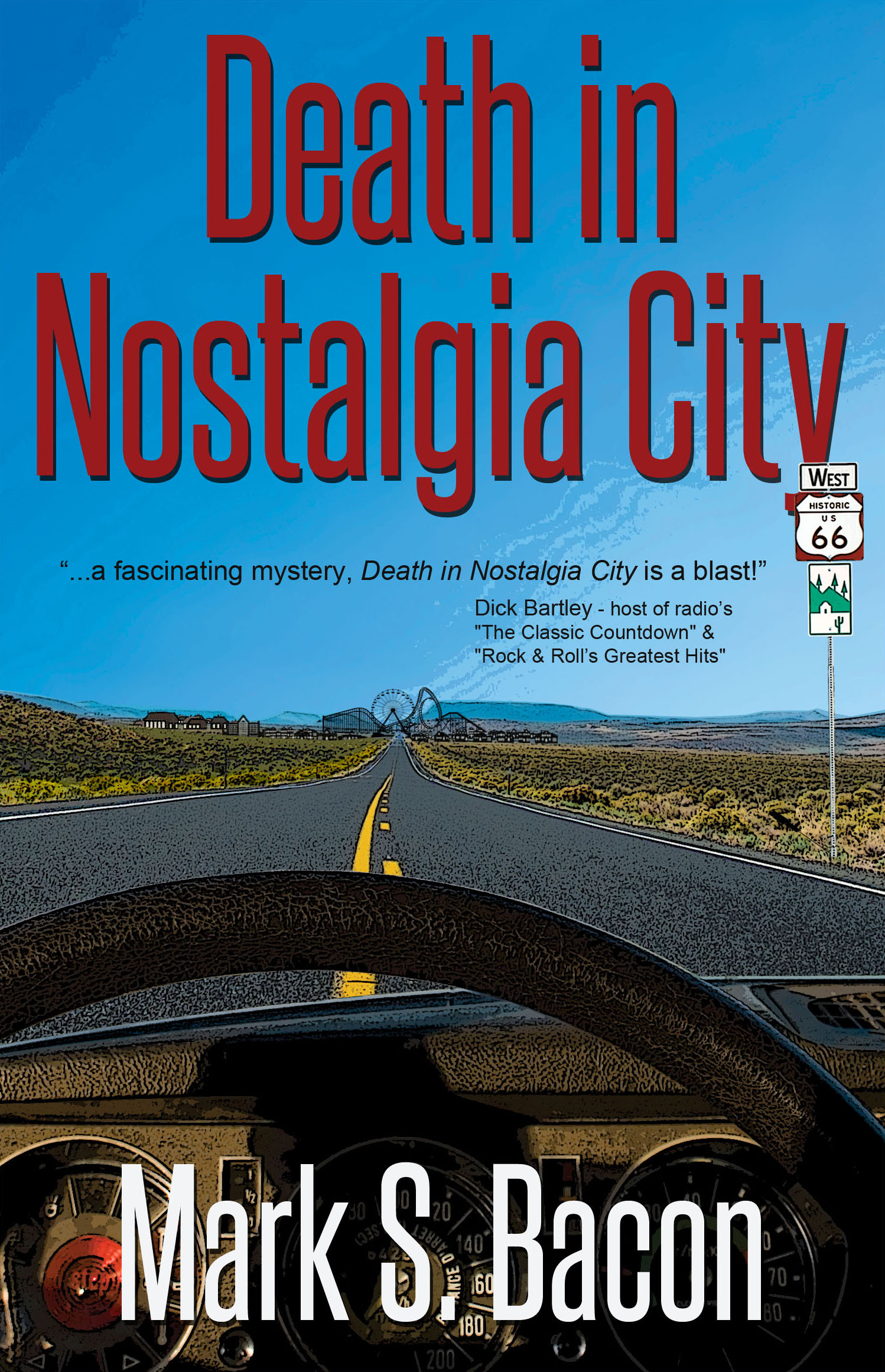
In this case, the cover design was the easy part, though not a short process. Ultimately designer Jacci Wilson created just the right cover.  It conveys the fact (a) that this is a mystery novel–although any title with the word “death” in it is likely a crime story–and (b) that the setting for the crimes is the desert near old Route 66. The cover also shows a hint of a town and an amusement park in the distance. That’s where the story’s headed.Final Cover front +++

The second of the two required tasks is to obtain blurbs. For the uninitiated, a blurb is a flattering quote about a book, preferably from an authority or well-known person, which is plastered on the cover. You’ve seen them.

These days, one or two blurbs seems not sufficient to establish a writer’s credibility. Many books have one or more pages of quotes attesting to the author’s talent, the incredibly involving content of the book and the necessity for readers to cease all productive activities in their lives until they’ve finished the tome.

One of the first places I went looking for a blurb was the Boston Globe. As a large part of my book takes place in Boston, I contacted a respected Globe feature writer offering her my manuscript for review. Turns out, reporter Beth Teitell has written books too, and was wise to my ploy. “You’re on a blurb quest,” she said.

Indeed. Fortunately, I managed to receive good blurb comments not only from other mystery writers, but from people in specialized fields–such as oldies music, theme parks and 60s/70s culture and trivia–that are part of the subject matter of my book.

With those two tasks behind me, I’ll be dividing my time between promoting the book and trying to write Nostalgia City volume II. Either of these tasks can easily be a full-time job. Pass the tranquilizers.

Post script.   My book was supposed to be available for advance orders on Amazon, a couple of weeks prior to its release. Today, in addition to noticing that the thumbnail of my book cover looks cloudy on Amazon (ditto for B&N), I also saw that the print version of the book is available for sale earlier than I expected. Also, the Kindle and print versions are not linked.  I’m told that after the Oct. 4 release date the listings will be combined.

Amazon and my publisher will sort things out. In the meantime,  read the first four chapters of the book here, on my website.  My reluctant investigators Lyle and Kate have some exciting surprises for you.

—–

I’m often asked if I have advice for people just starting out to be writers. My advice: Some less stressful jobs might be worth exploring, like crab fishing in the arctic, testing experimental aircraft or painting radio towers.