Nostalgia City Mysteries

Mark S. Bacon

Category Archives: craft of writing

Do you hate f***ing profanity in mystery novels?

3

A thug the size of an NFL lineman grabs Sam Shamus around the neck and throws him down the stairs. The bad guy follows him, stomps on his face and tells him he’s a low-life private dick and if he ever shows up again he’ll get a real beating.

Somehow Sam manages to get to his feet. He glares at the crook and says, “Pardon me sir, but I object to the way you’re characterizing my profession. And I ask that you refrain from inflicting further physical indignities, you hooligan.”Profanity-balloon
That’s what Sam says, anyway. Your average detective-novel hero might use different words.

Sam’s situation—or a version of it—went through my mind when I started writing mystery short stories and later, my first mystery novel. Should I use profanity? My initial answer: no. We’re slammed with the f-word so often in crime movies that profanity loses its punch. But the more I wrote, and the more I thought about it, studiously avoiding profanity seemed unrealistic. What the hell was I to do?

Profanity in literature, a fascinating topic—particularly in the mystery/suspense/thriller genre—varies from author to author. But before we get into that, a few words about four-letter words. While I eventually decided in favor of what’s delicately called swear words in my fiction, I’m still a journalist when I’m writing articles online. My inner AP Stylebook doesn’t permit me to use words you won’t find in your daily paper. Therefore I’m going to resort to f*** and s*** for two words everyone knows. Bear with me.

Not long ago, someone writing on an Amazon discussion page asked about bad language. She wrote: “I am Continue Reading →

Ross Macdonald taught us how to do it

0

Private investigator Lew Archer walks into the mob boss’s house. “It looked as if the decorator had been influenced by the Fun House at a carnival.” Then Archer says something to irritate the boss.

“His fresh skin turned a shade darker, but he held his anger. He had an actor’s dignity, controlled by some idea of his own importance. His face and body had an evil swollen look as if they had grown stout on rotten meat.”

These are the words of Ross Macdonald from his Lew Archer series, “the finest series of detective Ross-Macdonald---Way-Peoplenovels ever written by an American,” according to William Goldman in The New York Times Book Review.
I’m a Ross Macdonald beginner, having only read a sampling of his work—and I’m hooked. It’s easy to rave about his exquisite way with words. He pounded a typewriter the way Heifetz played the violin, Reggie Jackson swung a bat. He belongs in the company with the best American detective writers, and some would say, with the best American writers period. Continue Reading →

Faulkner’s ‘Fissures’ filled with strange moments

0
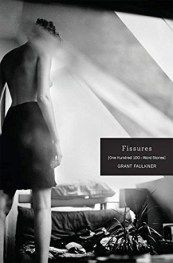
Fissures
Grant Faulkner
Press 53    2015
122 pages
Trade paper $14.95

“We all carry so many strange little moments within us,” author Grant Faulkner says in the introduction to his new book of one hundred, 100-word stories. In Fissures he offers weird day dreams, wonderful expressions, stories of love and morality, character studies and other “strange little moments” that will have you rereading, pondering and admiring these delicately crafted vignettes.

Although short tales have been around since Aesop, flash fiction has only recently become an accepted–though evolving–literary genre, and a challenging one, especially if you limit yourself to an arbitrary 100 words. Arbitrary is perhaps not the correct terminology because the 100-word limit fissures-web-optiseems to be the most widely accepted format for flash fiction, though there are others. The arbitrariness lies in selecting this daunting form.

Faulkner’s stories sometimes neared 150 words as he wrote, he explains in the introduction. But with discipline, the excess is removed. And the result is a collection of precise, incredibly creative moments in the lives of Faulkner’s characters.

Faulkner is not a newcomer to the genre. He is founder of the online literary journal, 100 Word Story. He’s also executive director of National Novel Writing Month.

It’s impossible to provide a complete review or synopsis of any 100-word story without almost repeating the story. Instead, let’s talk about the book’s style, subject matter and characters.   In his flash fiction, it’s Faulkner’s sentences that make the stories and it’s his inventive metaphors, similes and his succinct philosophical observations that make the sentences. A few samples:

True lovers are experts at constructing penitentiaries.

He felt like a cheerleader with Tourette Syndrome.

Funny how when Russians speak, it always sounds like someone is going to get killed.

Palm trees swayed like drugged witches… Continue Reading →