Nostalgia City Mysteries

Mark S. Bacon

Category Archives: Movie review

Bogart’s “Lonely Place” gets darker

0

Noir movie review

In a Lonely Place is a profound relationship film of trust and the meaning of love highlighting Humphrey Bogart’s best performance and delivering a moody, heartbreaking story tinged with suspicion and regret.

At least that’s the opinion of critics and film goers alike.  Not exactly mine. It’s a fine picture though. I can explain.

Robert Muller, host of Turner Classic Movies’ “Noir Alley” and author of books on film noir says the 1950 movie is his “all-time favorite film” and marks Bogart’s “unmistakably most personal role.”

The late critic Roger Ebert also gave Bogart high praise in his portrayal of a vulnerable, flawed man and says the film was “a superb example of the mature Hollywood studio system at the top of its form.”

Rotten Tomato’s audience score was 89 percent and reviewers gave 96 percent approval.  The Guardian’s Peter Bradshaw’s review was typical:  “A noir masterpiece.”

I saw the movie many years ago and remembered being unimpressed.  I watched it recently for this review, however, and now appreciate the story and the acting.  Nevertheless, I watched the film this second time after reading the novel of the same name, by Dorothy B. Hughes.  The book is superb and yet so completely different from the film it gave me a case of cognitive dissonance.

But a great movie can be made from a great book, even if it ignores the book, right?   In the book, Dix Steele is a serial rapist and murderer. In the film he’s a depressed movie script writer with a dangerous hair-trigger temper.

The film begins with Steele driving his top-down convertible in Hollywood.  At a stop-light a blonde passenger in the car next to him recognizes Steele:

“Dix Steele! How are you?” she says.  “Don’t you remember me?”

“No, I’m sorry. I can’t say that I do.”

“You wrote the last picture I did at Columbia.”

“I make it a point never to see pictures I write.”

The driver of the car interrupts and tells Steele to “stop bothering my wife.”

Steele then insults him and the driver tells Steele to pull over to the curb.  “What’s wrong with right here,” says Steele.  As he starts to open his door, the other car speeds off.

This scene introduces Bogart’s character, his occupation and his usual disposition.  The second scene is commentary on the plot and rounds out Steele’s circumstances and perhaps his future:

He drives up to a Hollywood restaurant and before he enters, he’s approached by two children.  One asks for his autograph.

“Who am I?” Steele asks.

“I don’t know,” the child replies.

“Don’t bother, he’s nobody,” the other child says.

“She’s right,” Steele says as he’s signing the autograph book.

When he meets his agent at the restaurant bar he tells Steele that he’s got a job for him. A film producer wants him to adapt a novel and the agent gives him the book.

“You’ve got to go to work,” the agent says, “you’ve been out of circulation too long.”

Steele tells him he won’t work on a book he doesn’t like.

“Are you in any position to be choosy,” says a film director seated next to them at the bar. “You haven’t written a hit since before the war.”

Steele seems to relent and as he leaves he hires a coat-room clerk to read the book to him. Continue Reading →
‘Gun Crazy’ shoots ’em up with style

1

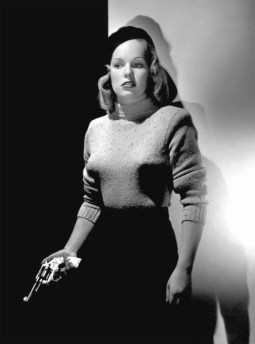
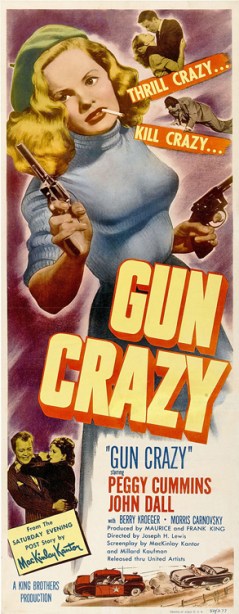
Halfway through the 1950 film Gun Crazy, Bart and Annie, dressed in buckskins and cowboy hats and brandishing shiny revolvers, stick up a bank, clobber a lawman, then jump in their car and make tracks out of town.

Peggy Cummins nearly 20 years before Faye Dunaway’s role

In a subsequent scene, actors John Dall and Peggy Cummins are dressed in street clothes, pulling a robbery and trying to make the best of a noir B movie. And they succeed. Backed by direction from Joseph H. Lewis and solid cinematography, the actors lift the film above its station and its average-at-best plot.

In fact this film, unknown outside of hardcore noir fans, is a critics’ choice breakthrough movie. Eddie Muller, TCM’s Noir Alley host and author of a book on Gun Crazy, says the film “is recognized as one of the most dynamic and subversive films of its day.”  Another critic called it an “impeccably crafted film… with a razor-sharp screenplay.”  I wouldn’t go that far. Yet Gun Crazy can draw you in if you watch closely.

Bart Tare (Dall) and Annie Laurie Starr (Cummins) meet when she’s the trick shooting, western-clad star of a carnival show and he’s an ex-GI World War II vet with a history.  During the performance, the show’s manager challenges audience members to try to outshoot the star and win $500. Having grown up fascinated with guns, Bart accepts the challenge.  He walks on stage smiling and eager.  Is it for the chance to shoot or for the beautiful Cummins’ attractions. He exchanges looks with the sultry shooter then outshoots her, earning himself a permanent place on stage with Annie.

As we learn in the film’s first scene, Bart became a crack shot through years of shooting bb guns and larger weapons as a child. His obsession with guns—despite abject fear of hurting anyone or anything—leads him to steal a revolver from a store window.  He’s caught and sent to reform school before joining the service.

Although his shooting prowess puts him on the stage with the six-gun siren, his job is short-lived. The manager who believes he has a hold on Annie becomes jealous when the two sharpshooters start to date, and he fires them.

On the road together Bart suggests marriage and Annie, who he calls Laurie, agrees.  In classic B movie fashion they drive up to a dark clapboard building housing a justice of the peace.  A large sign proclaims, “Desert justice – Get married.” The building also has signs, “Cocktails, bar, café.” And conveniently next door is the Continue Reading →

Temptress Claire has lots to offer, but not to poor Quimby

0
Movie review

Pharmacist Warren Quimby (Richard Basehart), night manager of a 24-hour Los Angeles drugstore, is a fool.

In an early scene in 1949’s Tension his wife Claire (Audrey Totter) is introduced by  sultry music as she’s eating dinner at the soda counter in Quimby’s drugstore.  Dressed in a slinky blouse, she takes an indifferent glance at her husband as he approaches tentatively, and she mumbles as she bites into a hamburger.

When he goes back to work on the other side of the store, Claire’s boyfriend shows up.  In an undisguised lie, she tells the counter clerk she’s going back to the Quimby’s apartment above the store.  Then she slips off her wedding ring and follows her suitor outside to his car.

Richard Basehart: resentful or scheming?

Quimby’s blindness to his wife’s blatant infidelities, coupled with his puppy-dog devotion—even after she deserts him for a boyfriend—is the film’s plot foundation.  You know this is more than a domestic drama however; because, in addition to its suggestive and suspenseful musical score and noirish nighttime settings, the movie is introduced and narrated by a homicide detective, Lieutenant Collier Bonnabel played by Barry Sullivan.

Basehart’s character is so innocent and trusting you want to root for him, but he’s so foolish you just want to smack him.  He’s stuck on his wife even after he tracks her down to a love nest in Malibu, vainly begs her to come home and gets beat up by her boyfriend, Barney Deager (Lloyd Gough).

When the film played in a 1998 San Francisco festival, SF Chronicle movie reviewer Walter Addiego wrote that Quimby was a “prize-winning sap.” 

Does he ever wise up?

Yes, but slowly.

While Claire continues her suggestive shenanigans at the beach, Quimby concocts a complex plan creating a new name and a layered second identity for himself. It’s unclear if he still wants Claire back, but his main goal is revenge and his phony identity will somehow be his cover.

In his new name he rents a Westwood, Calif. apartment—in addition to his flat over the pharmacy.  He meets an attractive Westwood neighbor, Mary Chanler (Cyd Charisse). Chanler is attracted to Quimby, who tells her he sells cosmetics and is on the road on weekdays, home on weekends. The two go out together, but Quimby tries not to return her affections.  He’s working on his revenge. Continue Reading →