Nostalgia City Mysteries

Mark S. Bacon

Category Archives: Noir

“In a Lonely Place”- Don’t confuse the novel with the Bogart film

0

Book Review

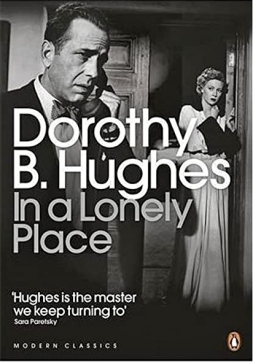
In a Lonely Place
Dorothy B. Hughes
NYRB Classics Edition, Aug. 2017 (Orig. 1947)
224 pages
$15.95 paper, $11.99 ebook Barnes and Noble

In Dorothy B. Hughes’ intense, ground breaking serial-killer novel, In a Lonely Place, Dix Steele is a scheming ex-GI psychopath. He rapes and murders young women in post-World War II Los Angeles.  A 1950 Humphrey Bogart film of the same name was adapted from the book.
Or was it?

In the film version, Bogart’s Dix Steele is an out-of-luck screen writer with a bad temper. See the resemblance?  Except for the title and the name of the main characters, the film is as close to the Hughes novel as it is to Dr. Seuss. 

Coincidentally perhaps, both works are engaging, well plotted and populated with memorable characters.  I suggest viewing them as separate creations albeit with somewhat similar themes.

According to Wikipedia, Hughes was “not bothered by the changes” made by the film’s director Nicolas Ray and its two script writers. I’d like to know why, given the reaction so many novelists have to films that alter, over simplify and otherwise mangle their original stories.  It could be that Hughes recognized a good movie, even though it was not her idea. Presumably it helped her book sales.

Here first, is a look at the novel.  A movie review follows in the next blog installment.

Dix Steele is stalking a woman in the foggy Pacific Palisades of Los Angeles.  His target is “more than pretty, she was nice looking, a nice girl.”

He follows her cautiously, but not too cautiously. He knows she’s heard him behind her for she quickens her pace.  It’s dark.  She’s alone and afraid.  But he doesn’t want to catch up to her too soon.  He anticipates finally reaching her when she’d “give a little scream.”  Unexpectedly however, cars appear ahead, their headlights bathing Steele and the road in “blatant light” spoiling his pursuit.  “Anger beat him like a drum.” Continue Reading →
‘Gun Crazy’ shoots ’em up with style

1

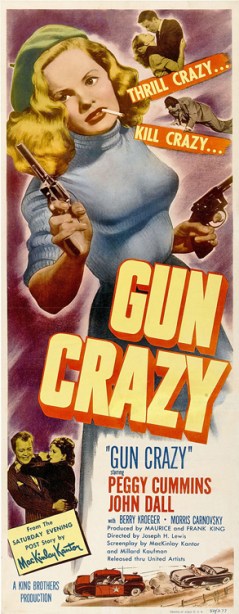
Halfway through the 1950 film Gun Crazy, Bart and Annie, dressed in buckskins and cowboy hats and brandishing shiny revolvers, stick up a bank, clobber a lawman, then jump in their car and make tracks out of town.

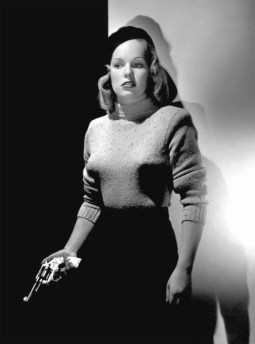
Peggy Cummins nearly 20 years before Faye Dunaway’s role

In a subsequent scene, actors John Dall and Peggy Cummins are dressed in street clothes, pulling a robbery and trying to make the best of a noir B movie. And they succeed. Backed by direction from Joseph H. Lewis and solid cinematography, the actors lift the film above its station and its average-at-best plot.

In fact this film, unknown outside of hardcore noir fans, is a critics’ choice breakthrough movie. Eddie Muller, TCM’s Noir Alley host and author of a book on Gun Crazy, says the film “is recognized as one of the most dynamic and subversive films of its day.”  Another critic called it an “impeccably crafted film… with a razor-sharp screenplay.”  I wouldn’t go that far. Yet Gun Crazy can draw you in if you watch closely.

Bart Tare (Dall) and Annie Laurie Starr (Cummins) meet when she’s the trick shooting, western-clad star of a carnival show and he’s an ex-GI World War II vet with a history.  During the performance, the show’s manager challenges audience members to try to outshoot the star and win $500. Having grown up fascinated with guns, Bart accepts the challenge.  He walks on stage smiling and eager.  Is it for the chance to shoot or for the beautiful Cummins’ attractions. He exchanges looks with the sultry shooter then outshoots her, earning himself a permanent place on stage with Annie.

As we learn in the film’s first scene, Bart became a crack shot through years of shooting bb guns and larger weapons as a child. His obsession with guns—despite abject fear of hurting anyone or anything—leads him to steal a revolver from a store window.  He’s caught and sent to reform school before joining the service.
Although his shooting prowess puts him on the stage with the six-gun siren, his job is short-lived. The manager who believes he has a hold on Annie becomes jealous when the two sharpshooters start to date, and he fires them.

On the road together Bart suggests marriage and Annie, who he calls Laurie, agrees.  In classic B movie fashion they drive up to a dark clapboard building housing a justice of the peace.  A large sign proclaims, “Desert justice – Get married.” The building also has signs, “Cocktails, bar, café.” And conveniently next door is the Continue Reading →

Mark Bacon’s Kollege of Noir Knowledge

0

Noir II – Advanced Investigation MB-302  Cain Building  T-Th 9 a.m.

Answers for Quiz #2

Here are the answers to the second quiz of this course. Okay, these last two questions were tough, but this is the advanced noir class. Remember your instructor has your best interests at heart.

For your next assignment, write a 300-page noir novel and include the line, “I don’t have to show you any sticking badges” or “Release the Kraken.”

Q 1. Who are the top selling mystery writers today?

Short answer: James Patterson and John Grisham.

Longer answer Extra credit: Finding out who were/are the best selling mystery writers via an internet search is a challenge. Nearly every response to a query about best sellers returned lists of “best” authors—in many persons’ opinions—not top selling mystery writers.  I resorted to Wikipedia’s list of best selling authors, regardless of genre, and picked out the mystery/crime writers.

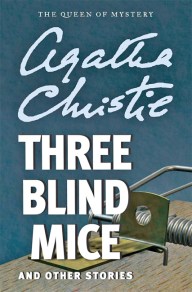
Agatha Christie, no matter how many billion of her books have been sold, is the undisputed champ. More books by Christie have been sold than anyone in history except Shakespeare. The French detective writer Georges Simenon is certain to be number two, beyond that it’s guesswork. What follows is the Wikipedia listing with the range of books likely sold.

Agatha Christie  2-4 billion

Georges Simenon, author of the French Inspector Maigret series, 500-700 million

Earl Stanley Gardener 100 – 325 million

James Patterson  150-275 million (the magazine Mental Floss says Patterson has sold 300 million books.)

John Grisham  100-250 million

Carter Brown 100-120 million

Mickey Spillane 100-200 million

Q 2.  Where did mystery writer Sue Grafton get the name for her fictional community?

Answer  Grafton’s make-believe community, Santa Teresa, bears the same name as the town that Ross Macdonalds’ detective, Lew Archer, haunts.  She used the name as a salute to Macdonald.

Q 3. Where is the town?

Answer  The town is generally thought to be patterned after Santa Barbara, Calif.

Question 4.   Who wrote, “The butler did it”? Continue Reading →