Nostalgia City Mysteries

Mark S. Bacon

Category Archives: Movie reviews

The mysteries continue here !

0

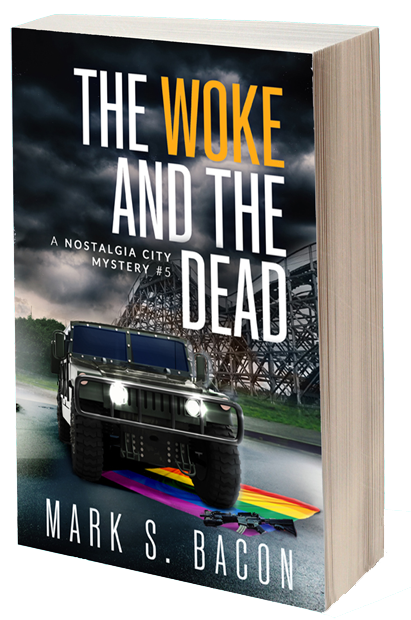
Win a free copy of The Woke and the Dead

The man’s T-shirt said, I’m proud of my— but the coagulated blood across his torso obliterated the rest of the slogan like the three bullets had obliterated him.

That’s the first line of my new murder mystery, The Woke and the Dead. It’s a sometimes gritty, occasionally funny mystery/suspense novel with political flavor, the kind of taste you can feel at the back of your throat.

For Nostalgia City followers, here is your next installment of Lyle and Kate who work at the world’s most elaborate theme park.  If you haven’t read a Nostalgia City mystery yet, you can still dive into The Woke and the Dead.

This novel gives you the background you need to get to know the regular characters as you’re quickly drawn into a story of murder, hate groups, racism, homophobia, corruption, and political espionage. Lyle’s sense of humor and Kate’s stick-to-itiveness flow throughout.

The book review blog, On a Reading Bender, calls The Woke and the Dead, “Fast-paced. Suspenseful. Full of secrets and lies [and] interesting, complex, likable protagonists.”

Check out the description on the Amazon page where you can pre-order the ebook book at the intro price of $2.99 until March 13. Print copies will also be available from Amazon in the middle of the month.

If you want a chance to win a free copy of the book, check out the giveaway on Goodreads, here. The giveaway ends, March26.

I’ll be a guest on a political podcast later this month talking about the book and its ideological and literary influences.  Details will be posted here soon, at https://baconsmysteries.com.

In the weeks and months to come I’ll be reviewing mystery/noir books and movies, posting excerpts from The Woke and the Dead, hosting articles from other mystery writers and holding another book giveaway.

In the meantime, you can find me on Facebook and Twitter (x) and soon on Bluesky.


Bogart’s “Lonely Place” gets darker

0

Noir movie review

In a Lonely Place is a profound relationship film of trust and the meaning of love highlighting Humphrey Bogart’s best performance and delivering a moody, heartbreaking story tinged with suspicion and regret.

At least that’s the opinion of critics and film goers alike.  Not exactly mine. It’s a fine picture though. I can explain.

Robert Muller, host of Turner Classic Movies’ “Noir Alley” and author of books on film noir says the 1950 movie is his “all-time favorite film” and marks Bogart’s “unmistakably most personal role.”

The late critic Roger Ebert also gave Bogart high praise in his portrayal of a vulnerable, flawed man and says the film was “a superb example of the mature Hollywood studio system at the top of its form.”

Rotten Tomato’s audience score was 89 percent and reviewers gave 96 percent approval.  The Guardian’s Peter Bradshaw’s review was typical:  “A noir masterpiece.”

I saw the movie many years ago and remembered being unimpressed.  I watched it recently for this review, however, and now appreciate the story and the acting.  Nevertheless, I watched the film this second time after reading the novel of the same name, by Dorothy B. Hughes.  The book is superb and yet so completely different from the film it gave me a case of cognitive dissonance.

But a great movie can be made from a great book, even if it ignores the book, right?   In the book, Dix Steele is a serial rapist and murderer. In the film he’s a depressed movie script writer with a dangerous hair-trigger temper.

The film begins with Steele driving his top-down convertible in Hollywood.  At a stop-light a blonde passenger in the car next to him recognizes Steele:

“Dix Steele! How are you?” she says.  “Don’t you remember me?”

“No, I’m sorry. I can’t say that I do.”

“You wrote the last picture I did at Columbia.”

“I make it a point never to see pictures I write.”

The driver of the car interrupts and tells Steele to “stop bothering my wife.”

Steele then insults him and the driver tells Steele to pull over to the curb.  “What’s wrong with right here,” says Steele.  As he starts to open his door, the other car speeds off.

This scene introduces Bogart’s character, his occupation and his usual disposition.  The second scene is commentary on the plot and rounds out Steele’s circumstances and perhaps his future:

He drives up to a Hollywood restaurant and before he enters, he’s approached by two children.  One asks for his autograph.

“Who am I?” Steele asks.

“I don’t know,” the child replies.

“Don’t bother, he’s nobody,” the other child says.

“She’s right,” Steele says as he’s signing the autograph book.

When he meets his agent at the restaurant bar he tells Steele that he’s got a job for him. A film producer wants him to adapt a novel and the agent gives him the book.

“You’ve got to go to work,” the agent says, “you’ve been out of circulation too long.”

Steele tells him he won’t work on a book he doesn’t like.

“Are you in any position to be choosy,” says a film director seated next to them at the bar. “You haven’t written a hit since before the war.”

Steele seems to relent and as he leaves he hires a coat-room clerk to read the book to him. Continue Reading →

Murder solved by 1950 version of CSI

1
Movie review: Mystery Street

Blonde floozy Vivian Heldon (Jan Sterling) is talking on the wall phone in the shadowy hallway of her Boston boarding house. Her landlady, appropriately named Mrs. Smerrling, (Elsa Lanchester) makes no pretense about listening in while she prods Heldon for back rent.

“Please honey,” Heldon says into the phone’s wall-mounted mouthpiece. “You gotta. I’m in a jam.”

Soon, Heldon gets herself killed but not before she involves a nervous expectant father she meets in a bar. So far, the 1950 film is a predictable B movie with noir overtones and few expected surprises.  

But Heldon’s murder is not discovered until six months later when a beachcomber finds her skeleton protruding from the sand on Cape Cod. The lack of fingerprints, or other obvious means of identifying the skeleton, lead the detective lieutenant on the case to enlist the aid of Dr. McAdoo (Bruce Bennett), a professor from the Department of Legal Medicine at Harvard Medical School. The film then develops into a CSI story 50 years before the Las Vegas crime lab TV series.

Some of the tools and techniques used by Dr. McAdoo seem a bit rudimentary today, but the scientific angles and the solid acting of Lanchester and the detective on the case—Richardo Montalban—make this relatively unknown film worth watching.

A New York Times review when the movie debuted said, “There is more science than mystery in this cops-versus-killer number, but it is an adventure which, despite a low budget, is not low in taste or its attention to technical detail, backgrounds and plausibility.”

This is not the say it’s perfect. It’s slow moving at times, and in one scene a murder suspect escapes a little too easily from a police chase thus extending the suspense.  For the most part, director John Sturges, who would go on to acclaim directing pictures such as The Magnificent Seven and the classic noir Bad Day at Black Rock, elevates the film past its meager budget.  The movie was shot on location in Boston and Cape Cod.

From the get-go, Montalban, as Lt. Peter Moralas, suspects the unidentified skeleton is a murder victim.  He delivers a box of bones, including the skull, to Dr. McAdoo who provides a surprising amount of information on the victim.

As Moralas looks at the bones arranged on a gurney, Dr. McAdoo tells him the skeleton was a woman.

“I suppose you’d like to know her age,” McAdoo says.

“I’d also like to know her height, weight, occupation and the name and phone number of the person who murdered her.”

“I think I can answer all those questions, except the last,” the confident doctor says.

Armed with that information and McAdoo’s guess at when the woman died–based on plants found with the body–Moralas reviews missing persons’ files for women in their early 20s. Thanks to further lab work at Harvard, Moralas thinks he’s found the victim’s name. That leads him to Mrs. Smerrling’s and the intrigue begins. You can see wheel’s turning in the landlady’s head as she remembers details about the victim’s circumstances.
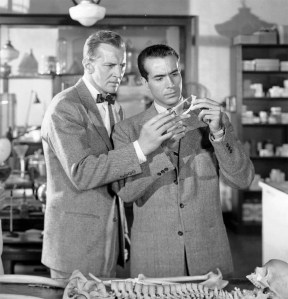
Ricardo Montalban, left, and Bruce Bennett examine a human bone at the Harvard School of Legal Medicine.

With the victim identified as Vivian Heldon, Moralas locates some of her possessions, including a little black book.  The names and phone numbers of 86 men in the book give Moralas a long list of suspects, but he needs one more bit of scientific evidence to prove the death was murder. Again, Dr. McAdoo provides the necessary information, and Moralas is left to hunt for motives. 

Meanwhile, the gin-tippling Mrs. Smerrling, who admits she wasn’t actually married, dreams of ways to cash in on her tenant’s demise.

Although she rates only fourth billing, Lanchester is perfect as the scheming landlady. You know from her expression that she’s only looking out for herself.

Montalban, a star in Mexican films before he was signed by MGM in the late 1940s, was one of a few Hispanic leading men in US films at the time. According to Wikipedia, he was the first Hispanic actor to appear on the cover of Life Magazine. The Times review of Mystery Street said Montalban was “natural and unassuming.” He handled the detective role well and never reminded you of his later, most popular TV role. (You know the one.) 

Late in the investigation, Dr. McAdoo has another tidbit for Moralas, but the detective has already discovered it for himself.

 “Professors work with their heads,” he tells McAddo. “Cops work with their feet.