Nostalgia City Mysteries

Mark S. Bacon

Category Archives: Mystery novels

Bogart’s “Lonely Place” gets darker

0

Noir movie review

In a Lonely Place is a profound relationship film of trust and the meaning of love highlighting Humphrey Bogart’s best performance and delivering a moody, heartbreaking story tinged with suspicion and regret.

At least that’s the opinion of critics and film goers alike.  Not exactly mine. It’s a fine picture though. I can explain.

Robert Muller, host of Turner Classic Movies’ “Noir Alley” and author of books on film noir says the 1950 movie is his “all-time favorite film” and marks Bogart’s “unmistakably most personal role.”

The late critic Roger Ebert also gave Bogart high praise in his portrayal of a vulnerable, flawed man and says the film was “a superb example of the mature Hollywood studio system at the top of its form.”

Rotten Tomato’s audience score was 89 percent and reviewers gave 96 percent approval.  The Guardian’s Peter Bradshaw’s review was typical:  “A noir masterpiece.”

I saw the movie many years ago and remembered being unimpressed.  I watched it recently for this review, however, and now appreciate the story and the acting.  Nevertheless, I watched the film this second time after reading the novel of the same name, by Dorothy B. Hughes.  The book is superb and yet so completely different from the film it gave me a case of cognitive dissonance.

But a great movie can be made from a great book, even if it ignores the book, right?   In the book, Dix Steele is a serial rapist and murderer. In the film he’s a depressed movie script writer with a dangerous hair-trigger temper.

The film begins with Steele driving his top-down convertible in Hollywood.  At a stop-light a blonde passenger in the car next to him recognizes Steele:

“Dix Steele! How are you?” she says.  “Don’t you remember me?”

“No, I’m sorry. I can’t say that I do.”

“You wrote the last picture I did at Columbia.”

“I make it a point never to see pictures I write.”

The driver of the car interrupts and tells Steele to “stop bothering my wife.”

Steele then insults him and the driver tells Steele to pull over to the curb.  “What’s wrong with right here,” says Steele.  As he starts to open his door, the other car speeds off.

This scene introduces Bogart’s character, his occupation and his usual disposition.  The second scene is commentary on the plot and rounds out Steele’s circumstances and perhaps his future:

He drives up to a Hollywood restaurant and before he enters, he’s approached by two children.  One asks for his autograph.

“Who am I?” Steele asks.

“I don’t know,” the child replies.

“Don’t bother, he’s nobody,” the other child says.

“She’s right,” Steele says as he’s signing the autograph book.

When he meets his agent at the restaurant bar he tells Steele that he’s got a job for him. A film producer wants him to adapt a novel and the agent gives him the book.

“You’ve got to go to work,” the agent says, “you’ve been out of circulation too long.”

Steele tells him he won’t work on a book he doesn’t like.

“Are you in any position to be choosy,” says a film director seated next to them at the bar. “You haven’t written a hit since before the war.”

Steele seems to relent and as he leaves he hires a coat-room clerk to read the book to him. Continue Reading →
Dark ride, dark story: the mystery begins

0

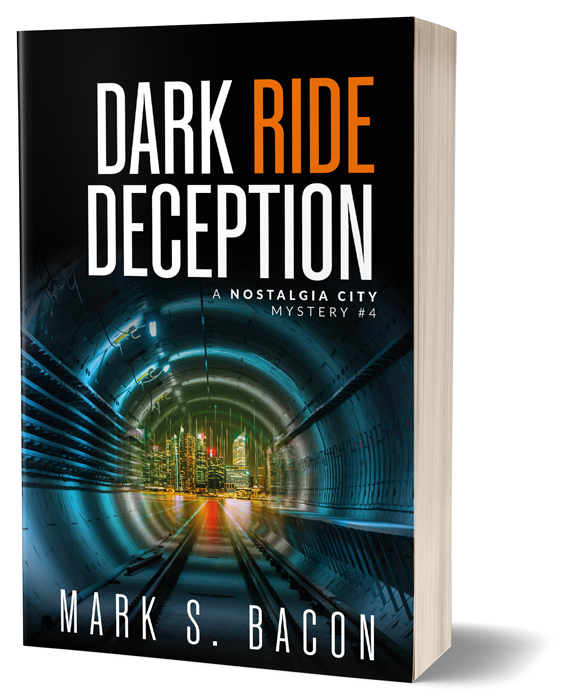
Here’s a chapter from my latest Nostalgia City mystery, Dark Ride Deception.

Max Maxwell, the CEO of Nostalgia City theme park, is holding an emergency meeting to discuss park secrets for new ride technology that have been stolen. The scientist who created the technology is missing.    

Chapter 7

     Maxwell roamed the conference room. Lyle often thought of him as an energetic, impulsive teenager housed in a short, wiry 75-year-old body. Or was he older? “When did we discover the hack?” Max said looking at Owings.

The senior vice president sounded matter-of-fact: “We went through the logs and access files Friday,” he said. “It’s routine. But after we found discrepancies, we reviewed all our systems over the weekend and we knew something was wrong.”

“Sort of an understatement, isn’t it Kerry?” Maxwell said. “We’ve spent millions on these plans already. Millions. We created programs, engineering studies, simulations, drawings, models. Yup, something is wrong all right.”

Lyle glanced at the woman seated across from him. Somewhere in her early forties, she parted her hair in the middle and it hung ragged on the sides. Jane Fonda in the ’70s? Or maybe something new. She sighed and lowered her head as Maxwell spoke. Was she to blame?

“I contacted the FBI,” Howard said. “Agents who specialize in economic espionage and computer crimes are coming out.”

“That’s fine Howard, but we have other problems too, don’t we? Our patents.”

Max looked at a man in a dark tailored suit and charcoal tie who could either be the park’s chief legal counsel or a mortician. “Usually we file for protection as we go along,” the man said, “and we have done this for some initial elements of the project we’re calling PDE. But there are issues.

“First, artificial intelligence is a complex and evolving element of the law. It’s not like seeking a patent for a new type of can opener. And software is challenging, too. If it’s tied to particular apparatuses or engineering creations, obtaining a patent is not as problematic. But we’re not just seeking a patent for a specific ride, are we?”

“So much for the jargon,” Max said. “Are you saying you couldn’t do it?”

“Of course not, but work on the project slowed for a while, and then it received a top priority. The innovation continued yet the legal department did not receive enough information, things we need to draft patent applications.”

“Max,” Owings said, “as you know, PDE was not finished. We were getting close, but there are a few challenges left and now we’re—”

“So you’re both saying our ass is hanging out. Our secrets are gone, and we don’t even have the ideas patented.” Max’s stare, always penetrating, seemed to bore through Owings and the attorney. Lyle wondered if they might soon be looking for work. Continue Reading →

Will a change of face brighten the dark passage?

0

Book Review

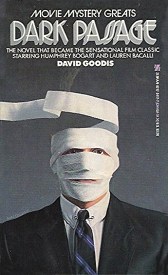
Dark Passage (1946)
David Goodis
Library of America 2012
247 pages
Kindle, Apple Books  $5.99

Vincent Parry’s wife was an ungrateful, unloving bitch.  But he didn’t kill her.

A jury said he did, and the judge gave him life in San Quentin.

This seemed like it would be the last chapter in Parry’s unremarkable life. An only child and orphan in central Arizona he stole food when he was hungry and found himself in a reformatory being punched in the face by a guard. During World War II his draft board labeled him 4-F due to sinus and kidney problems. The 145-lb, five-foot-seven-inch Parry found work as a clerk in a San Francisco securities investment house, a position he took because it would permit him to smoke at work.  He earned $35 a week and smoked three packs a day.

Early in their marriage, at her insistence, Parry bought his wife Gert a ring with a flame opal, her favorite stone.  She told him it was flawed, that he paid too much and she threw it at his face.  Less than a year and a half after they were married, she started seeing other men.

One day he came home to find police cars parked in front of his apartment building.  Gert had been murdered, her skull smashed by a heavy glass ashtray.  A witness told police the wife’s dying words were that Parry had killed her.

Parry’s attorney asserted that Mrs. Gert Parry simply tripped and hit her head, but no one was buying it.

Dark Passage is a story of lonely, sad, miserable people. The book envelopes the reader in an atmosphere as cheery as a rainy night in a graveyard.

In San Quentin Parry worried about the guards, remembering his experience in the reformatory. But he thought this might be different.

He had an idea that he might be able to extract some ounce of happiness out of prison life. He had always wanted happiness, the simple and ordinary kind. He had never wanted trouble.

Eventually,  however,  he again met up with a brutal guard.  During the ensuing pummeling, Parry sobbed, a reaction that would revisit him more than once in the coming weeks.

When he was placed in solitary confinement temporarily, and permanently removed from his prison accounting job, he decided to escape.

He made it, and once outside the prison grounds a young woman in a new Pontiac convertible offered him a ride, telling him she heard of his escape on the radio and came to help him.  “You’ll stay at my place,” she tells him.

Vincent Parry’s life was about to turn around. And around.

Once safe in the expensively furnished San Francisco apartment Parry learns his blonde savior’s name, Irene Janney. 

The way her lips were set told him she didn’t get much out of life.  One thing, she had money. That grey-violet [her clothes] was money. The Pontiac was money.

She tells him she attended his trial and that Madge Rapf, the woman who found Gert’s body and heard her dying words, is an acquaintance of hers.

Parry knows Rapf, a friend of his wife’s who visited them frequently. Too frequently.

She was miserable and the only thing that eased her misery was to see other people miserable. If they weren’t miserable she pestered them until they became miserable.   Parry had a feeling that one of the happiest moments in Madge Rapf’s life was when the foreman stood up and said that he was guilty.

Parry’s fate begins to look promising when Janney buys him new clothes and gives him $1,000 in cash for the road.

He leaves her, hales a cab and is identified as a fugitive by the driver. But instead of turning him in, the driver tells Parry about a doctor friend of his, a plastic surgeon, who could give him a new face—no questions asked. Continue Reading →