Nostalgia City Mysteries

Mark S. Bacon

Tag Archives: Alfred Hitchcock

‘Gun Crazy’ shoots ’em up with style

1

Halfway through the 1950 film Gun Crazy, Bart and Annie, dressed in buckskins and cowboy hats and brandishing shiny revolvers, stick up a bank, clobber a lawman, then jump in their car and make tracks out of town.
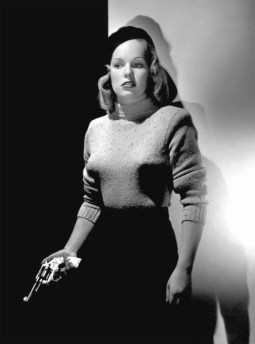
Peggy Cummins nearly 20 years before Faye Dunaway’s role

In a subsequent scene, actors John Dall and Peggy Cummins are dressed in street clothes, pulling a robbery and trying to make the best of a noir B movie. And they succeed. Backed by direction from Joseph H. Lewis and solid cinematography, the actors lift the film above its station and its average-at-best plot.

In fact this film, unknown outside of hardcore noir fans, is a critics’ choice breakthrough movie. Eddie Muller, TCM’s Noir Alley host and author of a book on Gun Crazy, says the film “is recognized as one of the most dynamic and subversive films of its day.”  Another critic called it an “impeccably crafted film… with a razor-sharp screenplay.”  I wouldn’t go that far. Yet Gun Crazy can draw you in if you watch closely.

Bart Tare (Dall) and Annie Laurie Starr (Cummins) meet when she’s the trick shooting, western-clad star of a carnival show and he’s an ex-GI World War II vet with a history.  During the performance, the show’s manager challenges audience members to try to outshoot the star and win $500. Having grown up fascinated with guns, Bart accepts the challenge.  He walks on stage smiling and eager.  Is it for the chance to shoot or for the beautiful Cummins’ attractions. He exchanges looks with the sultry shooter then outshoots her, earning himself a permanent place on stage with Annie.
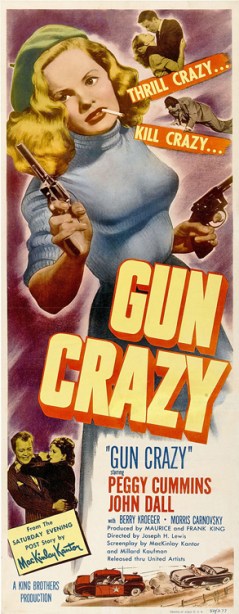
As we learn in the film’s first scene, Bart became a crack shot through years of shooting bb guns and larger weapons as a child. His obsession with guns—despite abject fear of hurting anyone or anything—leads him to steal a revolver from a store window.  He’s caught and sent to reform school before joining the service.

Although his shooting prowess puts him on the stage with the six-gun siren, his job is short-lived. The manager who believes he has a hold on Annie becomes jealous when the two sharpshooters start to date, and he fires them.

On the road together Bart suggests marriage and Annie, who he calls Laurie, agrees.  In classic B movie fashion they drive up to a dark clapboard building housing a justice of the peace.  A large sign proclaims, “Desert justice – Get married.” The building also has signs, “Cocktails, bar, café.” And conveniently next door is the Continue Reading →

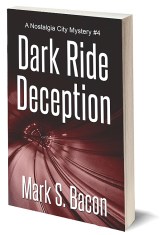
Dark Ride Deception novel beats Disney to new ride

3

“Dark Ride Deception,” published in September, describes a technology that gives visitors a virtual reality experience—without goggles.  The Walt Disney Company received a patent for such technology three months later.

According to The Los Angeles Daily News, the Walt Disney Company was granted a patent on Dec. 28 by the U.S. Patent and Trademark Office for a technology that enables users to experience a 3D world without glasses, goggles or digital devices.

“Dark Ride Deception,” describes an advanced technology that is stolen from Nostalgia City, an Arizona theme park. The stolen secrets allow park guests to experience virtual reality without goggles.

VR Goggles no longer needed?

The Disney technology, according to the Daily News story, is called a Virtual World Simulator.  The stolen Nostalgia City tech is called the Perception Deception Effect.

Since my first Nostalgia City novel I’ve been following the development of amusement park attractions.  I never read anything about this new Disney technology, however; but it’s the next logical step in virtual reality.  Inventing the Perception Deception Effect just made sense.

In the book, a brilliant theme park engineer disappears, along with details of his ground-breaking technology—before the plans can be patented. Nostalgia City employee and ex-cop, Lyle Deming, is tasked with finding the missing engineer and recovering the secrets.

Critical details of the Perception Deception Effect are known only to the missing engineer, Tom Wyrick.  Deming speculates that Wyrick was either kidnapped or killed to obtain the secrets or that he plans to sell his inventions to the highest bidder.

“What’s he going to do,” Deming asks, “start his own theme park?”

When I wrote the book, I thought theme park rides needed to be bumped to a higher technological level.  Apparently, so did Disney.
—————–

Looking for the second half of Hitchcock’s Sabotage?

The first half of my review of the Hitchcock film had a bunch of words unnecessarily underlined in the email version. Distracting.  It doesn’t show up in the WordPress editor or in the web version of the story.

The second half of the review will be published soon.  And it will be linked to the online version of the first half. Stay tuned.

Woolrich novel is campy noir film

0

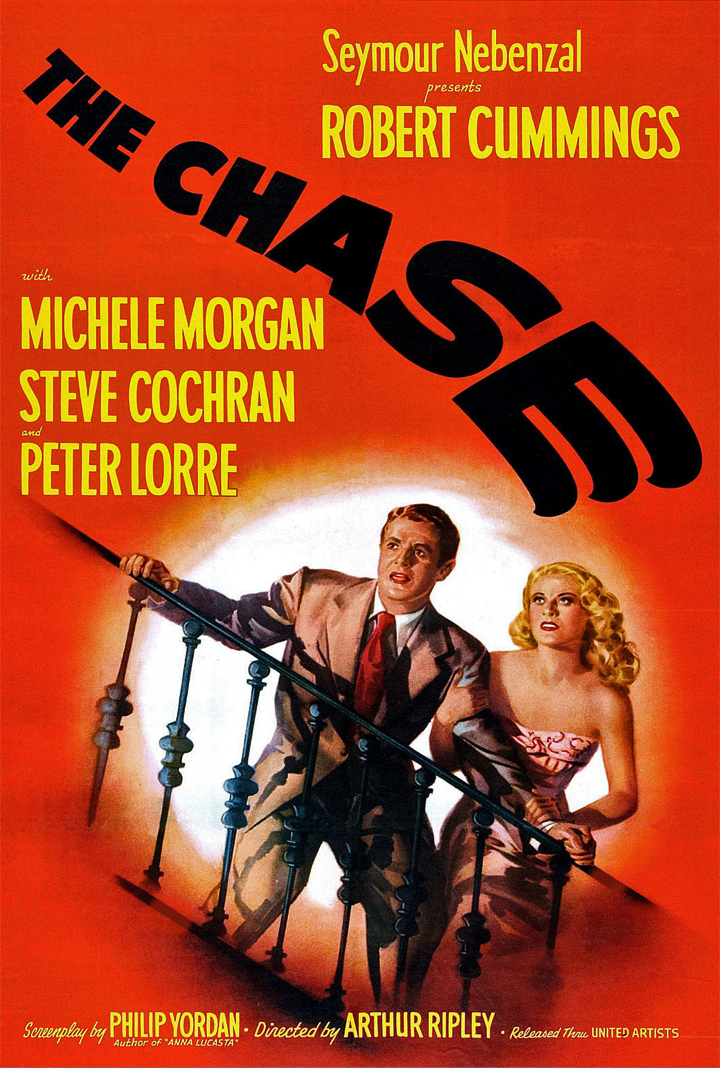
Read a novel, then see the movie and you’re often disappointed.  It’s difficult for a motion picture to recreate a detailed, nuanced book filled with subplots and many characters and do justice to the original story.  This has been true perhaps since the advent of motion pictures.  Case in point: the 1946 production of The Chase, based on the novel, The Black Path of Fear, by Cornell Woolrich. 

In this space I recently reviewed the Woolrich suspense novel, a story of lost love and of desperation in the dark alleys of post-World War II Havana.  Many of the author’s novels and short stories became radio, TV or motion picture dramas and I looked to see if the film version of Black Path, called The Chase, was available on Netflix.  No luck; probably one of those “B” crime movies that have faded away as the celluloid deteriorated. 

Not so.  Checking the cast on imdb.com, I noticed a link to the Internet Archive.  That site had a copy of the movie that could be streamed, so I let it play. 

It’s difficult to discuss details of the plot without spoiling either the book or the movie.  Things that take place in the middle of the book, via a flashback,  form the first scenes of the movie.   And an event in the middle of the movie, happens in the first few pages of the book.

Without getting into too many specifics, Chuck Scott, played by Bob Cummings, is an honest, destitute vet who finds a wallet on a Miami street and returns it to its owner, Eddie Roman, played by Steve Cochran.  It’s obvious that Roman is a ruthless, wealthy hood.  The first evidence of this is a scene when he knocks his manicurist to the floor when she displeases him. The second bit of evidence is that his assistant, aka henchman, is played by Peter Lorre.

Admiring, while mocking Scott’s honesty, Roman gives him a job as his chauffer.  Later, after an unnecessary scene designed to remind viewers—if they had fallen asleep in the previous five minutes—that Roman was really a nasty guy, Scott meets the glamorous Mrs. Lorna Roman (Michele Morgan). 

The majority of the book and a relatively small portion of the movie take place in dingy alleys and flop houses in Havana.  The noirish movie does a fairly good job reproducing the book’s skid-row atmosphere, with some dialog sounding as if it were taken directly from the novel.  But this part of the film story is about as close as it gets to the book.  New scenes and new characters are added and the film makes abrupt, substantial and sometimes laughable changes in the storyline. 

For example, in the book Roman urges Scott, as his chauffer, to drive fast.  In the movie, Roman doesn’t need to tell him to speed up.  He has an auxiliary accelerator and speedometer in the back seat.  The Chase movie To speed up, Roman floors it and tells Scott to steer carefully as they exceed 100 mph in a clichéd race with a locomotive to a railroad crossing.

Critics, including Woolrich biographer Francis Nevins, Jr., criticized screen writer Philip Yordan and director Arthur Ripley for twisting Woolrich’s story, ultimately changing the character and meaning of the novel’s original “chase.”  Roman, a relatively minor character in the book, is on screen too long and Cochran’s mobster portrayal is over the top.  Woolrich’s story is about a hapless guy on the run.  Yordan’s story is partly about a harassed gangster and partly about a guy who falls for a mobster’s wife. 

In  spite of numerous missteps in the script, Cummings comes across as a vulnerable everyman, as Woolrich portrayed him, and keeps the movie alive.  The actor had recently starred in Alfred Hitchcock’s Saboteur, and eight years later would become a protagonist in the Hitchcock classic, Dial M for Murder.   Lorre’s smarmy presence, of course, is a highlight of the film.  In some scenes he seems a bit bored, but that was perhaps part of his character.  Or this perception could be the fault of the grainy, scratchy print with occasional sprocket noise. 

The film is also available on DVD from Amazon but based on some of the online reviews, the DVD quality is no better than what’s available on the web stream.

Driven by a music score that rises and falls melodramatically—to almost humorous proportions at times—The Chase veers from campy gangster fare to classic film noir and back again several times.  If you see the movie before you read the book, it’s worth watching—and it’s so removed from the novel’s plot that the things you learn will not materially spoil the novel.