Nostalgia City Mysteries

Mark S. Bacon

Unknown's avatar

About mbaconauthor

Mystery writer and journalist; former newspaper police reporter.

Do you hate f***ing profanity in mystery novels?

3

A thug the size of an NFL lineman grabs Sam Shamus around the neck and throws him down the stairs. The bad guy follows him, stomps on his face and tells him he’s a low-life private dick and if he ever shows up again he’ll get a real beating.

Somehow Sam manages to get to his feet. He glares at the crook and says, “Pardon me sir, but I object to the way you’re characterizing my profession. And I ask that you refrain from inflicting further physical indignities, you hooligan.”Profanity-balloon
That’s what Sam says, anyway. Your average detective-novel hero might use different words.

Sam’s situation—or a version of it—went through my mind when I started writing mystery short stories and later, my first mystery novel. Should I use profanity? My initial answer: no. We’re slammed with the f-word so often in crime movies that profanity loses its punch. But the more I wrote, and the more I thought about it, studiously avoiding profanity seemed unrealistic. What the hell was I to do?

Profanity in literature, a fascinating topic—particularly in the mystery/suspense/thriller genre—varies from author to author. But before we get into that, a few words about four-letter words. While I eventually decided in favor of what’s delicately called swear words in my fiction, I’m still a journalist when I’m writing articles online. My inner AP Stylebook doesn’t permit me to use words you won’t find in your daily paper. Therefore I’m going to resort to f*** and s*** for two words everyone knows. Bear with me.

Not long ago, someone writing on an Amazon discussion page asked about bad language. She wrote: “I am Continue Reading →

Stay on the edge of your seat with these

0
The Edge of Normal, Reeve LeClaire Series
Carla Norton
Minotaur Books 2014
384 pages
Kindle $7.99 Mass market paperback $7.99Edge-of-Normal

Carla Norton has rewritten the benchmarks for novels about child kidnappers, upping the tension while introducing a new type of leading character—a kidnapping and abuse victim. Reeve LeClaire is really no investigator. Struggling in all areas of her life, but managing to persevere, barely, after being held captive for four years, Reeve is drawn into helping a 13-year-old kidnap victim.

In her early 20s, Reeve has worked to form a life for herself six years after her own ordeal. When Reeve’s therapist is asked to assist in the case of Tilly, a young teen who was abducted and freed, Reeve jumps in to help. Leaving San Francisco for a small northern California town, Reeve discovers Tilly has suffered some of the same cruelties as she did. Police have arrested someone suspected of being Tilly’s tormentor—but there’s more. Much more. Reading through to the edgy, rewarding conclusion you learn Norton has also created new meaning for the word creepy.

Publishers Weekly said, “Norton skillfully keeps the suspense taut with myriad surprises while giving a tender look at victims whose ordeals are rehashed by lawyers, the media, and pop psychologists.”

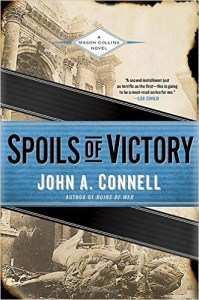
Spoils of Victory, a Mason Collins Novel
John A. Connell
Berkeley 2016
384 pages
Kindle $12.99 Hardback $21.33Spoils-of-Victory

Former Chicago police detective, soldier, POW, and now-U.S. Army criminal investigator, Mason Collins finds himself in Garmisch-Partenkirchen, a scenic Alpine ski town that managed to escape the destruction of World War II. Months after the Nazi’s defeat, the town is the home of fleeing war criminals, a depository for the Nazis’ stolen riches. With millions of dollars to be made on the black market, murder, extortion, and corruption have become commonplace. Continue Reading →

Ross Macdonald taught us how to do it

0

Private investigator Lew Archer walks into the mob boss’s house. “It looked as if the decorator had been influenced by the Fun House at a carnival.” Then Archer says something to irritate the boss.

“His fresh skin turned a shade darker, but he held his anger. He had an actor’s dignity, controlled by some idea of his own importance. His face and body had an evil swollen look as if they had grown stout on rotten meat.”

These are the words of Ross Macdonald from his Lew Archer series, “the finest series of detective Ross-Macdonald---Way-Peoplenovels ever written by an American,” according to William Goldman in The New York Times Book Review.

I’m a Ross Macdonald beginner, having only read a sampling of his work—and I’m hooked. It’s easy to rave about his exquisite way with words. He pounded a typewriter the way Heifetz played the violin, Reggie Jackson swung a bat. He belongs in the company with the best American detective writers, and some would say, with the best American writers period. Continue Reading →